Cross-cultural exchange connects American and Japanese students
Unique partnership enhances students' insight on different cultures and health care realities

Global partnerships between nursing colleges allow students to gain cultural humility, increase perspective on different health care models and deepen understanding on the importance of environmental, cultural and historical factors impacting health care.
For more than 10 years, faculty from different programs at the University of Cincinnati (UC) and Chiba University, in Japan, have partnered in initiatives including joint lectures and inter-university team projects through Chiba’s Collaborative Online International Learning (COIL). While the nursing-focused partnership started in 2021, COVID-19 restrictions delayed in-person experiences until last spring, when 10 Bachelor of Science in Nursing students, UC’s Department of Nursing Chair and Associate Professor Donna Green, PhD, RN and Assistant Professor Samantha Boch, PhD, RN, traveled to Chiba.

UC Nursing students and Dr. Samantha Boch at Kamatori train station in Chiba
“One of the primary goals of this trip was to provide students with a comprehensive understanding of Japan’s culture, health systems, community dynamics and health care services,” says Green. “Throughout this learning experience, students were able to compare and contrast health care access and the influence of community planning on health outcomes in Japan and in the United States. Additionally, students discussed how they intend to apply the insights from this experience to enhance their future nursing practice.”
During their time at Chiba University, the group joined a university hospital tour and presentations on the Japanese health care system, learned about the most common health conditions cared for in Japanese hospital settings and the need for frequent training for earthquakes and disasters. They also joined nurses in community home visits, learned about childcare access at a nursery school and about older adult care and support for individuals with dementia at a retirement community. Touring historic buildings, sightseeing Tokyo, Shinjuku Gyoen National Gardens and Enoshima Kamakura allowed the group to reflect on the Japanese culture and community and how it impacts the country’s health and heath care.
"Visiting Japan increased my knowledge and cultural awareness, which I’ll be able to incorporate into my own nursing practice back in the U.S.,” says Anijah Slaughter, BSN ’24. “I also felt inspired by the many unique technologies and health care techniques and practices I observed in this trip.”
In September, it was Chiba’s turn to visit Cincinnati as part of the COIL initiative. Seven nursing students and two faculty learned about health care delivery at different levels and models by visiting urban, suburban and specialty hospitals, as well as assisted living and addiction care facilities. They were also acclimated to U.S. and local history and its influence shaping social determinants of health by experiencing the Cincinnati History Museum and the Freedom Center.

Chiba nursing students at the Center for Addiction Treatment in Cincinnati
“My favorite part of this trip was when we visited the Center for Addiction Treatment. In Japan, addiction is very shameful and not talked about in health care,” says Miyu Lida, a Chiba student. “Seeing the efforts to help people who use drugs recover from addiction was eye-opening.”
Japanese students were also able to attend classes, connect with UC students and attend the UC football game to experience university life in the US.
“This exchange with Chiba University is unique as it allows students from both universities to experience the others’ culture and health care reality,” says Kate York, PhD, RN, the college’s director of global health nursing. “These programs are invaluable in fostering our students’ culture awareness and broadening their horizons by observing different health care models.”
Another UC College of Nursing visit to Chiba University and surrounding communities is planned for March 2025.
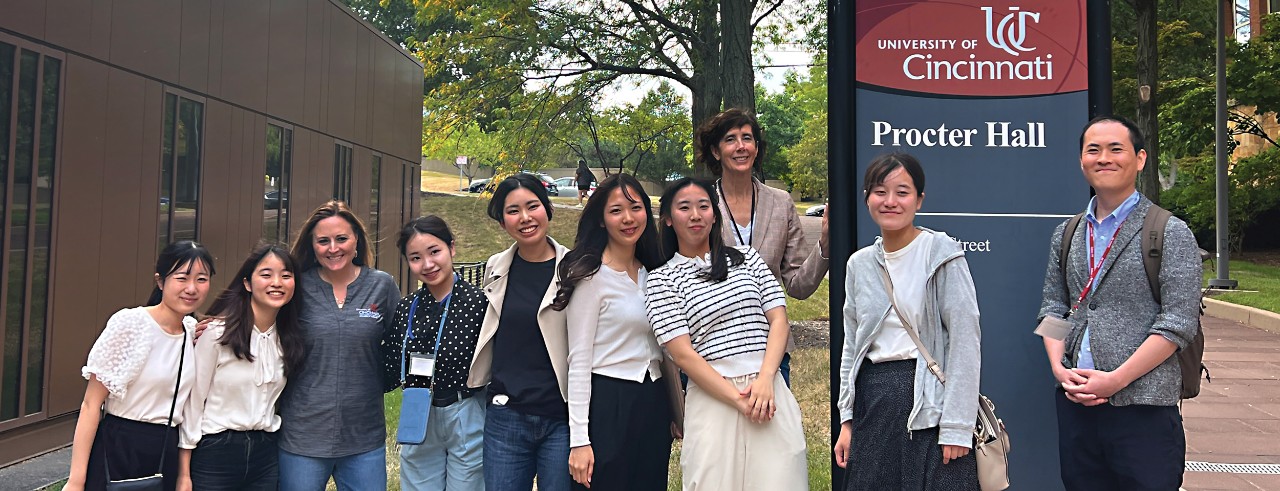
Featured image at top: Chiba University students visit the UC College of Nursing. Photo/provided.
Learn more about our Bachelor of Science in Nursing program's experiential learning opportunities.
Related Stories
Sugar overload killing hearts
November 10, 2025
Two in five people will be told they have diabetes during their lifetime. And people who have diabetes are twice as likely to develop heart disease. One of the deadliest dangers? Diabetic cardiomyopathy. But groundbreaking University of Cincinnati research hopes to stop and even reverse the damage before it’s too late.
App turns smartwatch into detector of structural heart disease
November 10, 2025

An app that uses an AI model to read a single-lead ECG from a smartwatch can detect structural heart disease, researchers reported at the 2025 Scientific Sessions of the American Heart Association. Although the technology requires further validation, researchers said it could help improve the identification of patients with heart failure, valvular conditions and left ventricular hypertrophy before they become symptomatic, which could improve the prognosis for people with these conditions.
Duo authentication changes coming January 2026
November 10, 2025
Effective Wednesday, January 21, 2026, Duo authentication via SMS text messages and phone calls will no longer be supported. Switch to the Duo Mobile app on an iOS or Android device (such as a smartphone or tablet). The Duo Mobile app supports Duo Push, which offers the most secure and user-friendly authentication experience.