Work with newborns opens new career paths for UC senior
Speech language hearing sciences student screens newborns’ hearing at hospital

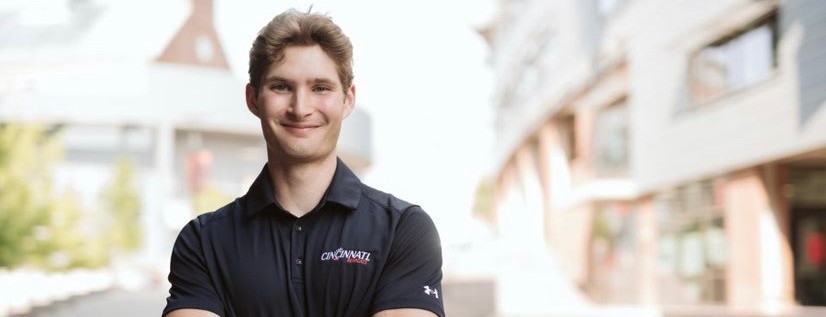
Working as a newborn hearing screener at a local hospital, University of Cincinnati student Sam Kroeger has found rewarding work that’s opened his mind to new career opportunities.

Sam Kroeger
Kroeger, who is entering his fourth year in the speech language hearing sciences program at UC’s College of Allied Health Sciences (CAHS), expected his future career to involve working at an outpatient audiology clinic, performing hearing tests and prescribing hearing aids. But his experience-based learning has introduced him to a wider range of job possibilities.
“It wasn’t really a population I had considered before,” the senior from Mason, Ohio, said. “I wanted to push myself and see a whole other world. I never really saw myself working with kids, especially babies that young, so I wanted to see if it would interest me. It’s been a really cool experience and something I could see myself continuing to do work with in the future.”
Kroeger wasn’t actively seeking a job when a faculty member from CAHS recommended him for the position, a job he’s held since the spring.
In his field, interacting with patients typically requires credentials, so work experience as an undergraduate student can be hard to find. When the opportunity came up, he was excited to get hands-on experience in a health care setting.
“I knew I wanted to go into audiology, and I knew I wanted to go to grad school, but I wasn’t really sure what setting I wanted to be in,” said Kroeger, who is the president of the College of Allied Health Sciences Ambassadors, the academic chair for Theta Chi, the speech language hearing sciences representative on the College of Allied Health Sciences Tribunal, a member of the Student Alumni Council and a member of the National Student Speech Language Hearing Association.
The Ohio Department of Health mandates that all newborns undergo a hearing screening before leaving a hospital or birthing center.
These initial hearing screenings do not diagnose hearing loss, but they do identify newborns who need more comprehensive diagnostic evaluations. Early identification and intervention are key components for speech and language development.
That’s been a skill I’ve seen myself develop, to be able to make clear recommendations and explain the results.
Sam Kroeger UC speech language hearing sciences student
One of the most valuable parts of his job, Kroeger said, has been getting to work directly with patients and communicate with their families.
“As a newborn hearing screener, I am expected to provide results and make recommendations for audiologic follow-up,” he said. “That’s been a skill I’ve seen myself develop, to be able to make clear recommendations and explain the results.”
Kroeger, who is minoring in Spanish and pursuing a Certificate of Spanish for Service Learning in Social Work and Health Care, has been able to serve a diverse and multicultural population.
“We serve people from all kinds of backgrounds,” he said. “I think it’s so important that everybody gets the care they need.”
Featured image at top: UC student Sam Kroeger. Photo/Sam Kroeger
Become a Bearcat
Whether you’re a first-generation student or from a family of Bearcats, UC is proud to support you at every step along your journey. We want to make sure you succeed — and feel right at home.
Related Stories
Sugar overload killing hearts
November 10, 2025
Two in five people will be told they have diabetes during their lifetime. And people who have diabetes are twice as likely to develop heart disease. One of the deadliest dangers? Diabetic cardiomyopathy. But groundbreaking University of Cincinnati research hopes to stop and even reverse the damage before it’s too late.
App turns smartwatch into detector of structural heart disease
November 10, 2025

An app that uses an AI model to read a single-lead ECG from a smartwatch can detect structural heart disease, researchers reported at the 2025 Scientific Sessions of the American Heart Association. Although the technology requires further validation, researchers said it could help improve the identification of patients with heart failure, valvular conditions and left ventricular hypertrophy before they become symptomatic, which could improve the prognosis for people with these conditions.
Duo authentication changes coming January 2026
November 10, 2025
Effective Wednesday, January 21, 2026, Duo authentication via SMS text messages and phone calls will no longer be supported. Switch to the Duo Mobile app on an iOS or Android device (such as a smartphone or tablet). The Duo Mobile app supports Duo Push, which offers the most secure and user-friendly authentication experience.