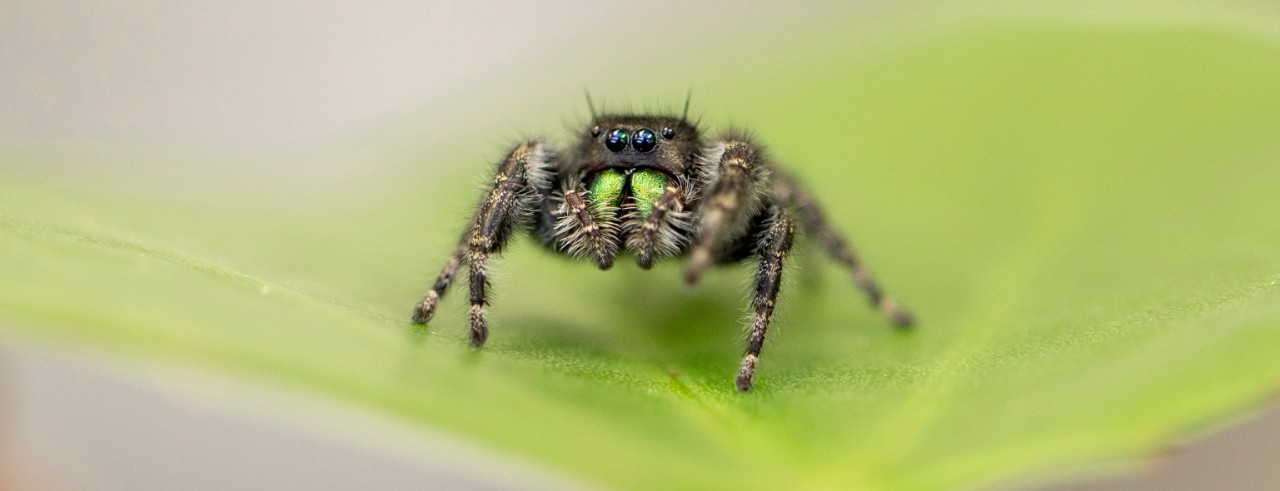
Hungry eyes: Spiders lose vision when they’re starving
Findings could foster a better understanding of the role nutrition plays in macular degeneration

Biologists at the University of Cincinnati discovered that underfed jumping spiders lose light-sensitive cells that are key to their vision.
UC College of Arts and Sciences Professor Elke Buschbeck and her co-authors studied photoreceptors in the eyes of bold jumping spiders, tiny eight-legged predators found across North America. The little hunters rely on their keen vision to stalk prey.
But researchers found that underfed spiders begin to lose photoreceptors that give them such good eyesight. Their findings could improve our understanding of the role that nutrition plays in common age-related vision problems such as macular degeneration.
The study was published in the journal Vision Research.

UC doctoral student and study lead author Shubham Rathore uses a custom ophthalmoscope to study how nutrition affects vision in UC Professor Elke Buschbeck's lab. Photo/Andrew Higley/UC Marketing + Brand
Their discovery occurred by serendipity while examining the eyes of wild-caught bold jumping spiders using her lab’s custom-made ophthalmoscope, which can take photos of the retinas of insects and spiders. They found dark spots on some of the spiders’ photoreceptors, suggesting they had degenerated during its life or development.
“You could tell just by looking at them that some of the photoreceptors had died,” Buschbeck said.
Wouldn’t it be wild if a breakthrough in macular degeneration treatments for humans was inspired by work on jumping spiders common to back yards across the United States?
Nathan Morehouse, UC's Institute for Research in Sensing
“But are the photoreceptors really degenerating?” UC doctoral student Shubham Rathore asked. “Or are they just getting bleached by the way we do the experiment?”
Rathore turned to electron microscopy to confirm that the cells indeed were dying.
The study suggests jumping spiders are a compelling model to study retinal and neuronal health.

UC Professor Elke Buschbeck created a custom ophthalmoscope in her lab to study the vision of insects and spiders. Photo/Andrew Higley/UC Marketing + Brand
Did poor nutrition cause it?
To test their hypothesis, Miranda Brafford and John Goté, both UC graduates, studied two groups of captive spiders, one fed a normal unrestricted diet and another that was given half portions. In the underfed group, spiders lost more photoreceptors, particularly in the part of the retina that has the highest density of them.

UC researchers study the photoreceptors of spiders in a lab. They found that undernourished spiders lose more photoreceptors. Photo/Buschbeck Lab
“It’s the functional equivalent of the macula in our eyes,” Buschbeck said.
That is the part of the eye that processes visual information directly in front of you.
“Photoreceptors are energetically costly. It’s hard to keep up with their energy needs,” Buschbeck said. “If you deprive them of nutrition, the system fails.”
Macular degeneration affects an estimated 20 million people in the United States. It’s the most common cause of age-related vision loss and has no cure.
“What’s interesting is macular degeneration in humans also has evidence of being linked to metabolic processes and difficulty with energy being delivered,” Buschbeck said.

Co-author and UC Assistant Professor Annette Stowasser uses a whiteboard to explain the science behind the research project. Photo/Andrew Higley/UC Marketing + Brand
Rathore and Buschbeck said they would like to see if the degeneration begins in the support tissues around the photoreceptors and what nutrients in particular support good visual health.
Study senior author Annette Stowasser, an assistant professor in UC’s College of Arts and Sciences, said it’s premature to draw direct comparisons between vision deficits in spiders and people.
“To be able to say anything about how this may inform treatments in people, first carefully designed studies would need to tease out which exact nutrients are involved, which may depend on environmental conditions and other factors,” Stowasser said.
“However, that nutrient deprivation can have the shown effect indicates the importance of paying close attention to the effects of nutrients,” she said.

UC Professor Elke Buschbeck has been unlocking secrets of insect and spider vision in her lab. Photo/Andrew Higley/UC Marketing + Brand
Co-author Nathan Morehouse, director of UC's Institute for Research in Sensing, has studied the vision of jumping spiders around the world.
“Wouldn’t it be wild if a breakthrough in macular degeneration treatments for humans was inspired by work on jumping spiders common to back yards across the United States?” said Morehouse, an associate professor of biological sciences.
“Sometimes answers to challenging problems can come from unexpected places,” he said.
The study was supported by grants from the National Science Foundation.
Featured image at top: University of Cincinnati researchers discovered that bold jumping spiders begin to lose their vision if they do not get enough nourishment. Photo/Joseph Fuqua II/UC

University of Cincinnati Professor Elke Buschbeck, left, doctoral student Shubham Rathore and Assistant Professor Annette Stowasser collaborated on a study of nutrition and vision in bold jumping spiders. Photo/Andrew Higley/UC Marketing + Brand
Next Lives Here
The University of Cincinnati is leading public urban universities into a new era of innovation and impact. Our faculty, staff and students are saving lives, changing outcomes and bending the future in our city's direction. Next Lives Here.
Related Stories
Sugar overload killing hearts
November 10, 2025
Two in five people will be told they have diabetes during their lifetime. And people who have diabetes are twice as likely to develop heart disease. One of the deadliest dangers? Diabetic cardiomyopathy. But groundbreaking University of Cincinnati research hopes to stop and even reverse the damage before it’s too late.
App turns smartwatch into detector of structural heart disease
November 10, 2025

An app that uses an AI model to read a single-lead ECG from a smartwatch can detect structural heart disease, researchers reported at the 2025 Scientific Sessions of the American Heart Association. Although the technology requires further validation, researchers said it could help improve the identification of patients with heart failure, valvular conditions and left ventricular hypertrophy before they become symptomatic, which could improve the prognosis for people with these conditions.
Duo authentication changes coming January 2026
November 10, 2025
Effective Wednesday, January 21, 2026, Duo authentication via SMS text messages and phone calls will no longer be supported. Switch to the Duo Mobile app on an iOS or Android device (such as a smartphone or tablet). The Duo Mobile app supports Duo Push, which offers the most secure and user-friendly authentication experience.