Answering the call, wherever it leads
UC Clermont students provide medical care in Mexico

College students typically head to Cancun, Mexico, for fun in the sun, beckoned by warm waters and tropical breezes.
In November, however, two UC Clermont students landed in the tourist destination to make a difference.
Jesse Anderson and Brennan Wages are in the college’s physical therapist assistant program. They joined Assistant Professor Carolyn Shisler and other University of Cincinnati allied health faculty and students to provide much needed medical treatment to Palace Resort and Foundation staff and their families.
“Good health care is so hard to get in Mexico,” said Shisler. “If you’re wealthy in Mexico, you can get high quality health care; if not, it’s tough. Many conditions go untreated or undertreated as a result.”
Students from UC’s College of Allied Health Sciences studying audiology, medical lab sciences, physical therapy and nutrition have made the trek to Mexico each year for nearly a decade, but this was the first trip open to UC Clermont students. The two students were supervised by Shisler and Dr. Rose Smith, professor emeritus from UC’s Doctor of Physical Therapy program. Students received course credit, and costs were covered by UC International and UC Clermont.

UC’s four-person PT/PTA team treated 173 patients over four-and-a-half days while in Mexico. From left: Carolyn Shisler, assistant professor and director of UC Clermont’s physical therapist assistant program; PTA student Jesse Anderson; PTA student Brennan Wages; and Rose Smith, professor emeritus from UC’s Doctor of Physical Therapy program.
“I wanted to have the opportunity to help people who were not receiving the treatment they required in order to heal,” Anderson said.
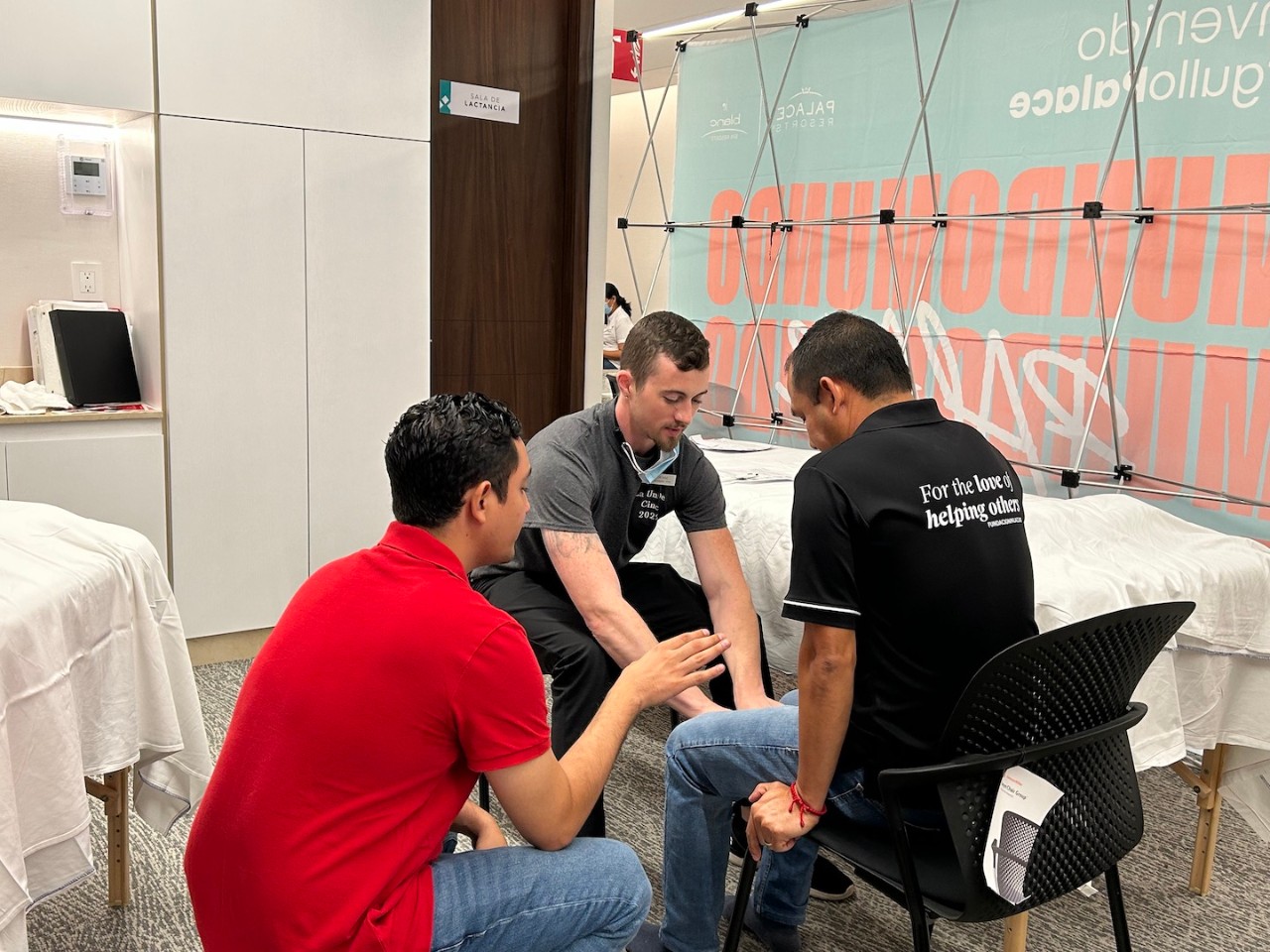
Upon arriving in Mexico, the team immediately got to work, offering triage therapy to laborers, kitchen staff, waiters and housekeepers. Many of the patients faced foot, knee, shoulder and back problems related to long, physically demanding workdays. Some of the musculoskeletal ailments were exacerbated or caused by sleeping in hammocks — a common solution to hot, humid nights with no air conditioning.
The physical therapy team even worked collaboratively with medical lab sciences and audiology on four patients with vestibular disorders, demonstrating the importance of interprofessional practice. Throughout the week, the physical therapy team’s job was to assess the problems and provide exercises and tools, such as orthotics and therapy resistance bands, to help patients function in their jobs.
One waitress, for instance, had broken her pinky finger, and a splint provided by a local doctor didn’t allow her to carry a food tray. Shisler, a licensed physical therapist with more than 30 years of experience, diagnosed the patient, while her students showed the waitress appropriate exercises for stretching and strengthening as well as how to tape her fingers so that she could continue to serve and not miss income. Interpreters provided translation between the clinicians and patients, most of whom did not speak English.
I wanted to help people who were not receiving the treatment they required in order to heal.
Jesse Anderson UC Clermont PTA student
The trip also included time in Merida, Mexico, where the UC teams treated primarily Palace Foundation office workers and their families. Over the course of four-and-a-half days, the four-person PT/PTA team of Anderson, Wages, Shisler and Smith treated 137 patients.
“Students were amazed at how welcoming and grateful people were for help,” said Shisler. “The experience helped them appreciate our own health care system, even with its flaws.”
She also noticed a tremendous amount of professional and academic growth in her students, noting that they were able to adapt quickly to a fast-paced environment and the ability to provide skilled treatment interventions with the help of an interpreter.
Shisler hopes to offer the international opportunity to her PTA students each November and said she already has had interest in future trips from potential students now applying to the program. They recognize the experience offers a unique environment to directly apply what they’ve learned in the classroom.

UC Clermont PTA student Jesse Anderson provides shoe orthotics to a patient who spends most of her day on her feet.
Anderson and Wages are scheduled to graduate in spring 2023. Anderson said he chose UC Clermont for the PTA program and the college’s close-to-home location. While Anderson also works at an outpatient clinic in Cincinnati, he said the gratefulness of the Mexican patients for the care they received particularly struck him.
“The patients were so thankful, and the trip provided evidence of the value and potential of my education at UC Clermont to positively impact the lives of the people I will go forward to treat,” Anderson said. “I have a newfound appreciation for the education I am receiving, and I am more confident in my abilities because of this experience.”
To learn more about UC Clermont’s Physical Therapist Assistant program, visit ucclermont.edu/pta.
Top featured photo: UC Clermont physical therapist assistant student Jesse Anderson demonstrates a home exercise program to a client with help from an interpreter in Mexico.
Related Stories
Sugar overload killing hearts
November 10, 2025
Two in five people will be told they have diabetes during their lifetime. And people who have diabetes are twice as likely to develop heart disease. One of the deadliest dangers? Diabetic cardiomyopathy. But groundbreaking University of Cincinnati research hopes to stop and even reverse the damage before it’s too late.
App turns smartwatch into detector of structural heart disease
November 10, 2025

An app that uses an AI model to read a single-lead ECG from a smartwatch can detect structural heart disease, researchers reported at the 2025 Scientific Sessions of the American Heart Association. Although the technology requires further validation, researchers said it could help improve the identification of patients with heart failure, valvular conditions and left ventricular hypertrophy before they become symptomatic, which could improve the prognosis for people with these conditions.
Duo authentication changes coming January 2026
November 10, 2025
Effective Wednesday, January 21, 2026, Duo authentication via SMS text messages and phone calls will no longer be supported. Switch to the Duo Mobile app on an iOS or Android device (such as a smartphone or tablet). The Duo Mobile app supports Duo Push, which offers the most secure and user-friendly authentication experience.