College of Nursing online program offers career-changing opportunities
Desire for a more personal connection with patients leads to a nurse practitioner path

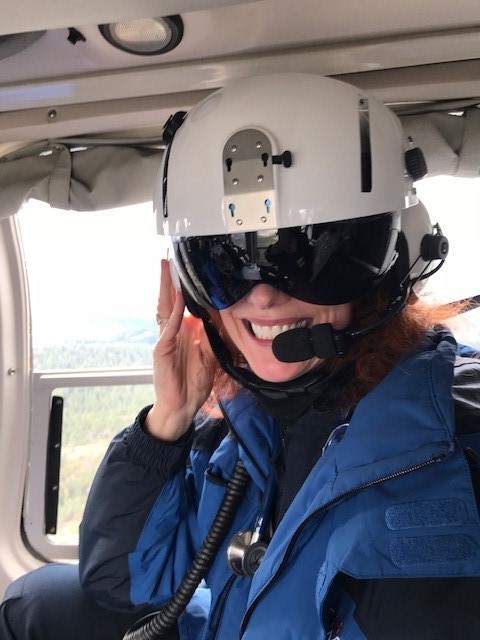
After 16 years as a flight nurse in the desert southwest and the Pacific Northwest, Arna Robins felt the need to connect with her patients on a more personal, long-term basis. When she decided to transition to family care medicine, she turned to an online program offered by the University of Cincinnati College of Nursing as part of her effort to become a nurse practitioner.
“I had to have a program that was 100% online,” says Robins. “I already had a master’s degree and the unfortunate thing is that the states of Ohio and Washington don’t have a contract in place so I can get my doctorate. That’s why I’m doing a post-master’s certificate. Of all of the things I had to have, being so remote in the Pacific Northwest, UC was the one that matched all those criteria.”
The College of Nursing’s Interactive Case Studies (ICS) is an online approach to teaching the differential diagnosis process, when a medical professional differentiates between two or more conditions that could be behind a person's symptoms. For years, the differential diagnosis course, which teaches holistic patient assessment, was taught onsite by leveraging in-person simulation opportunities using standardized patients (SP).
In 30-minute segments, each student entered the examination room, gathered a SP’s history, performed a focused physical assessment, left the room to review lab data and wrote up findings as he or she determined the top three differential diagnoses for this SP. The process was then repeated on another SP with different demographics, complaints and health history. This experience, developed by Christine Colella, a doctor of nursing practice, professor and executive director of graduate programs at the College of Nursing, gave students the opportunity to practice before engaging with real patients.

Christine Colella, PhD, of the UC College of Nursing/Photo/Andrew Higley/UC Creative+Brand
“What it did for me was add a little bit more interactivity to patient care,” Robins says. “I was more of a clinical expert because of my background in pediatrics and the ER. I can tell you what’s going to kill somebody in the next 30 minutes, but let’s say you have a patient with right flank pain. How do you manage that? Or you have somebody who has this constellation of symptoms and now you need to talk through how to manage that.”
To replicate a similar simulation experience for distance learners, Colella turned to technology to develop the ICS by partnering with Matt Rota, PhD, the college’s assistant dean for technology.
“The ICS is different from other solutions as it requires every decision made to be supported by a rationale,” says Colella. “This teaches students the most important component of learning the art of differential diagnosis: To understand and see the reasons for decisions made. It also enabled a standardized simulation experience for all online students, allowing for consistency and engagement.”
Robins says when she first experienced the ICS process she felt some frustration of being guided into a way of thinking. Once she got more familiar with the process, she was able to adapt to what she describes as a more linear way of thinking.
“As an ER nurse, the challenge is that we think in terms of like a shotgun [or broadly try a number of approaches or treatments] and this was more, ‘Ok, this is one symptom, go forward,’” says Robins. “The nice thing about the program is you pause and you can take time to think through something or take some notes. I think with my background it was a little bit of a challenge to do that, but once I adapted I was able to say, ‘I can take some time with this and review.’ Clearly you don’t want to take all day to make those decisions, but I could slow down a little bit and really think through what was being presented.”
Once she has completed her classes at UC this spring, Robins hopes to take her nursing boards this summer and thinks she will accept a position with a health clinic where she lives on San Juan Island, Washington, where she can serve her local community and not have to move.
”Would I do the ICS program again? Yes, without question,” she says. “Becoming a nurse practitioner represents the culmination of a lifelong dream, and, as I consider the days ahead, the thought of supporting community health as a nurse practitioner brings me joy.”
Lead image of Arna Robins provided.
Impact Lives Here
The University of Cincinnati is leading public urban universities into a new era of innovation and impact. Our faculty, staff and students are saving lives, changing outcomes and bending the future in our city's direction. Next Lives Here.
Stay up on all UC's COVID-19 stories, or take a UC virtual visit and begin picturing yourself at an institution that inspires incredible stories.
Related Stories
Sugar overload killing hearts
November 10, 2025
Two in five people will be told they have diabetes during their lifetime. And people who have diabetes are twice as likely to develop heart disease. One of the deadliest dangers? Diabetic cardiomyopathy. But groundbreaking University of Cincinnati research hopes to stop and even reverse the damage before it’s too late.
App turns smartwatch into detector of structural heart disease
November 10, 2025

An app that uses an AI model to read a single-lead ECG from a smartwatch can detect structural heart disease, researchers reported at the 2025 Scientific Sessions of the American Heart Association. Although the technology requires further validation, researchers said it could help improve the identification of patients with heart failure, valvular conditions and left ventricular hypertrophy before they become symptomatic, which could improve the prognosis for people with these conditions.
Duo authentication changes coming January 2026
November 10, 2025
Effective Wednesday, January 21, 2026, Duo authentication via SMS text messages and phone calls will no longer be supported. Switch to the Duo Mobile app on an iOS or Android device (such as a smartphone or tablet). The Duo Mobile app supports Duo Push, which offers the most secure and user-friendly authentication experience.