UC Answers: How do I get the most out of online classes?
Medical student Halimat Olaniyan shares tips for making the most of virtual learning

Q: What advice would you give students who want to be successful in an online course?
Olaniyan: Definitely make yourself a schedule and hold yourself accountable to it. Set an alarm like you normally would, and write out a plan for each day. I loved having extra free time to get things done but that also made me more likely to procrastinate. I think the key is balance. And you get to set what that balance looks like for you.
Q: What are your academic and professional goals?
Olaniyan: I’m currently a second-year medical student, and I look forward to becoming a doctor and serving underserved or otherwise neglected communities. I’d love to work in a community health center or with sickle cell patients. I also see myself very involved in whichever community I serve and maybe writing a few books along the way.
Q: What has your experience with online courses been at UC?
Olaniyan: We could always stream lectures from home, which was nice when I didn’t feel like getting out of bed, but I personally preferred attending lectures real time. The switch to everything being online [due to COVID-19] was pretty rapid. Watching lectures from home was kind of new to me but not too different from in person. And as time went on they figured out how to add the experiences we were missing like clinical skills and our learning community by using Zoom or Webex. We even had live virtual lectures.
Q: What are some of the advantages of taking a course online vs. in-person?
Olaniyan: I love being able to stay home, sleep in, have pjs on. It’s also nice to have so much extra free time. I don’t have to get dressed up or sit in traffic. I’m just going to my desk.
Q: What were your expectations before taking online courses, and how did the experience compare to what you expected?
Olaniyan: I honestly did not know what to expect. I didn’t think it would be too different from school. I definitely had to become more disciplined in waking up at a reasonable time and watching lectures. But as time went on, I got better at it, and I think it became easier than physically going to class. Our school also got better at supporting us and offering the same resources just virtually.
Q: Have you had a favorite online learning experience, and what made it so positive?
Olaniyan: Yes, I loved clinical skills. We got to practice our telemedicine skills, work with our peers, see standardized patient actors and discuss health cases with faculty in real time — all via WebEx. I just really enjoyed being able to see my classmates and bounce ideas off of them and work with patients again, even though they were actors.
Q: Were there any particular professors who took a creative or innovative approach to online learning, and if so, could you describe what made it so?
Olaniyan: Dr. Bruce Giffin had to think of a way for us to still do anatomy but of course virtually. So he made all these recordings of everything you could ever want to know about the dissection we were there to watch. He also made us image banks to study from. It all really streamlined learning the anatomy, and I think I actually did better than I would have in person because there were less factors to stress over — like waiting in line to take the practical.
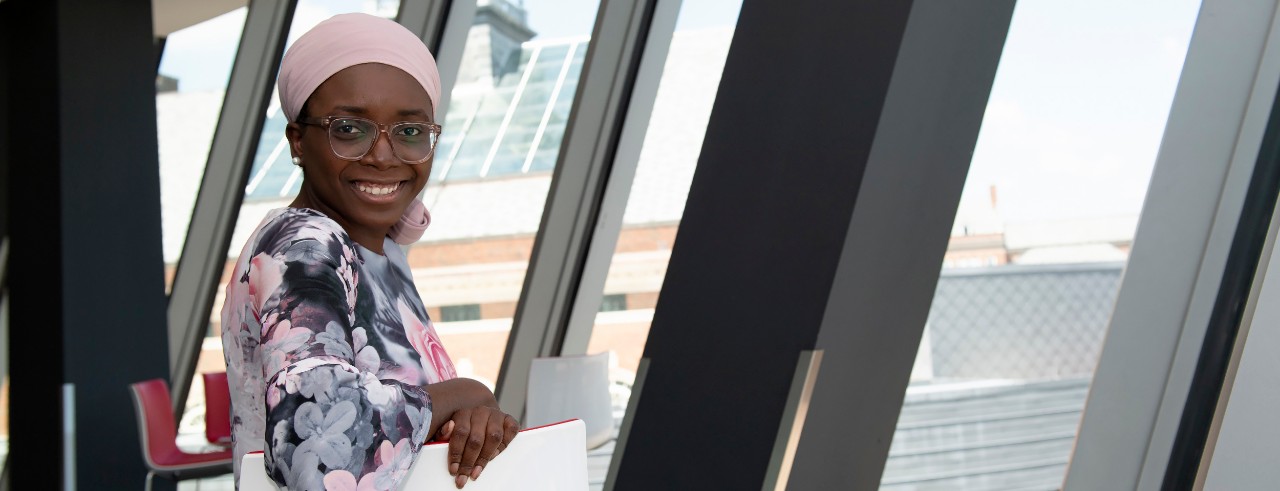
Featured image at top: Second-year medical student Halamat Olaniyan intends to become a doctor and help underserved communities. photo/Colleen Kelley/UC Creative + Brand
Explore UC Online Options
The University of Cincinnati has robust innovative online opportunities. See for yourself what is available and find more UC Answers to your important questions.
Related Stories
Sugar overload killing hearts
November 10, 2025
Two in five people will be told they have diabetes during their lifetime. And people who have diabetes are twice as likely to develop heart disease. One of the deadliest dangers? Diabetic cardiomyopathy. But groundbreaking University of Cincinnati research hopes to stop and even reverse the damage before it’s too late.
App turns smartwatch into detector of structural heart disease
November 10, 2025

An app that uses an AI model to read a single-lead ECG from a smartwatch can detect structural heart disease, researchers reported at the 2025 Scientific Sessions of the American Heart Association. Although the technology requires further validation, researchers said it could help improve the identification of patients with heart failure, valvular conditions and left ventricular hypertrophy before they become symptomatic, which could improve the prognosis for people with these conditions.
Duo authentication changes coming January 2026
November 10, 2025
Effective Wednesday, January 21, 2026, Duo authentication via SMS text messages and phone calls will no longer be supported. Switch to the Duo Mobile app on an iOS or Android device (such as a smartphone or tablet). The Duo Mobile app supports Duo Push, which offers the most secure and user-friendly authentication experience.