National Geographic: UC professor discusses ancient spiders
UC biology professor Nathan Morehouse says fossils suggest ancient spiders were night predators

A University of Cincinnati biology professor spoke to National Geographic about the recent discovery of spider fossils in South Korea.
The discovery by the Korea Polar Research Institute suggests ancient spiders had reflective eyes like many of today’s spiders.
If you shine a flashlight in your grassy back yard, you’re likely to see tiny eyes shining back at you. These are the glowing eyes of wolf spiders, which have an iridescent lens called a tapetum that reflects light.
According to National Geographic, paleontologists discovered nearly a dozen inch-long fossils of ancient spiders dating back more than 106 million years during the Cretaceous Period. These spiders, too, have reflective lenses that capture more light for animals that are active at night. Their findings were published in the Journal of Systematic Paleontology.
“These fossils are extraordinary,” UC biology professor Nathan Morehouse told National Geographic.
“It’s always a thrill when something of the visual system is preserved,” he said. “More exciting to me and other vision scientists is the glimpse that the tapetum offers into the lifestyle of these ancient animals. They were likely nocturnal hunters!”
Morehouse has been studying the vision and behavior of spiders, particularly jumping spiders, in UC’s McMicken College of Arts and Sciences. He is using a National Science Foundation grant to study spider vision around the world.
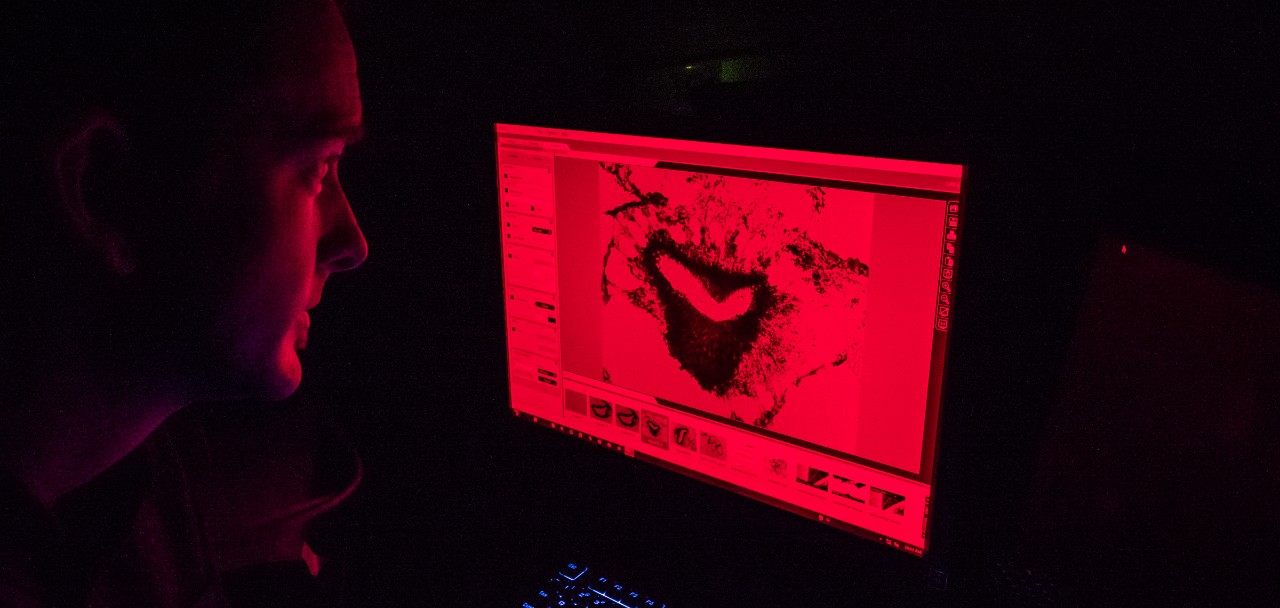
Featured image at top: UC biology professor Nathan Morehouse uses micro-spectrophotometry to measure how the photoreceptor cells in spiders absorb light. Photo/Jay Yocis/UC Creative Services
Related Stories
Sugar overload killing hearts
November 10, 2025
Two in five people will be told they have diabetes during their lifetime. And people who have diabetes are twice as likely to develop heart disease. One of the deadliest dangers? Diabetic cardiomyopathy. But groundbreaking University of Cincinnati research hopes to stop and even reverse the damage before it’s too late.
App turns smartwatch into detector of structural heart disease
November 10, 2025

An app that uses an AI model to read a single-lead ECG from a smartwatch can detect structural heart disease, researchers reported at the 2025 Scientific Sessions of the American Heart Association. Although the technology requires further validation, researchers said it could help improve the identification of patients with heart failure, valvular conditions and left ventricular hypertrophy before they become symptomatic, which could improve the prognosis for people with these conditions.
Duo authentication changes coming January 2026
November 10, 2025
Effective Wednesday, January 21, 2026, Duo authentication via SMS text messages and phone calls will no longer be supported. Switch to the Duo Mobile app on an iOS or Android device (such as a smartphone or tablet). The Duo Mobile app supports Duo Push, which offers the most secure and user-friendly authentication experience.