Supporting nurses who make a difference: Jasmine Lewis named CVS Health Foundation scholar

Despite widespread recognition that access to primary care improves health outcomes and reduces mortality across the lifespan, the U.S. continues to face significant challenges in providing adequate primary care—particularly in rural and low-income communities. With nearly 90% of nurse practitioners trained in primary care, their role in expanding health access is both critical and timely.
To support the expansion of primary care for everyone, the CVS Health Caring Hearts Family Nurse Practitioner (FNP) Student Scholarship provides funding to 50 outstanding FNP students across the nation. In 2025, the University of Cincinnati College of Nursing was proud to be selected as a recipient of these funds, which were awarded to one exceptional FNP student.
“We are so grateful to the CVS Health Foundation for their collaboration and support of advanced practice nursing through the FNP scholarship award program,” says Amy Fathman, DNP, APRN, FNP-BC, associate professor in the FNP program and scholarship submission author. “Given that 30% of the U.S. population lives in Health Professional Shortage Areas, this generous support makes it possible for FNP students to pursue careers in various areas by alleviating a significant financial burden.”
Jasmine Lewis, RN, was selected as this year’s CVS Health Caring Hearts FNP Student Scholar—a recognition of her deep-rooted commitment to health access and service for all communities.
Since 2018, Lewis has volunteered as a tutor at LivingWell-Home Healthcare, an organization that serves Medicaid patients—many from low-income households. She works one-on-one with children who have developmental delays, focusing on building both academic skills and self-confidence in reading and math.
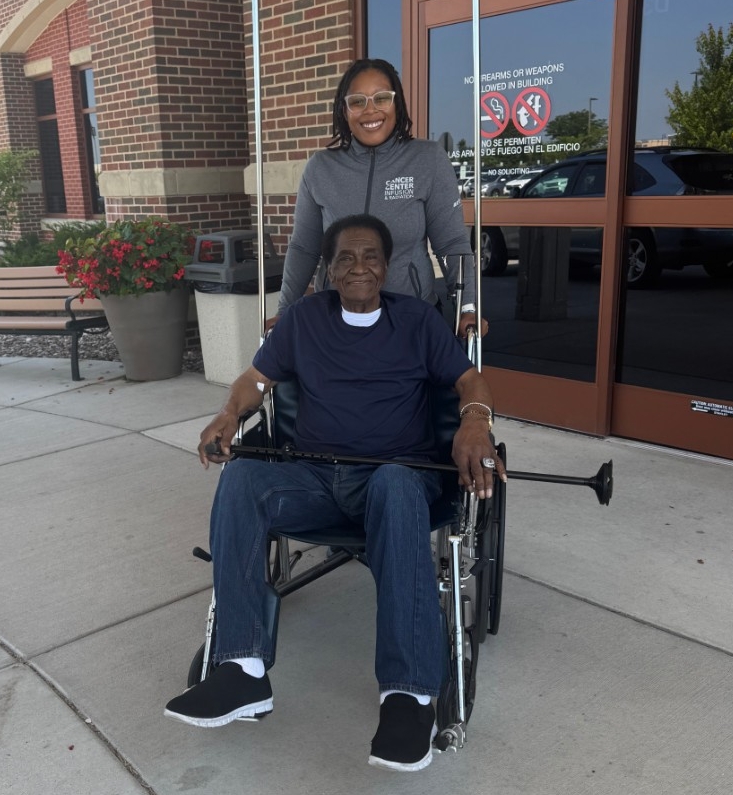
Lewis and her grandfather at the oncology clinic where she works
After becoming a registered nurse in 2021, Lewis began integrating evidence-based strategies to better support her students by addressing behavioral challenges, improving focus and fostering a more supportive learning environment. Her clinical training enables her to recognize signs of sensory processing issues, learning disabilities and emotional regulation difficulties, further enhancing her ability to meet each child’s unique needs.
In addition to tutoring, she has volunteered to combat food insecurity and provide essential items to all communities. Her efforts have included distributing food and clothing, harvesting fresh produce and assembling hygiene kits and baby supplies for families in need.
“These experiences have shown me how vital it is to support people beyond the exam room—to see the whole person, not just the patient,” Lewis reflects.
As a Family Nurse Practitioner student and oncology nurse, she remains dedicated to serving all populations. In the oncology clinic, she assists Medicaid patients in accessing resources, navigating insurance and overcoming barriers to care.
“As an FNP student, I’m learning not only how to treat illness, but how to advocate for people whose voices often go unheard,” she says.
These experiences have deepened Lewis’s commitment to health access and service for all and reinforced her belief that healthcare must meet people where they are—whether in their homes, schools, or communities. Inspired by the challenges her patients face, she also plans to establish a foundation in her family’s name to support cancer patients experiencing financial hardship.
Related Stories
UC launches Bearcats Affordability Grant
January 7, 2026
The University of Cincinnati is making college more attainable for students across Ohio with the creation of the Bearcats Affordability Grant. The new grant will provide a pathway to tuition-free college for students of families who make less than $75,000 per year. Beginning in fall 2026, the Bearcats Affordability Grant will cover the remaining cost of tuition for Ohio residents who are Pell eligible.
Sugar overload killing hearts
November 10, 2025
Two in five people will be told they have diabetes during their lifetime. And people who have diabetes are twice as likely to develop heart disease. One of the deadliest dangers? Diabetic cardiomyopathy. But groundbreaking University of Cincinnati research hopes to stop and even reverse the damage before it’s too late.
App turns smartwatch into detector of structural heart disease
November 10, 2025

An app that uses an AI model to read a single-lead ECG from a smartwatch can detect structural heart disease, researchers reported at the 2025 Scientific Sessions of the American Heart Association. Although the technology requires further validation, researchers said it could help improve the identification of patients with heart failure, valvular conditions and left ventricular hypertrophy before they become symptomatic, which could improve the prognosis for people with these conditions.