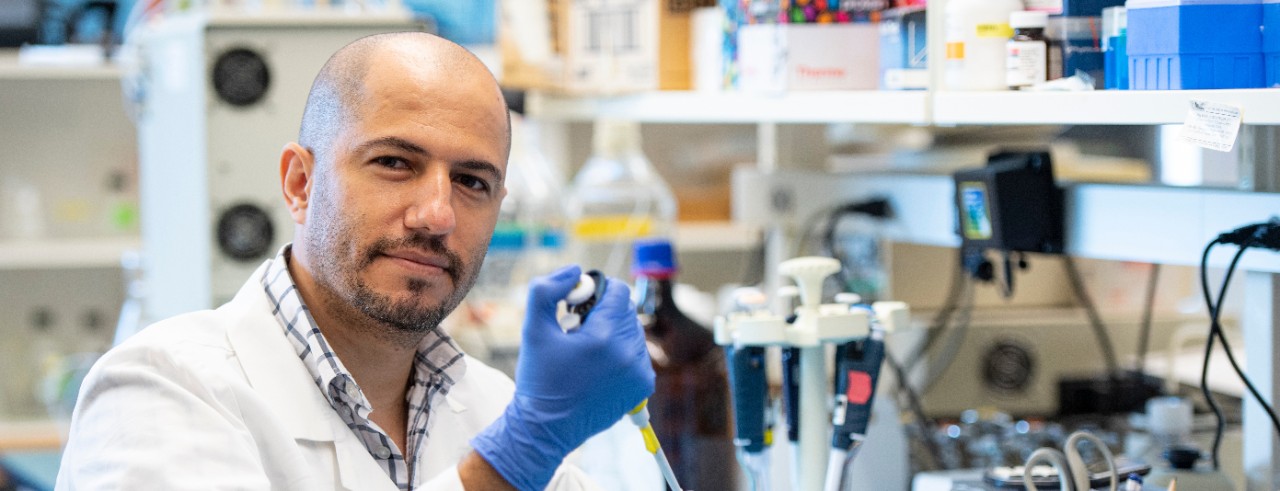
Researcher developing pancreatic cancer treatment that targets newly identified protein
MSN highlights Cancer Center trainee associate member

MSN highlighted the University of Cincinnati Cancer Center’s Ahmet Kaynak's research that examined the unique tumor microenvironment of pancreatic ductal adenocarcinoma cells, identified one of the key proteins that aids tumor treatment resistance and developed a new drug targeting this protein that reduced tumor size and increased survival in animal models.
The tumor microenvironment is the ecosystem that includes the tumor and surrounding immune cells, blood vessels and other tissue. Kaynak said PDAC’s microenvironment has unique characteristics that suppress the immune system’s ability to attack the cancer cells (causing immunosuppression), hinder drug delivery, and promote resistance to chemotherapy, radiotherapy and immunotherapy.
“There is an unmet need for the development of novel treatment approaches,” said Kaynak, PhD, a trainee associate member of the Cancer Center and postdoctoral fellow in the Hematology & Oncology Division of the Department of Internal Medicine in UC’s College of Medicine. “In this project, we asked the question of what the factors are that lead to immunosuppression in the tumor microenvironment.”
Kaynak and colleagues identified that a protein called Hsp70 contributes to tumor immunosuppression.
The team then developed a drug called SapC-DOPG that specifically targets cancer cells by binding to phosphatidylserine, a lipid on the cells’ surface. This work builds upon that of Kaynak’s mentor, Xiaoyang Qi, PhD, who developed a similar drug called SapC-DOPS that is currently in Phase 2 clinical trials as a lung cancer treatment.
SapC-DOPG was designed to target Hsp70 within PDAC cells. In animal models of PDAC, the drug was well tolerated and resulted in smaller tumor size and increased survival.
“We hope to transition to clinical settings and investigate whether SapC-DOPG can be used as a therapeutic agent in pancreatic cancer patients,” Kaynak said. “The safety of the analog SapC-DOPS has been proven in clinical trials with patients. We hope our novel drug can also be safely used in patients in the future.”
Read the original UC News story.
Featured photo at top of Kaynak in the lab. Photo/provided.
Related Stories
Sugar overload killing hearts
November 10, 2025
Two in five people will be told they have diabetes during their lifetime. And people who have diabetes are twice as likely to develop heart disease. One of the deadliest dangers? Diabetic cardiomyopathy. But groundbreaking University of Cincinnati research hopes to stop and even reverse the damage before it’s too late.
Is going nuclear the solution to Ohio’s energy costs?
November 10, 2025

The Ohio Capital Journal recently reported that as energy prices continue to climb, economists are weighing the benefits of going nuclear to curb costs. The publication dove into a Scioto Analysis survey of 18 economists to weigh the pros and cons of nuclear energy. One economist featured was Iryna Topolyan, PhD, professor of economics at the Carl H. Lindner College of Business.
App turns smartwatch into detector of structural heart disease
November 10, 2025

An app that uses an AI model to read a single-lead ECG from a smartwatch can detect structural heart disease, researchers reported at the 2025 Scientific Sessions of the American Heart Association. Although the technology requires further validation, researchers said it could help improve the identification of patients with heart failure, valvular conditions and left ventricular hypertrophy before they become symptomatic, which could improve the prognosis for people with these conditions.