UC Brain Tumor Center’s groundbreaking research finds support along the Ohio River
Survivors, advocates lead the charge on Oct. 19, at ‘Walk Ahead for Brain Tumor Discoveries’

Event Information (passed)
When Jennifer McClure named her brain tumor “Fred,” she never expected to one day lead hundreds of walkers in an annual mission to send tumors like his packing. But this fall, she’ll do just that.
The annual “Walk Ahead for Brain Tumor Discoveries" returns Sunday, October 19, 2025, to Cincinnati’s scenic Sawyer Point — and this year’s event is more personal than ever. Walk Ahead benefits the Brain Tumor Center at the University of Cincinnati Gardner Neuroscience Institute.
“After waking up from a seizure in 2013, I had no idea it would mark the beginning of a decade-long journey — not just of recovery, but of advocacy, leadership and hope,” says McClure. “This event gave me purpose when I needed it most. Now I get to help others find that same spark.”
The annual 5K walk/run brings together more than 1,500 patients and over 50 teams of caregivers, researchers and supporters. The goal? To raise awareness and funding for life-saving brain tumor research happening right here in the Queen City.
From seizure to survivor

A CT scan reveals McClure’s golf-ball-sized tumor, which she lightheartedly named Fred — a foe she was determined to defeat. Photo/provided
McClure’s journey began in 2013 with a single nighttime seizure — and a shocking diagnosis: a meningioma tumor pressing behind her right eye. With no family history or known risk factors, the news was as unexpected as it was frightening.
World-renowned UC Health neurosurgeon and UC emeritus professor Mario Zuccarello, MD, successfully removed the tumor, but McClure’s path didn’t end there. What followed was a grueling round of 33 radiation treatments and ongoing physical therapy with Phil Cadman at Premiere Physical Therapy.
“I receive physical therapy every month to regain control of my eyelid muscles,” McClure says. “The nerves were wrapped around the tumor and got bruised during surgery, but my doctors believe I can still make progress.”
Watch as McClure is interviewed about her journey by WLWT5's Sheree Paolello and Mike Dardis.
Walking ahead and leading the way

Six weeks post surgery, McClure’s scar is nearly invisible, a quiet reminder of strength beneath the hair her surgeon spared. Photo/provided
Just three months post-surgery, McClure was back on her feet — literally. She returned to work, resumed kickboxing and cycling classes and began building her now-legendary Shepherd Color team.
Her team started as a close-knit circle of family and friends. Today, it includes coworkers and sponsors from her employer, The Shepherd Color Company — a fifth-generation family-owned commercial pigments business where McClure works as a marketing communications manager.
“Shepherd Color isn’t just a company, it’s a family and we show up big,” she says proudly. “The company not only walks but has sponsored the event the past three years.”
Today, she’s still working to regain full control of her right eyelid and facial sensation through targeted physical therapy and electric nerve stimulation. But her spirit? Fully intact — and fiercely determined.
“I’m not giving up,” McClure says. “We’ve made amazing advances in medicine, especially here at UC. The next miracle could be just around the corner.”
From patient to planner

McClure's lapel pin she aptly designed 'Goodbye Fred' in honor of her resected tumor. Photo/provided
McClure has taken her advocacy to the next level, joining the Walk Ahead planning committee and using her marketing savvy to boost awareness.
Her efforts sparked connections within her own workplace.
“After I created a video about my journey to share with my coworkers, another coworker shared his own story through video,” McClure says.
“It turns out, several people at my company have been impacted by brain tumors. It’s not just my story anymore. It’s all of ours.”
Fueling the future of research

Cincinnati brain tumor survivors celebrated resilience at the annual Walk Ahead fundraiser. Photo/provided
Proceeds from Walk Ahead fuel game-changing research at the UC Brain Tumor Center. Just a few of the center’s groundbreaking advances include:
- A Phase 2 clinical trial repurposing a breast cancer drug to fight glioblastoma
- The development of a kinase-targeted therapy for aggressive tumors
- 3D-printed brain tumor vascular models to fast-track drug testing
“In fact, a UC-led research study explored the connection between hormonal therapies, such as birth control pills or injections, and the development of meningiomas in women,” McClure says.
It's a discovery that may offer answers for future patients and deepen McClure’s personal mission.
“It’s not just about me anymore,” McClure says. “When I shared my story, others started telling theirs. The Walk Ahead event is more than fundraising, it’s about building a community of support and awareness.”
Join the movement

With a proud smile, McClure joined fellow survivors at the 2024 Walk Ahead event, a living testament to hope and healing. Photo/provided
This October, the UC community and beyond will gather once again — not just to walk or run, but to honor stories like McClure’s, celebrate survivors, remember loved ones and fuel the future of brain tumor care.
“Because when we walk together, we move science forward,” McClure adds.
Walk Ahead for Brain Tumor Discoveries
Sunday, October 19, 2025
Cincinnati’s Sawyer Point
Register at walkahead.org or start a team now
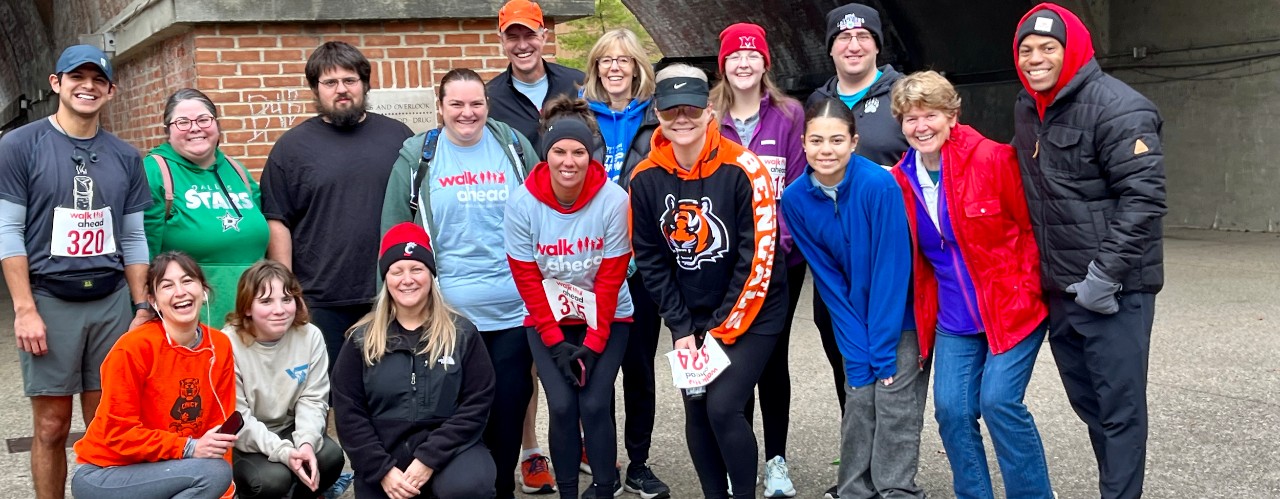
Featured image at top: The Shepherd Color Company team has walked and supported the annual 'Walk Ahead for Brain Tumor Discoveries' event since 2023. Photo/provided
This is how breakthroughs happen
Your generosity has illuminated what’s next: Student success beyond the classroom. Bearcats winning on the Big 12 stage. The gift of discovery for the health of our community. When you give to the University of Cincinnati and UC Health, you invest in the problem-solvers of tomorrow.
Related Stories
UC launches Bearcats Affordability Grant
January 7, 2026
The University of Cincinnati is making college more attainable for students across Ohio with the creation of the Bearcats Affordability Grant. The new grant will provide a pathway to tuition-free college for students of families who make less than $75,000 per year. Beginning in fall 2026, the Bearcats Affordability Grant will cover the remaining cost of tuition for Ohio residents who are Pell eligible.
Sugar overload killing hearts
November 10, 2025
Two in five people will be told they have diabetes during their lifetime. And people who have diabetes are twice as likely to develop heart disease. One of the deadliest dangers? Diabetic cardiomyopathy. But groundbreaking University of Cincinnati research hopes to stop and even reverse the damage before it’s too late.
App turns smartwatch into detector of structural heart disease
November 10, 2025

An app that uses an AI model to read a single-lead ECG from a smartwatch can detect structural heart disease, researchers reported at the 2025 Scientific Sessions of the American Heart Association. Although the technology requires further validation, researchers said it could help improve the identification of patients with heart failure, valvular conditions and left ventricular hypertrophy before they become symptomatic, which could improve the prognosis for people with these conditions.