UC researchers help create national registry for adaptive athletes
Spectrum News highlights new research initiative benefiting UC student athletes

Spectrum News spoke with members of UC's adaptive track and field team, coach Jacob Counts and researcher MeMe Earnest-Stanley about a new national collaboration co-led by UC that is spearheading research and wellness programming with the goal of improving care for adaptive athletes.
Researchers at UC, the University of Alabama at Birmingham and Spaulding Rehabilitation Hospital are working together to develop the Para-Athlete Research for Wellness, Injury Prevention and Sports Medicine Excellence (PARA-WISE) registry.
Adaptive track and field athletes Lydia Yax, Mikiahya Greene and Logan Cover told Spectrum News they each have had different journeys to the track, which also has come with different injuries.
“I’ve cut my arms quite a few times, and as I’ve built more muscle and practiced more, I’ve kind of pinched radial nerves. I can’t feel below a certain level, so I have to do skin assessments because it’s still possible to get an injury at a lower level and not know,” Greene said.
The PARA-WISE registry aims to build the infrastructure necessary to support a nationwide network of adaptive athlete injury information, ultimately developing the capacity to sustain and expand successful injury prevention programs tailored to these athletes.
“The great thing about it is it’s going to give us a lot of information just about recreational, competitive, elite athletes in the U.S.,” Earnest-Stanley said. “Getting the data that we’re going to get from this study is going to help us find the balance to help them really prevent injury and help them improve their quality of life and help them reach their peak level of performance."
Read or watch the Spectrum News story.
Read more about the PARA-WISE research.
Read more about UC Adaptive Athletics.
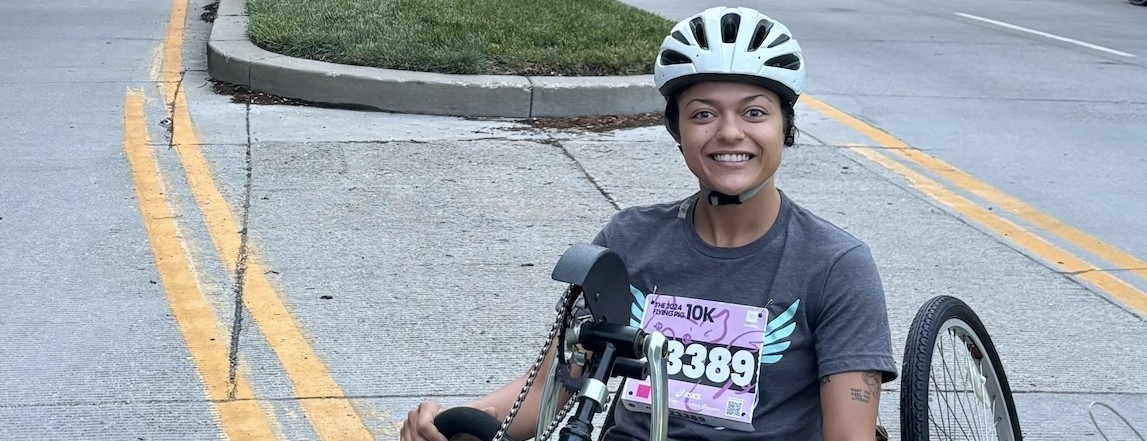
Featured photo at top of Mikiahya Greene at the Flying Pig Hand Cycle 10K provided.
Related Stories
Sugar overload killing hearts
November 10, 2025
Two in five people will be told they have diabetes during their lifetime. And people who have diabetes are twice as likely to develop heart disease. One of the deadliest dangers? Diabetic cardiomyopathy. But groundbreaking University of Cincinnati research hopes to stop and even reverse the damage before it’s too late.
Is going nuclear the solution to Ohio’s energy costs?
November 10, 2025

The Ohio Capital Journal recently reported that as energy prices continue to climb, economists are weighing the benefits of going nuclear to curb costs. The publication dove into a Scioto Analysis survey of 18 economists to weigh the pros and cons of nuclear energy. One economist featured was Iryna Topolyan, PhD, professor of economics at the Carl H. Lindner College of Business.
App turns smartwatch into detector of structural heart disease
November 10, 2025

An app that uses an AI model to read a single-lead ECG from a smartwatch can detect structural heart disease, researchers reported at the 2025 Scientific Sessions of the American Heart Association. Although the technology requires further validation, researchers said it could help improve the identification of patients with heart failure, valvular conditions and left ventricular hypertrophy before they become symptomatic, which could improve the prognosis for people with these conditions.