Making sense of the U.S. Supreme Court’s rulings during its final week in session
UC Law’s Anne Lofaso shares her analysis with WXVU

The U.S. Supreme Court gave President Donald Trump a wave of victories in the final week of its session. The high court sided with the president to limit universal injunctions issued by federal court.
WVXU spoke with Anne Lofaso, professor at the University of Cincinnati College of Law, about what the court’s decisions will mean for birthright citizenship, LGBTQ+ books in public schools and more a segment of Cincinnati Edition.
The Supreme Court in a June 27 ruling granted the administration’s request to partially stop nationwide injunction blocking an executive order ending birthright citizenship for certain people born in the United States.
Writing for the majority, Justice Amy Coney Barrett said “universal injunctions” issued by district judges “likely exceed the equitable authority that Congress has given to federal courts.”
“It didn’t rule on the merits, which means it did not talk about whether the President’s executive orders were actually constitutional,” Lofaso told WVXU. “It only ruled on whether or not an individual district court judge could actually issue a universal or what’s called a nationwide injunction. So the court said this is almost certainly not within the power of a district court and therefore it gave the president a limited victory.”
The Supreme Court also ruled that school systems are required to offer parents an ‘opt-out’ provision that allows their children to be excused from class if course material conflicts with religious beliefs. The case arose when a group of parents in Montgomery County, Maryland sued the school board seeking an opt out for elementary students when reading material included books on LGBTQ characters.
Lofaso, a former attorney for the National Labor Review Board, teaches constitutional law, employment law and labor law.
Listen to the WVXU segment on Supreme Court rulings online.
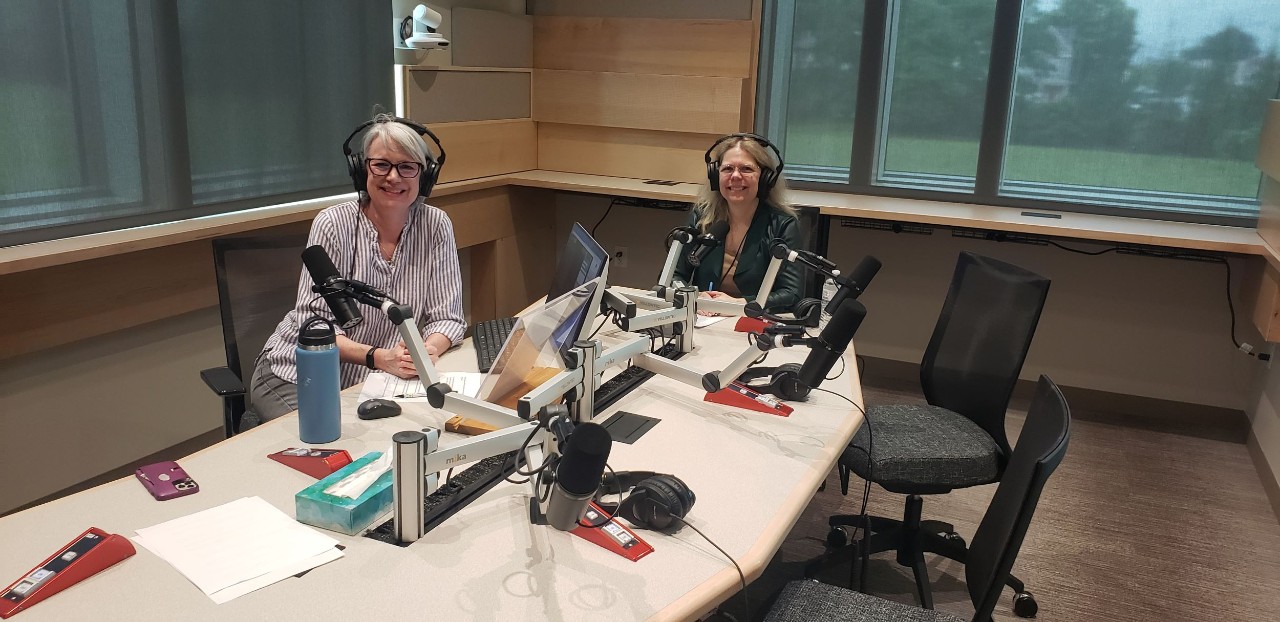
Featured top image of WVXU Journalist Lucy May and UC Law's Anne Lofaso in studio. Photo provided.
Related Stories
Sugar overload killing hearts
November 10, 2025
Two in five people will be told they have diabetes during their lifetime. And people who have diabetes are twice as likely to develop heart disease. One of the deadliest dangers? Diabetic cardiomyopathy. But groundbreaking University of Cincinnati research hopes to stop and even reverse the damage before it’s too late.
Is going nuclear the solution to Ohio’s energy costs?
November 10, 2025

The Ohio Capital Journal recently reported that as energy prices continue to climb, economists are weighing the benefits of going nuclear to curb costs. The publication dove into a Scioto Analysis survey of 18 economists to weigh the pros and cons of nuclear energy. One economist featured was Iryna Topolyan, PhD, professor of economics at the Carl H. Lindner College of Business.
App turns smartwatch into detector of structural heart disease
November 10, 2025

An app that uses an AI model to read a single-lead ECG from a smartwatch can detect structural heart disease, researchers reported at the 2025 Scientific Sessions of the American Heart Association. Although the technology requires further validation, researchers said it could help improve the identification of patients with heart failure, valvular conditions and left ventricular hypertrophy before they become symptomatic, which could improve the prognosis for people with these conditions.