A toothy debate
UC mosasaur expert discusses new species discovered in Morocco

The Globe and Mail turned to a University of Cincinnati expert on mosasaurs to explain how researchers study teeth for clues about prehistoric species new to science.
UC College of Arts and Sciences Associate Professor Takuya Konishi studies ancient marine reptiles called mosasaurs that ruled the oceans more than 66 million years ago.
The Canadian news outlet reached out to Konishi to discuss a scientific debate over the fossils of a mosasaur discovered in Morocco that some researchers say is a species never before documented. The specimen features bladelike teeth like a shark's that differ from the conical teeth often associated with other mosasaurs.
Konishi was not a member of the team that made the discovery but studies ancient marine reptiles in his UC biology lab.

UC Associate Professor Takuya Konishi studies mosasaurs in his biology lab. Photo/Joseph Fuqua II/UC
Now a group of scientists from Alberta is asking if the specimen uncovered by phosphate miners could have been altered like some fossils sold in Morocco's lucrative private fossil trade to make them more appealing to collectors.
Natural history has myriad examples of specimens new to science that were the subject of scientific controversy. Paleontology, in particular, has seen a dramatic evolution in our understanding of what these ancient animals looked like, what they ate and how they moved because there are no living comparisons. Researchers often must make inferences and calculations based on a scant fossil record.
Konishi told the Globe and Mail that he thinks experts who study ancient reptilian teeth could help shed light on the new discovery.
In the meantime, researchers told the news outlet they plan to conduct a CT scan on the specimen.
Konishi was part of a team of scientists who described a new species of Japanese mosasaur in 2023 that he and his colleagues called the Wakayama Soryu, which means blue dragon. Dragons are creatures of legend in Japanese folklore, Konishi said.
Read the Globe and Mail story.
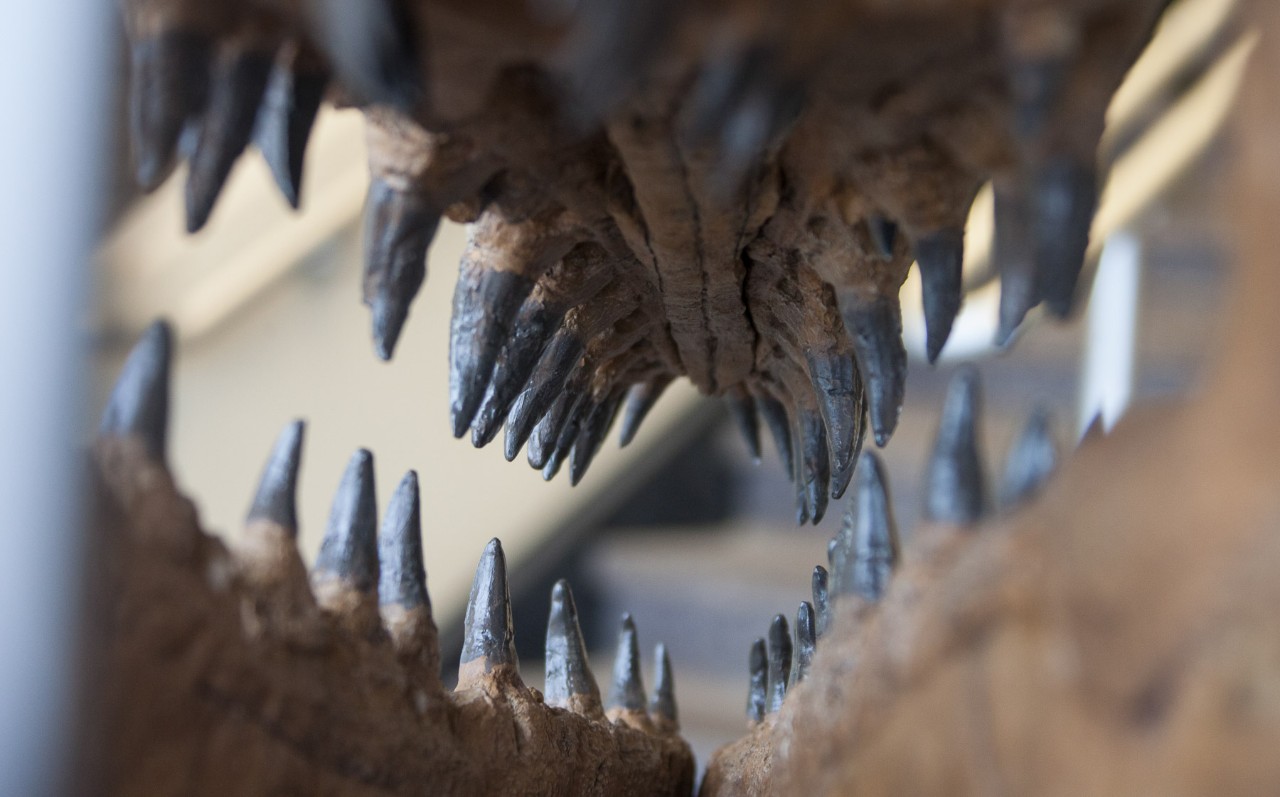
Featured image at top: A view from within the toothy jaws of a mosasaur reproduction in UC's Department of Biological Sciences. Photo/Ravenna Rutledge/UC Marketing + Brand

UC Associate Professor Takuya Konishi was lead author of a 2023 paper in the Journal of Systematic Paleontology describing a new species of Japanese mosasaur called the "blue dragon." Graphic/Provided
Related Stories
Sugar overload killing hearts
November 10, 2025
Two in five people will be told they have diabetes during their lifetime. And people who have diabetes are twice as likely to develop heart disease. One of the deadliest dangers? Diabetic cardiomyopathy. But groundbreaking University of Cincinnati research hopes to stop and even reverse the damage before it’s too late.
Is going nuclear the solution to Ohio’s energy costs?
November 10, 2025

The Ohio Capital Journal recently reported that as energy prices continue to climb, economists are weighing the benefits of going nuclear to curb costs. The publication dove into a Scioto Analysis survey of 18 economists to weigh the pros and cons of nuclear energy. One economist featured was Iryna Topolyan, PhD, professor of economics at the Carl H. Lindner College of Business.
App turns smartwatch into detector of structural heart disease
November 10, 2025

An app that uses an AI model to read a single-lead ECG from a smartwatch can detect structural heart disease, researchers reported at the 2025 Scientific Sessions of the American Heart Association. Although the technology requires further validation, researchers said it could help improve the identification of patients with heart failure, valvular conditions and left ventricular hypertrophy before they become symptomatic, which could improve the prognosis for people with these conditions.