Ohio could soon make breast cancer screenings more affordable
Cancer Center expert, legislator, patient advocate speak to media on proposed Ohio bill

The University of Cincinnati Cancer Center's Ann Brown was featured in Local 12 and Cincinnati Enquirer reports on a bill introduced by Rep. Jean Schmidt in the Ohio legislature that seeks to eliminate out of pocket medical expenses such as copays and deductibles associated with supplemental breast cancer screenings.
Schmidt, Brown and breast cancer survivor and advocate Michele Young were among the proponents that helped get House Bill 371 passed in 2022. That bill requires insurance companies to cover additional screenings for individuals who are at high risk for breast cancer or have dense breast tissue, but the new Breast Examination and Screening Transformation (BEST) Act goes further by eliminating out-of-pocket expenses for these screenings.
"No one should have to choose between paying their mortgage or finding out if they have cancer," said Brown, associate professor of radiology at the UC College of Medicine and a UC Health breast radiologist. "For those with dense breasts, we may be missing some early cancers that would otherwise be detected. So, supplemental screening is something that we wanted to educate women on and educate providers on with this legislation passing."
"When I was detected in 2015, it came to stage four by 2018, so what this bill is going to do is it's going to allow every woman in Ohio, no matter who they are, to have a chance to have the life-saving screening and not worry about the cost, and it will save us money," Young added.
Read or watch the Local 12 report.
Read the Cincinnati Enquirer article.
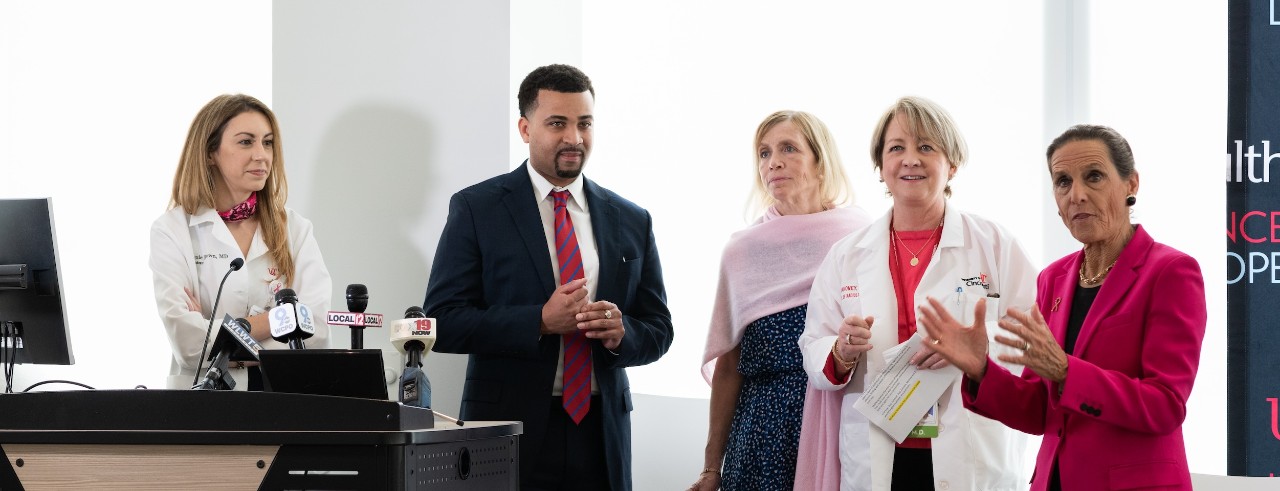
Featured photo at top of Ann Brown, MD, from left, Rep. Sedrick Denson, breast cancer survivor Michele Young, Mary Mahoney, MD, and Rep. Jean Schmidt at a 2022 press conference celebrating the passage of House Bill 371. Photo/UC Health.
Related Stories
Sugar overload killing hearts
November 10, 2025
Two in five people will be told they have diabetes during their lifetime. And people who have diabetes are twice as likely to develop heart disease. One of the deadliest dangers? Diabetic cardiomyopathy. But groundbreaking University of Cincinnati research hopes to stop and even reverse the damage before it’s too late.
Is going nuclear the solution to Ohio’s energy costs?
November 10, 2025

The Ohio Capital Journal recently reported that as energy prices continue to climb, economists are weighing the benefits of going nuclear to curb costs. The publication dove into a Scioto Analysis survey of 18 economists to weigh the pros and cons of nuclear energy. One economist featured was Iryna Topolyan, PhD, professor of economics at the Carl H. Lindner College of Business.
App turns smartwatch into detector of structural heart disease
November 10, 2025

An app that uses an AI model to read a single-lead ECG from a smartwatch can detect structural heart disease, researchers reported at the 2025 Scientific Sessions of the American Heart Association. Although the technology requires further validation, researchers said it could help improve the identification of patients with heart failure, valvular conditions and left ventricular hypertrophy before they become symptomatic, which could improve the prognosis for people with these conditions.