Cancer Center, Dana-Farber, more receive $1.2M from family foundation
Cincinnati Business Courier highlights pediatric brain tumor research

The Cincinnati Business Courier highlighted a $1.2 million grant received by the University of Cincinnati Cancer Center's Timothy Phoenix and colleagues at Dana-Farber Cancer Institute and the German Cancer Research Center to study pediatric low-grade gliomas.
Low-grade gliomas are one of the most common types of brain tumors and are associated with overall better survival outcomes, but these tumors and associated treatments still have a large impact on quality of life for kids, Phoenix said.
“There’s been progress the past decade, and just last year there were multiple new drugs approved by the FDA that show efficacy and promise,” said Phoenix, PhD, a Cancer Center researcher and associate professor in UC’s James L. Winkle College of Pharmacy. “But we still don’t have a curative therapy for low-grade gliomas.”
Using experience from developing models of pediatric high-grade gliomas, Phoenix and his colleagues will develop new models of pediatric low-grade gliomas to better understand their biology and growth patterns across brain development and maturation.
“There’s really no good model for this disease, so we’ll be using our system to try to understand how these tumor cells interact with the normal brain during development and how that influences the start-and-stop growth pattern that they see in the clinic,” he said. “If we can improve and understand why this occurs and why after a certain age the chance of growth diminishes, then hopefully we can develop therapies that target these interactions.”
Read the Cincinnati Business Courier article.
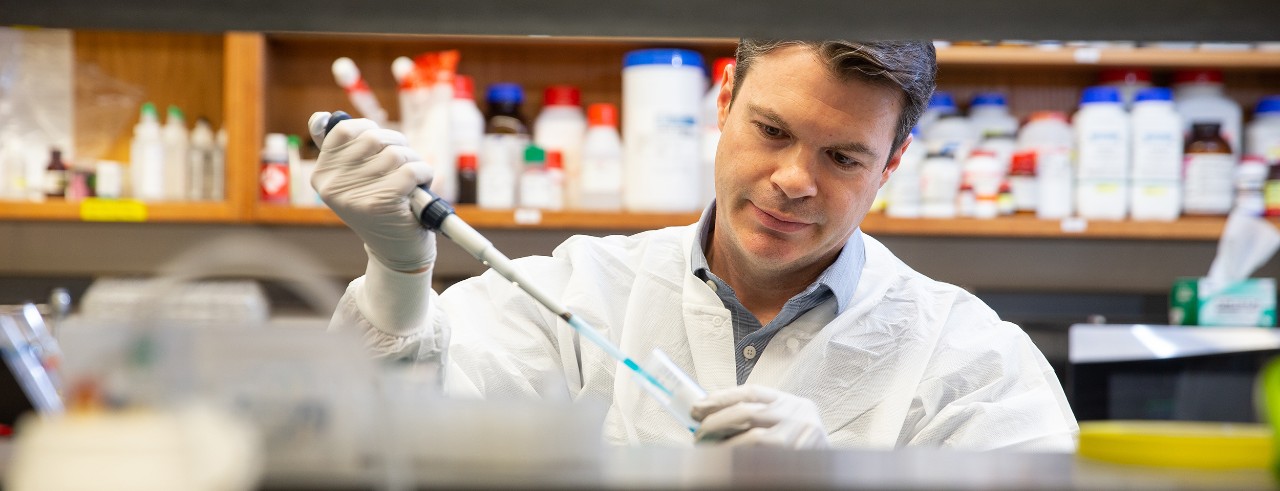
Featured photo at top of Phoenix working in his lab. Photo/Andrew Higley/UC Marketing + Brand.
Related Stories
UC launches Bearcats Affordability Grant
January 7, 2026
The University of Cincinnati is making college more attainable for students across Ohio with the creation of the Bearcats Affordability Grant. The new grant will provide a pathway to tuition-free college for students of families who make less than $75,000 per year. Beginning in fall 2026, the Bearcats Affordability Grant will cover the remaining cost of tuition for Ohio residents who are Pell eligible.
BearcatGPT AI platform now available to all UC faculty and staff
December 9, 2025
University of Cincinnati Digital Technology Solutions is excited to announce that BearcatGPT, the university’s private, secure AI platform, is now available to all UC faculty and staff.
Sugar overload killing hearts
November 10, 2025
Two in five people will be told they have diabetes during their lifetime. And people who have diabetes are twice as likely to develop heart disease. One of the deadliest dangers? Diabetic cardiomyopathy. But groundbreaking University of Cincinnati research hopes to stop and even reverse the damage before it’s too late.