Cancer Center researcher studies unique behavior of pediatric brain tumors
Team Jack Foundation funds $1.2 million multisite grant

The University of Cincinnati Cancer Center’s Timothy Phoenix is part of a multisite team researching the biology and behavior of a specific type of pediatric brain tumor.
Phoenix; Pratiti (Mimi) Bandopadhayay, MBBS, PhD, of Dana-Farber Cancer Institute; and David Jones, PhD, of the German Cancer Research Center have been awarded a $1.2 million grant from the Team Jack Foundation to study pediatric low-grade gliomas.
Low-grade gliomas are one of the most common types of brain tumors and are associated with overall better survival outcomes, but these tumors and associated treatments still have a large impact on quality of life for kids, Phoenix said.
“There’s been progress the past decade, and just last year there were multiple new drugs approved by the FDA that show efficacy and promise,” said Phoenix, PhD, a Cancer Center researcher and associate professor in UC’s James L. Winkle College of Pharmacy. “But we still don’t have a curative therapy for low-grade gliomas.”

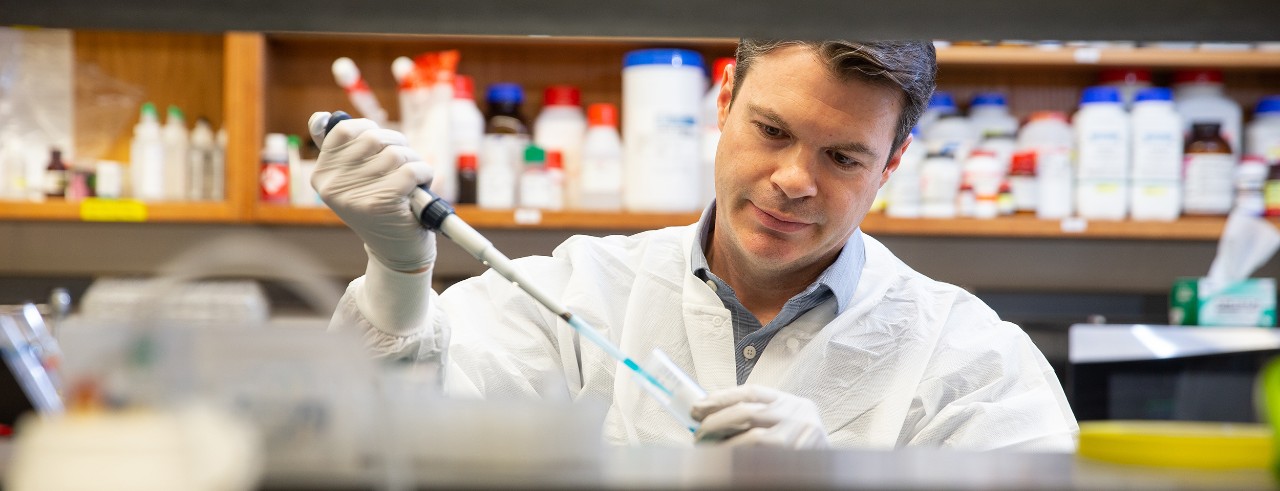
Phoenix's lab will develop new models to better understand how pediatric low-grade gliomas grow. Photo/Andrew Higley/UC Marketing + Brand.
Clinician researchers, including Bandopadhayay, have found that low-grade gliomas behave in a unique start-and-stop pattern over the course of a patient’s childhood.
“Patients can display symptoms and get diagnosed with a low-grade glioma, but it doesn’t always continuously grow,” Phoenix said. “Patients are closely monitored and may be stable for a while — years even — and then it could grow between checkups and then stop again.”
If medical teams are able to manage the start-and-stop pattern during childhood, Phoenix said the tumors are highly unlikely to continue growing after a patient reaches early adulthood. But it’s unknown why this pattern occurs during childhood and why the tumors rarely grow in adulthood.
Using experience from developing models of pediatric high-grade gliomas, Phoenix and his colleagues will develop new models of pediatric low-grade gliomas to better understand their biology and growth patterns across brain development and maturation.
“There’s really no good model for this disease, so we’ll be using our system to try to understand how these tumor cells interact with the normal brain during development and how that influences the start-and-stop growth pattern that they see in the clinic,” he said. “If we can improve and understand why this occurs and why after a certain age the chance of growth diminishes, then hopefully we can develop therapies that target these interactions.”
Phoenix said the knowledge gained in this research may also apply to adult low-grade gliomas, which are more likely to continue to grow and do not typically display the start-and-stop pattern.
The Team Jack Foundation’s mission is to raise money to fund impactful pediatric brain cancer research and work to create national awareness for the disease. Its namesake, the late Jack Hoffman, courageously battled brain cancer for 14 years, memorably scored a touchdown for the University of Nebraska at age 7, and became a catalyst for pediatric brain cancer fundraising and research.
“Any time we receive funding from a family and their foundation, it really means the world to us. We do our research for them. They’re the driving force and the motivation,” Phoenix said. “We have Jack’s picture hanging up in the lab, and he inspires us every day. It’s extremely inspirational to be able to do the work related to this project and try to advance our understanding of the underlying biology of low-grade gliomas.”
Stay connected with the Cancer Center
Interested in learning more about the University of Cincinnati Cancer Center? Keep up to date by signing up for communications and newsletters based on your specific interests. Sign up for Cancer Center communications.
Featured photo at top of Phoenix working in his lab. Photo/Andrew Higley/UC Marketing + Brand.
Related Stories
Sugar overload killing hearts
November 10, 2025
Two in five people will be told they have diabetes during their lifetime. And people who have diabetes are twice as likely to develop heart disease. One of the deadliest dangers? Diabetic cardiomyopathy. But groundbreaking University of Cincinnati research hopes to stop and even reverse the damage before it’s too late.
Is going nuclear the solution to Ohio’s energy costs?
November 10, 2025

The Ohio Capital Journal recently reported that as energy prices continue to climb, economists are weighing the benefits of going nuclear to curb costs. The publication dove into a Scioto Analysis survey of 18 economists to weigh the pros and cons of nuclear energy. One economist featured was Iryna Topolyan, PhD, professor of economics at the Carl H. Lindner College of Business.
App turns smartwatch into detector of structural heart disease
November 10, 2025

An app that uses an AI model to read a single-lead ECG from a smartwatch can detect structural heart disease, researchers reported at the 2025 Scientific Sessions of the American Heart Association. Although the technology requires further validation, researchers said it could help improve the identification of patients with heart failure, valvular conditions and left ventricular hypertrophy before they become symptomatic, which could improve the prognosis for people with these conditions.