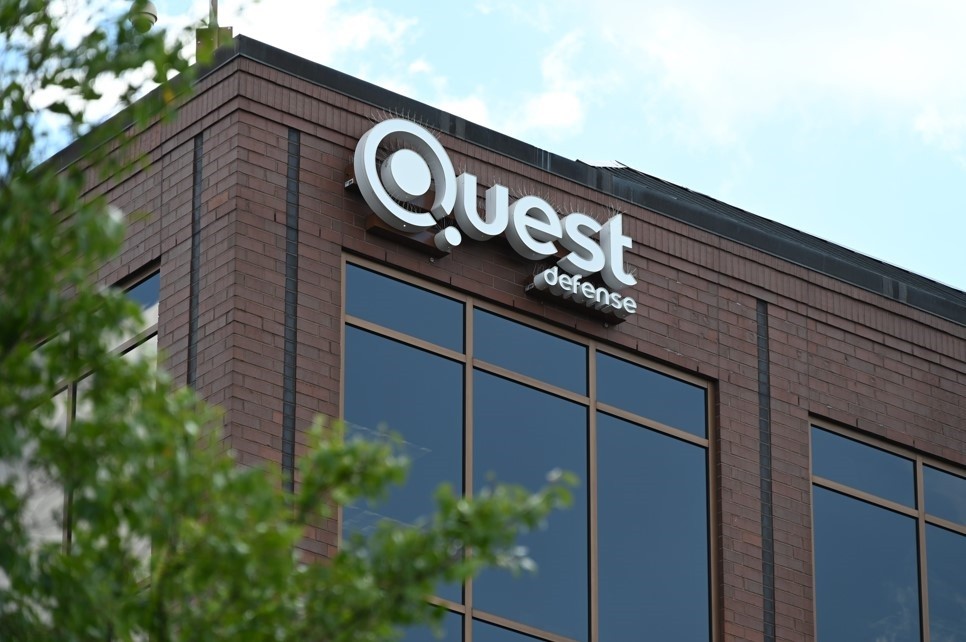
Quest Defense moves into UC’s 1819 Innovation Hub
Partnership enhances industry-academia collaboration

According to the Cincinnati Business Courier, the 1819 Innovation Hub at the University of Cincinnati has secured another tenant, Quest Defense Systems and Solutions.
A rapidly expanding local firm headquartered in Blue Ash, Quest Defense Systems and Solutions is at the forefront of land-defense engineering, delivering vital solutions for contemporary ground operations.
With more than 25 years of aerospace and defense engineering expertise, the company said it is committed to delivering high-quality, transformative solutions sets it apart — not just as an industry leader but as a driving force for impactful change.
A growing number of our faculty work on defense-related research, so this new partnership with Quest Defense holds immense promise for everyone involved.
Ryan Hays UC Executive Vice President and Chief Innovation and Strategy Officer

Quest Defense space with living wall logo. Photo/Quest Defense
The company plans to start occupying its space inside 1819 in April. The company said its move aligns with its strategy to foster innovation and expand its talent pipeline by collaborating with UC students through its co-op program.
UC invented the co-op model more than 100 years ago and is dedicated to advancing workforce development while also showcasing the increasing collaboration between corporations like Quest Defense and higher education. Beginning April 1, QDSS will have a group of team members occupy its 700-square-foot suite. The layout is intended to promote student engagement and collaboration.
Through the 1819 ecosystem, student experiences and learning in the field of innovation equip UC co-ops with the essential skills needed to succeed.
Quest Defense will be in good company as 1819 innovation partners include Western & Southern, Microsoft, Procter & Gamble, and several venture capital firms and startups.
Ryan Hays, UC’s executive vice president and chief innovation and strategy officer for UC, sees a strategic advantage to having Quest Defense at 1819.
“UC is home to the second-oldest aerospace engineering program in the country. A growing number of our faculty work on defense-related research, so this new partnership with Quest Defense holds immense promise for everyone involved,” he said.
The 1819 Innovation Hub is the nerve center of the Cincinnati Innovation District, the first innovation district built in Ohio. The district was launched in 2020 as a historic partnership between JobsOhio, the University of Cincinnati, and Cincinnati Children’s Hospital Medical Center. The district continues to accelerate the growth of talent, innovation, research, commercialization, and entrepreneurship across the region.
Read more from the: Cincinnati Business Courier
Cover photo: Quest Defense building logo. Photo/Quest Defense
Next Lives Here
Next Lives Here, the University of Cincinnati’s strategic direction, defines our moment and our momentum. More nimble and more robust than a plan, Next Lives Here announces our vision to the world — to lead urban public universities into a new era of innovation and impact.
Related Stories
Sugar overload killing hearts
November 10, 2025
Two in five people will be told they have diabetes during their lifetime. And people who have diabetes are twice as likely to develop heart disease. One of the deadliest dangers? Diabetic cardiomyopathy. But groundbreaking University of Cincinnati research hopes to stop and even reverse the damage before it’s too late.
Is going nuclear the solution to Ohio’s energy costs?
November 10, 2025

The Ohio Capital Journal recently reported that as energy prices continue to climb, economists are weighing the benefits of going nuclear to curb costs. The publication dove into a Scioto Analysis survey of 18 economists to weigh the pros and cons of nuclear energy. One economist featured was Iryna Topolyan, PhD, professor of economics at the Carl H. Lindner College of Business.
App turns smartwatch into detector of structural heart disease
November 10, 2025

An app that uses an AI model to read a single-lead ECG from a smartwatch can detect structural heart disease, researchers reported at the 2025 Scientific Sessions of the American Heart Association. Although the technology requires further validation, researchers said it could help improve the identification of patients with heart failure, valvular conditions and left ventricular hypertrophy before they become symptomatic, which could improve the prognosis for people with these conditions.