
DTS hosts successful conference on AI and emerging tech
DTS hosts successful conference on AI and emerging tech


UC Clermont College Learning Commons staff present “Burning the Midnight Oil: Using AI to Create Asynchronous Tutoring Solutions.” From left, Valentine Johns, Don Peteroy, Bethany Brown and Cheyenne Riley.
Hundreds of University of Cincinnati students, faculty and staff members turned out for the Digital Technology Solutions (DTS) AI & Emerging Technology Symposium Thursday in UC's Tangeman University Center.
“The DTS AI & Emerging Technology Symposium brought the UC community together to explore the applications and implications of artificial intelligence and emerging technologies in modern society,” said UC Vice President and Chief Digital Officer Bharath Prabhakaran.
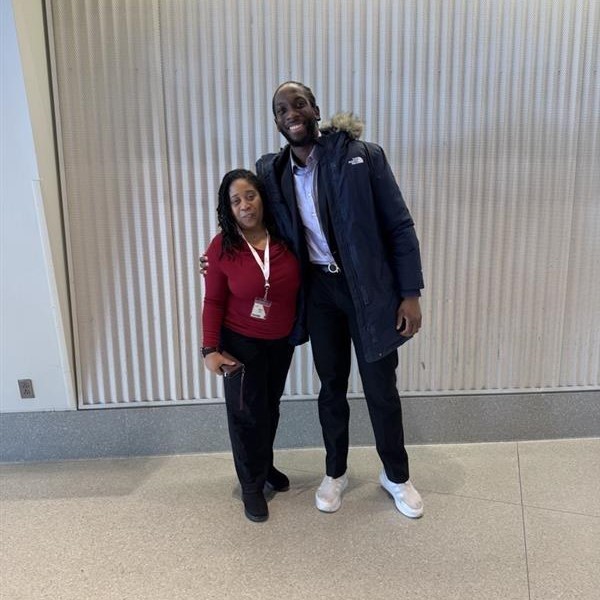
From left Josette Riep, assistant vice president, UC Digital Technology Solutions, with graduate student presenter EJ Agoba.
“All the feedback has been overwhelmingly positive, making the symposium a huge step in advancing digital awareness and literacy across the university,” Prabhakaran continued.
The daylong event explored topics around AI and robotic process automation; smart campus innovation; and extended reality, virtual reality, and augmented reality.
Twenty-nine speakers from 16 different colleges and units presented during the symposium's breakout sessions.

UC alum Nick Ernest, chief architect, Thales, Inc., presents the morning keynote address at the symposium.

From left Josette Riep, assistant vice president UC Digital Technology Solutions; Nick Ernest, chief architect, Thales, Inc.; Bharath Prabhakaran, UC vice president and chief digital officer; Yannick Assoud, executive vice-president, avionics, and Thales executive committee member, Thales, Inc. and Kelly Cohen, Brian H. Rowe Endowed Chair in aerospace engineering, UC College of Engineering and Applied Science.
The event also featured two keynote presentations from industry experts.
UC alum Nick Ernest, PhD, and his Thales Avionics, Inc., colleague Executive Vice-President, Avionics & Thales Executive Committee Member Yannick Assoud delivered the morning keynote address.
Ernest, chief architect at Thales, created sophisticated artificial intelligence capable of outmaneuvering fighter pilots in simulations using fuzzy logic. As part of a 2023 memorandum of understanding with UC’s Office of Research, Thales shares its state-of-the-art transparent artificial intelligence system, which uses fuzzy logic, with UC students and faculty. UC aerospace engineering professor Kelly Cohen introduced Ernest, his former student, at the symposium.

From left, Bharath Prabhakaran, UC vice president and chief digital officer with afternoon keynote presenter Pete Blackshaw, founder and CEO, BrandRank.AI.
Pete Blackshaw, founder and CEO of BrandRank.AI, delivered the afternoon keynote address.
BrandRank.AI, a Cincinnati-based startup and SaaS platform and service, helps brands measure, protect, and grow trust through the power of AI-driven search and discovery.
For more information about AI initiatives and how we’re working to support AI-driven innovation across UC, visit uc.edu/ai.
Related Stories
UC launches Bearcats Affordability Grant
January 7, 2026
The University of Cincinnati is making college more attainable for students across Ohio with the creation of the Bearcats Affordability Grant. The new grant will provide a pathway to tuition-free college for students of families who make less than $75,000 per year. Beginning in fall 2026, the Bearcats Affordability Grant will cover the remaining cost of tuition for Ohio residents who are Pell eligible.
BearcatGPT AI platform now available to all UC faculty and staff
December 9, 2025
University of Cincinnati Digital Technology Solutions is excited to announce that BearcatGPT, the university’s private, secure AI platform, is now available to all UC faculty and staff.
Sugar overload killing hearts
November 10, 2025
Two in five people will be told they have diabetes during their lifetime. And people who have diabetes are twice as likely to develop heart disease. One of the deadliest dangers? Diabetic cardiomyopathy. But groundbreaking University of Cincinnati research hopes to stop and even reverse the damage before it’s too late.