UC faculty member works to buck ‘voluntourism’ trend in global health
College of Medicine researcher to present her work at international oral health conference in India

A University of Cincinnati College of Medicine faculty member is working to buck a trend by creating sustainable funding models for global oral health initiatives.
Priyanka Gudsoorkar hopes to help organizations consciously move away from what is referred to as “parachuting” and “voluntourism” trends and to instead create impactful global cooperation with sustained funding that also utilizes knowledge exchanges, skill transfers and meaningful volunteering.
Gudsoorkar, an assistant professor-educator in the Department of Environmental and Public Health Sciences and director of the global health concentration in the bachelor of science in public health program, has traveled to Ghana, Tanzania and Ecuador to scale up international partnerships.
“The success of global oral health initiatives hinges on fostering transborder collaborations that integrate community-driven approaches with evidence-based strategies,” said Gudsoorkar. “These case studies showcase how effective global partnerships can lead to sustainable solutions in oral health.”

Priyanka Gudsoorkar and others from her University of Cincinnati master's in public health program traveled to Ecuador, where they used adaptive mobile dental units to treat people living there. Photo/provided.
Gudsoorkar will present case studies from her research as an international delegate and keynote speaker at the Global Conclave on Oral Health Innovation and Research, Feb. 15 and 16, in New Delhi, India. The Indian Dental Association is hosting the conference, and 21 universities will take part, including UC, Tufts University, Queen Mary University of London, the University of Queensland and the University of Hong Kong.
Gudsoorkar visited Ecuador while earning her master’s degree in public health at UC. When she and others in her group traveled to the Andean foothills to improve the oral health-related quality of life in underserved populations, they met native tribal communities and collaborated with local breweries, flower farms and exporters.
They also partnered with the Inter-American Development Bank, social enterprise Novulis and the nonprofit Solidarity Dental Foundation and deployed adaptive mobile dental units through combined public, private and philanthropic funding.
For her master’s degree thesis, Gudsoorkar traveled to Tanzania, where she and other UC students worked to integrate traditional practices with innovative interventions to address women’s health, dental health, oral cancer screening and noma, a severe, often fatal disease that affects the mouth and face.
Impact isn’t just measured in miles traveled but in smiles and lives changed.
Priyanka Gudsoorkar UC College of Medicine
“We quickly learned nobody knows who a dentist is. They were using sticks as toothbrushes, so we were educating right away,” said Gudsoorkar of her African experience.
They partnered with local leaders, traditional healers and the Shirati Health, Education and Development Foundation in Tanzania. They also worked with the University of Cincinnati Blue Ash’s dental hygiene technology program and the nonprofit Village Life Outreach Project.

Priyanka Gudsoorkar and others from the University of Cincinnati traveled to Tanzania and integrated traditional practices with innovative interventions to offer oral health exams to people there. Photo/provided.
Gudsoorkar said two UC grants supported the efforts in Tanzania, including funding the purchase of portable dental chairs. The project, which involves medical students and master’s of public health students, is now in its fourth year.
Most recently, Gudsoorkar went to Ghana as part of a group working with local community health workers. They partnered with Global Brigades, an international nonprofit that implements a holistic model to meet a community’s health goals, as well as the University of Cape Coast, a UC strategic partner.
The research initiative, which is ongoing thanks to an inventive fundraising model, addresses gaps in dental care accessibility, menstrual hygiene awareness and HIV prevention.
Now, she has an opportunity to present case studies from her research in Ghana, Tanzania and Ecuador to highlight models of these international partnerships.
“Impact isn’t just measured in miles traveled but in smiles and lives changed,” said Gudsoorkar. “By bridging tradition and innovation, we’re not just providing care — we’re reshaping global health.”
Impact Lives Here
The University of Cincinnati is leading public urban universities into a new era of innovation and impact. Our faculty, staff and students are saving lives, changing outcomes and bending the future in our city's direction. Next Lives Here.
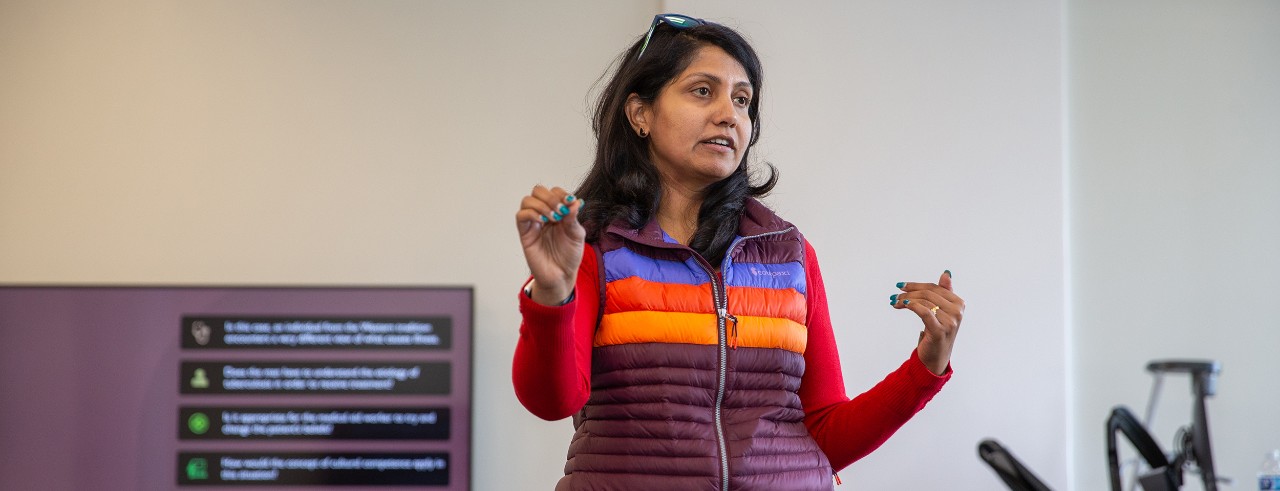
Featured image at top: Priyanka Gudsoorkar teaches an undergraduate public health course, Global Health Dynamics. Photo/Andrew Higley/UC Marketing + Brand.
Related Stories
Sugar overload killing hearts
November 10, 2025
Two in five people will be told they have diabetes during their lifetime. And people who have diabetes are twice as likely to develop heart disease. One of the deadliest dangers? Diabetic cardiomyopathy. But groundbreaking University of Cincinnati research hopes to stop and even reverse the damage before it’s too late.
Is going nuclear the solution to Ohio’s energy costs?
November 10, 2025

The Ohio Capital Journal recently reported that as energy prices continue to climb, economists are weighing the benefits of going nuclear to curb costs. The publication dove into a Scioto Analysis survey of 18 economists to weigh the pros and cons of nuclear energy. One economist featured was Iryna Topolyan, PhD, professor of economics at the Carl H. Lindner College of Business.
App turns smartwatch into detector of structural heart disease
November 10, 2025

An app that uses an AI model to read a single-lead ECG from a smartwatch can detect structural heart disease, researchers reported at the 2025 Scientific Sessions of the American Heart Association. Although the technology requires further validation, researchers said it could help improve the identification of patients with heart failure, valvular conditions and left ventricular hypertrophy before they become symptomatic, which could improve the prognosis for people with these conditions.