Why is anxiety worse at night?
UC expert featured in TIME article

The University of Cincinnati's Jeffrey Strawn was featured in a TIME article discussing why anxiety can often be worse at night and tips to address nighttime anxiety.
Strawn said during the day, people are likely preoccupied with work, errands, chores and other obligations, but at night the brain has fewer distractions. Especially once you get into bed, this can create a “perfect setup for that runaway anxiety, that ruminative thinking about ‘what if’ and ‘what about,’ and then also replaying the prior day,” he said.
Getting into a good sleep routine and a good night's rest can help ease anxiety.
“Sleep is medicine,” said Strawn, MD, professor in the Department of Psychiatry and Behavioral Neuroscience in UC’s College of Medicine and a UC Health child and adolescent psychiatrist.
If you're spiraling into anxiety while in bed and unable to fall asleep, Strawn said it's important to get out of the bed. He recommends doing something that isn't cognitively stimulating, like reading your dishwasher's manual, to avoid subconsciously associating your bed with worry and wakefulness.
“If folks aren’t able to fall asleep in about 15 minutes, I want them to get out of bed,” he said.
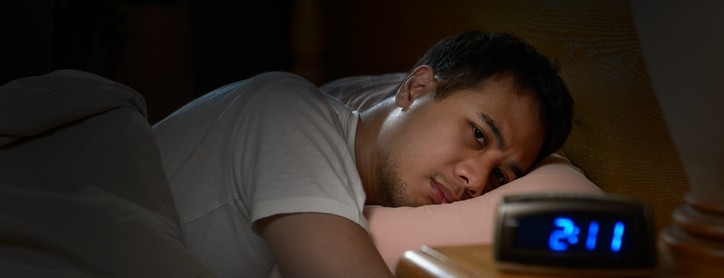
Featured photo at top of a person awake in the middle of the night. Photo/amenic181/iStock Photo.
Related Stories
Sugar overload killing hearts
November 10, 2025
Two in five people will be told they have diabetes during their lifetime. And people who have diabetes are twice as likely to develop heart disease. One of the deadliest dangers? Diabetic cardiomyopathy. But groundbreaking University of Cincinnati research hopes to stop and even reverse the damage before it’s too late.
Is going nuclear the solution to Ohio’s energy costs?
November 10, 2025

The Ohio Capital Journal recently reported that as energy prices continue to climb, economists are weighing the benefits of going nuclear to curb costs. The publication dove into a Scioto Analysis survey of 18 economists to weigh the pros and cons of nuclear energy. One economist featured was Iryna Topolyan, PhD, professor of economics at the Carl H. Lindner College of Business.
App turns smartwatch into detector of structural heart disease
November 10, 2025

An app that uses an AI model to read a single-lead ECG from a smartwatch can detect structural heart disease, researchers reported at the 2025 Scientific Sessions of the American Heart Association. Although the technology requires further validation, researchers said it could help improve the identification of patients with heart failure, valvular conditions and left ventricular hypertrophy before they become symptomatic, which could improve the prognosis for people with these conditions.