Upstream river flooding becoming more common
WVXU highlights UC study examining world's rivers

WVXU spoke to a University of Cincinnati professor about her study in the journal Nature examining changing water flow in rivers around the world.
UC College of Engineering and Applied Science Assistant Professor Dongmei Feng and study co-author Colin Gleason, a professor at the University of Massachusetts Amherst, examined changing water flow in rivers over the past 35 years.
In her Terrestrial Hydrology Lab, Feng and her students use the latest technology to study how climate change is affecting waterways around the world.
They found increasing flooding in upstream sections of rivers. These are particularly dangerous because typically there are fewer flood-mitigation measures in place in upstream sections of rivers, she said.
“Those human settlements are typically less protected compared to the downstream segments,” Feng told WVXU.
Meanwhile, Feng and Gleason found decreasing water flow in downstream sections where more people and human development depends on water from rivers. Low water levels can lead to a myriad of problems from more Cyanobacteria to clogged intakes in hydroelectric dams.
“I would say it's kind of concerning,” Feng said. “If you look at the global map of population distribution, you will see downstream are the most surrounded by human settlements — a lot more than upstream. So that means a lot more population relies on the downstream rivers for water resources and maybe energy supply, hydropower supply and other purposes.”
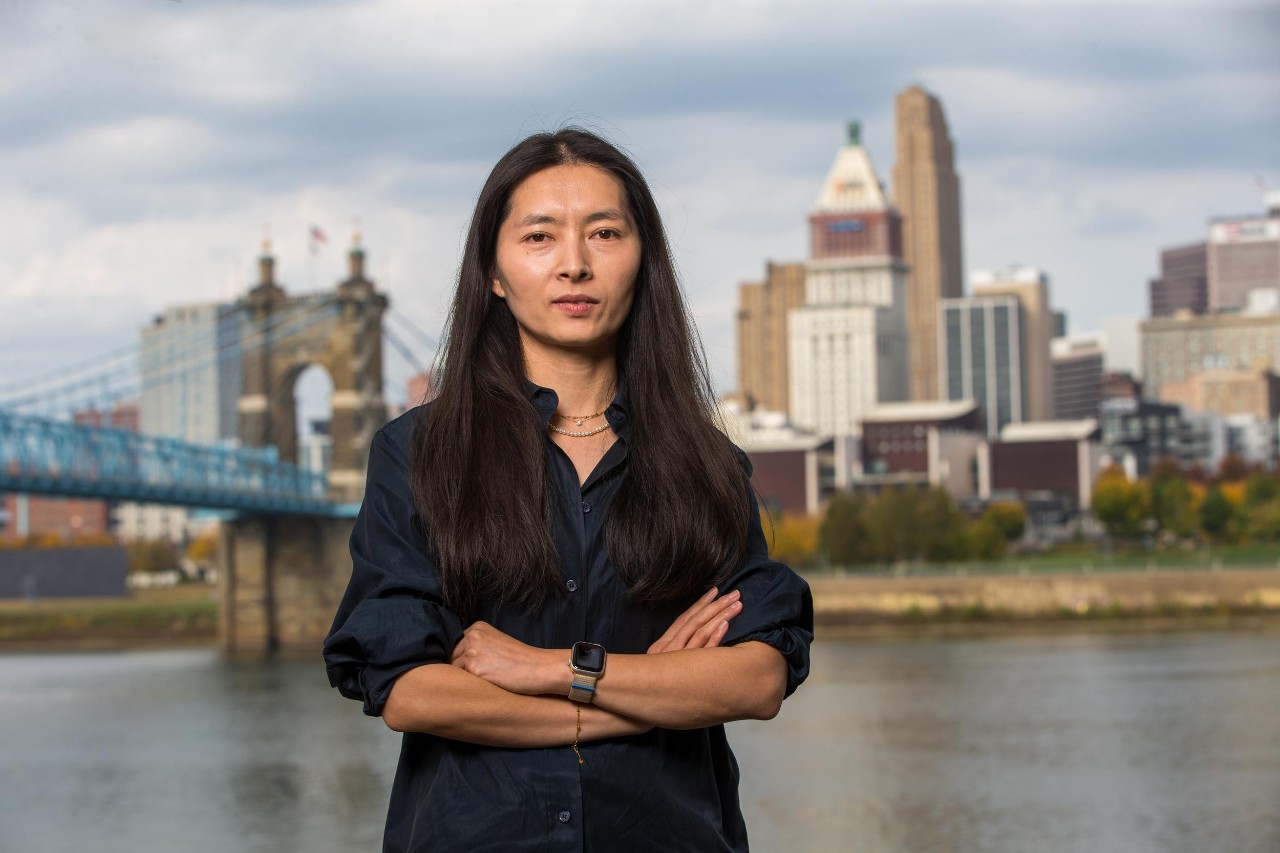
Featured image at top: UC College of Engineering and Applied Science Assistant Professor Dongmei Feng, standing on the banks of the Ohio River, examined water flow in the world's rivers over the last 35 years. Photo/Andrew Higley/UC Marketing + Brand
Related Stories
Sugar overload killing hearts
November 10, 2025
Two in five people will be told they have diabetes during their lifetime. And people who have diabetes are twice as likely to develop heart disease. One of the deadliest dangers? Diabetic cardiomyopathy. But groundbreaking University of Cincinnati research hopes to stop and even reverse the damage before it’s too late.
Is going nuclear the solution to Ohio’s energy costs?
November 10, 2025

The Ohio Capital Journal recently reported that as energy prices continue to climb, economists are weighing the benefits of going nuclear to curb costs. The publication dove into a Scioto Analysis survey of 18 economists to weigh the pros and cons of nuclear energy. One economist featured was Iryna Topolyan, PhD, professor of economics at the Carl H. Lindner College of Business.
App turns smartwatch into detector of structural heart disease
November 10, 2025

An app that uses an AI model to read a single-lead ECG from a smartwatch can detect structural heart disease, researchers reported at the 2025 Scientific Sessions of the American Heart Association. Although the technology requires further validation, researchers said it could help improve the identification of patients with heart failure, valvular conditions and left ventricular hypertrophy before they become symptomatic, which could improve the prognosis for people with these conditions.