Icelandic volcano previously dormant for 800 years erupting again
UC geologist tells ABC News the eruption created a slow-moving lava flow

ABC News talked to a University of Cincinnati geosciences professor about the seventh eruption of an Icelandic volcano that prompted new evacuations and closures in a coastal hamlet.
Residents in Grindavik evacuated the town again Wednesday after a nearly two-mile-long fissure opened up, spewing lava. The lava threatened a world famous site called the Blue Lagoon.
UC College of Arts and Sciences Professor Thomas Algeo told ABC News that the eruption comes from a rift activity volcano in which deep fissures are pulled apart through the Mid-Atlantic Ridge. This differs from conical volcanoes that can have explosive eruptions.
Algeo said the eruption is far less dangerous than other types because it creates slower-moving basaltic flows of lava.
"It's a style of volcanic activity that is effusive, slow flowing, not violently eruptive, like would be the case with a subduction zone volcanic system" Algeo told ABC News.
The eruption is the seventh there in the past year after sitting dormant for more than 800 years.
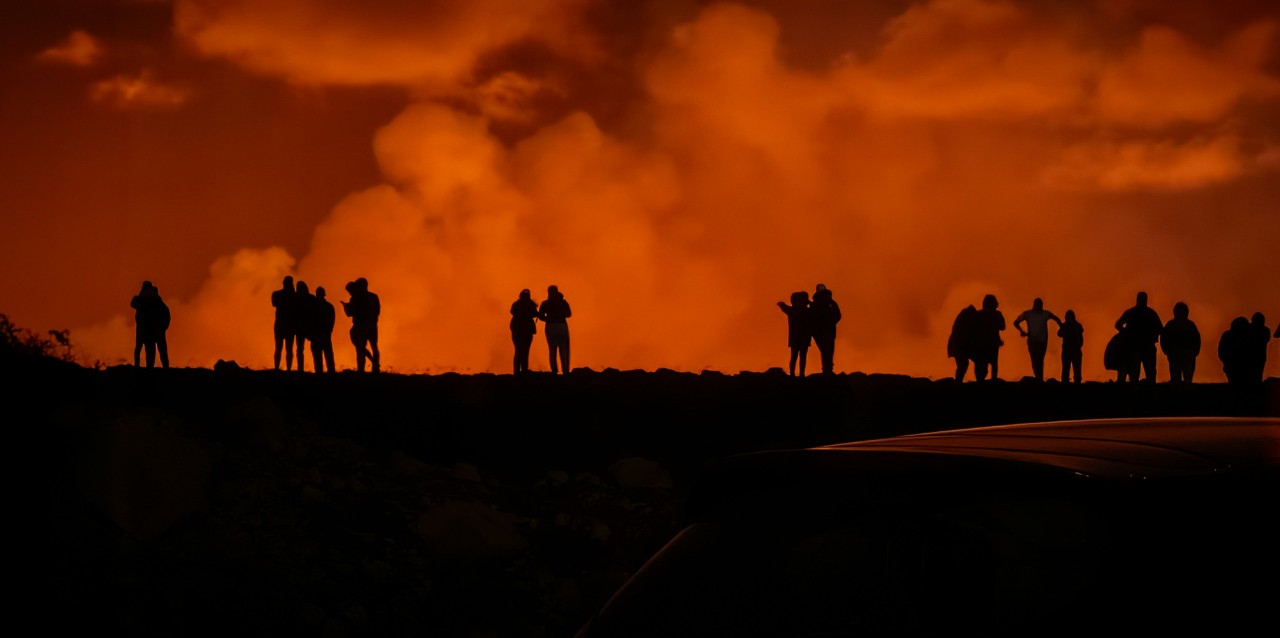
Featured image at top: Visitors admire a volcanic eruption outside Grindavik, Iceland, in August. Officials say the volcano erupted for the seventh time this week. Photo/Maria Semenaka

UC Professor of Geosciences Thomas Algeo stands in front of rock cores. He studies some of Earth's biggest natural calamities. Photo/Andrew Higley/UC Marketing + Brand
Related Stories
Sugar overload killing hearts
November 10, 2025
Two in five people will be told they have diabetes during their lifetime. And people who have diabetes are twice as likely to develop heart disease. One of the deadliest dangers? Diabetic cardiomyopathy. But groundbreaking University of Cincinnati research hopes to stop and even reverse the damage before it’s too late.
Is going nuclear the solution to Ohio’s energy costs?
November 10, 2025

The Ohio Capital Journal recently reported that as energy prices continue to climb, economists are weighing the benefits of going nuclear to curb costs. The publication dove into a Scioto Analysis survey of 18 economists to weigh the pros and cons of nuclear energy. One economist featured was Iryna Topolyan, PhD, professor of economics at the Carl H. Lindner College of Business.
App turns smartwatch into detector of structural heart disease
November 10, 2025

An app that uses an AI model to read a single-lead ECG from a smartwatch can detect structural heart disease, researchers reported at the 2025 Scientific Sessions of the American Heart Association. Although the technology requires further validation, researchers said it could help improve the identification of patients with heart failure, valvular conditions and left ventricular hypertrophy before they become symptomatic, which could improve the prognosis for people with these conditions.