UC Cancer Center uses AI to enhance early lung cancer detection
UC expert featured in Local 12 report

Local 12 highlighted how artificial intelligence technology (AI) is helping University of Cincinnati Cancer Center experts improve early detection of lung cancer, potentially saving lives by identifying suspicious findings sooner.
"It's like looking for a different star in a night sky full of stars," said Sangita Kapur, MD, adjunct associate professor and section chief of cardiopulmonary radiology in the Department of Radiology in UC's College of Medicine and a UC Health radiologist.
The AI software "cleans up" CT scan images, making it easier to identify potential lung nodules that could be cancerous.
"So what remains? Just the funny looking stars," Kapur explained.
The AI system not only speeds up the results but also increases the likelihood of detecting early signs of cancer in at-risk individuals.
Read or watch the Local 12 report.
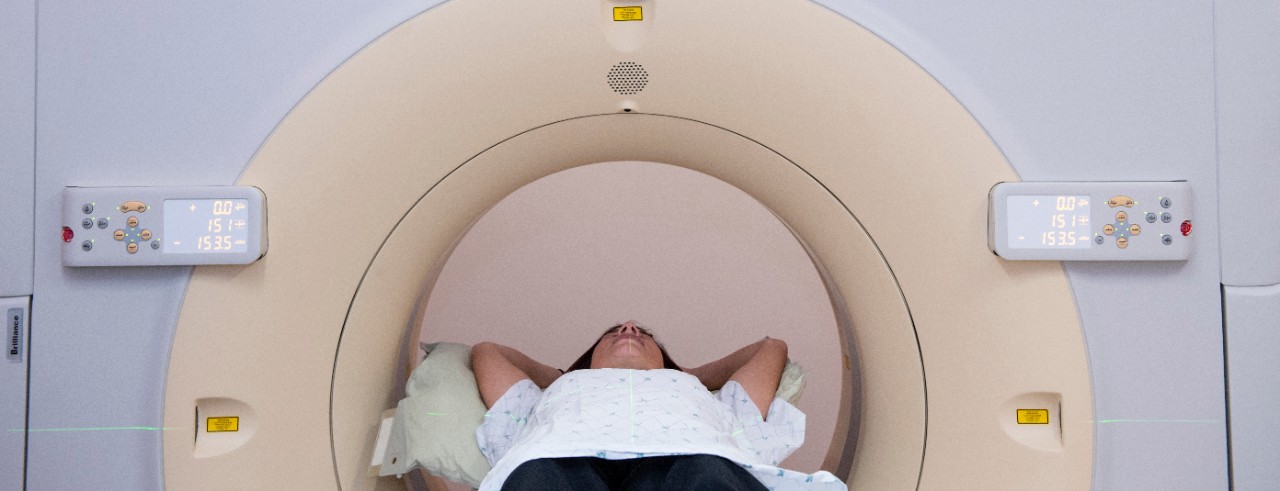
Featured photo of a person in a CT machine. Photo/Colleen Kelley/UC Marketing + Brand.
Screening can save lives
The United States Preventive Services Task Force recommends annual screening for lung cancer with low-dose computed tomography (LDCT) in adults aged 50-80 who have a 20 pack year smoking history and currently smoke or have quit within the past 15 years.
A pack year is calculated by multiplying the number of packs of cigarettes smoked per day by the number of years they have smoked, with one pack year equivalent to smoking one pack of cigarettes per day for one year or two packs per day for six months. A 20 pack year history would mean smoking one pack a day for 20 years.
Interested in learning more about the University of Cincinnati Cancer Center? Keep up to date by signing up for communications and newsletters based on your specific interests. Sign up for Cancer Center communications.
Related Stories
Sugar overload killing hearts
November 10, 2025
Two in five people will be told they have diabetes during their lifetime. And people who have diabetes are twice as likely to develop heart disease. One of the deadliest dangers? Diabetic cardiomyopathy. But groundbreaking University of Cincinnati research hopes to stop and even reverse the damage before it’s too late.
Is going nuclear the solution to Ohio’s energy costs?
November 10, 2025

The Ohio Capital Journal recently reported that as energy prices continue to climb, economists are weighing the benefits of going nuclear to curb costs. The publication dove into a Scioto Analysis survey of 18 economists to weigh the pros and cons of nuclear energy. One economist featured was Iryna Topolyan, PhD, professor of economics at the Carl H. Lindner College of Business.
App turns smartwatch into detector of structural heart disease
November 10, 2025

An app that uses an AI model to read a single-lead ECG from a smartwatch can detect structural heart disease, researchers reported at the 2025 Scientific Sessions of the American Heart Association. Although the technology requires further validation, researchers said it could help improve the identification of patients with heart failure, valvular conditions and left ventricular hypertrophy before they become symptomatic, which could improve the prognosis for people with these conditions.