UC celebrates first-generation college students throughout November
WLWT speaks with UC students and administrators about first-gen efforts

Her parents were both born in Guatemala and neither had any formal education. But Gabriella Mendez is now the first in her family to go to college and has made the University of Cincinnati home.
"It's OK to be afraid," Mendez said. "You're going to be the one to kind of put the blueprint (on education for your family).”
The third year finance and marketing major found community in UC’s 1MPACT House and the Gen-1 program, which together offer support to about 200 students. The 1MPACT House provides a focused residential community for first-gen students. The Gen-1 program offers scholarships, has a service-learning component, and was the nation’s first living-learning community supporting Pell-eligible, first-generation students in their transition to college life.
Mendez and Courtney Ware, a second-year criminal justice major, spoke with WLWT about UC’s efforts to assist first-gen students.
“I would definitely say persevere and advocate for yourself,” explains Ware, also a first-gen student.
Individuals who are the first in their family to attend college, or first-generation students, now account for 10,198 students at the University of Cincinnati. That’s an increase of more than 10% accounting for nearly 1 in every 5 Bearcats.

Courtney Ware and Gabriella Mendez shown on WLWT segment. Photo provided.
“You are the first in your family to really set a new course,” explains Jack Miner, vice provost for enrollment management. “It’s really incredible because you end up becoming a role model for others in your family and others in your neighborhood.”
Suzette Combs, director of the Gen-1/1MPACT House, says UC is continuing its efforts that specifically target first-generation students.
“If given the proper tools and support our first-gen students do succeed,” says Combs.
The six-year graduation rate for UC undergraduate students overall is 75% while that of students participating in the 1MPACT House is 78%. For first-generation students overall at UC that six-year undergraduate grad rate is about 64%.
UC is waiving the application admissions fee for an undergraduate program throughout the month of November in hopes of encouraging more first-generation college students to consider becoming a Bearcat.
Listen to a segment on WLWT featuring first-gen students at UC online.
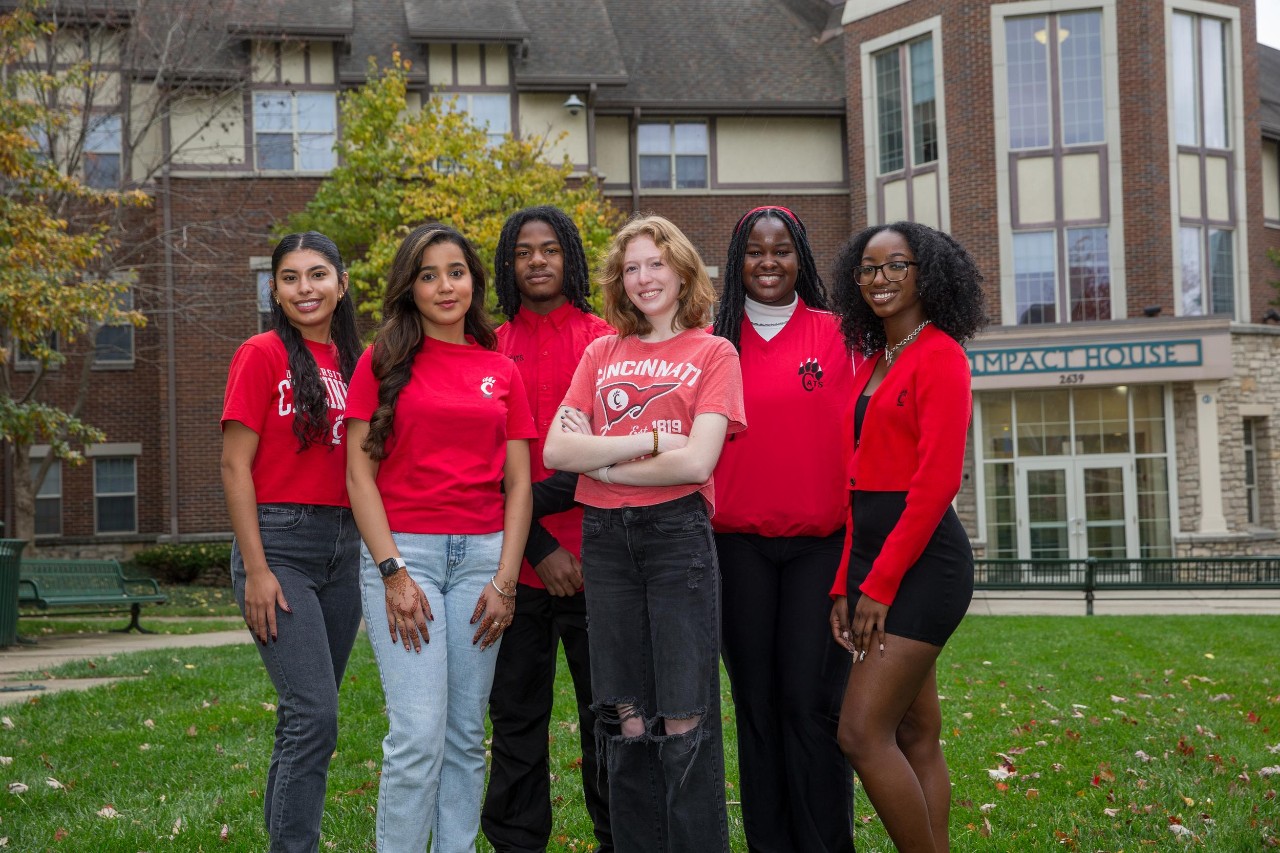
UC students Sofia Rodriguez, Kangan Bawa, Brandon Mapp Jr., Isabel Lewis, Danielle Hall and Ramatoulaye Diallo are shown in front of the 1MPACT House. on the UC campus. Photo by Andrew Higley/UC Marketing + Brand.
Related Stories
Sugar overload killing hearts
November 10, 2025
Two in five people will be told they have diabetes during their lifetime. And people who have diabetes are twice as likely to develop heart disease. One of the deadliest dangers? Diabetic cardiomyopathy. But groundbreaking University of Cincinnati research hopes to stop and even reverse the damage before it’s too late.
Is going nuclear the solution to Ohio’s energy costs?
November 10, 2025

The Ohio Capital Journal recently reported that as energy prices continue to climb, economists are weighing the benefits of going nuclear to curb costs. The publication dove into a Scioto Analysis survey of 18 economists to weigh the pros and cons of nuclear energy. One economist featured was Iryna Topolyan, PhD, professor of economics at the Carl H. Lindner College of Business.
App turns smartwatch into detector of structural heart disease
November 10, 2025

An app that uses an AI model to read a single-lead ECG from a smartwatch can detect structural heart disease, researchers reported at the 2025 Scientific Sessions of the American Heart Association. Although the technology requires further validation, researchers said it could help improve the identification of patients with heart failure, valvular conditions and left ventricular hypertrophy before they become symptomatic, which could improve the prognosis for people with these conditions.