International students: How to show financial ability
UC’s Ron Cushing speaks with U.S. News and World Report

International students accepted to an American college must then demonstrate financial ability to pay for tuition, books and living expenses while in the United States, according to a story in the U.S. News & World Report.
“There are numerous ways international students can demonstrate financial ability,” explained Ron Cushing, director of UC International Services for the U.S. News & World Report story. “Students must show that they have the first year of support available and indicate how subsequent years of study will be funded.”
U.S. News & World report reports that accepted students at American colleges will work with their designated school official, or DSO, who serves as a liaison between the school and the Student and Exchange Visitor Program. SEVP is a U.S. government program that ensures U.S. schools and international students comply with laws and regulations.
DSOs "are required to receive, review and evaluate proof of financial responsibility for an international student prior to issuing the student a Form I-20," Paige Hughes, a spokeswoman for Homeland Security Investigations, wrote in an email.
A Form I-20 certifies that an international student has been admitted for full-time study once proof of financial ability is established. Hughes says prospective students must provide evidence that meets their school's specific requirements.
After a school issues an I-20, students are eligible to apply for a student visa at a U.S. embassy or consulate. A U.S. government official will review the documents, including the evidence of financial ability, and make the final decision about whether a student can pay, and if so will issue a student visa to study in the U.S.
UC enrolled 4,616 international students for Fall 2024 with nearly half coming from India and substantial numbers also coming from China, Vietnam, Nepal and Nigeria, according to the Office of Institutional Research.
Read the full U.S. News & World Report article online.
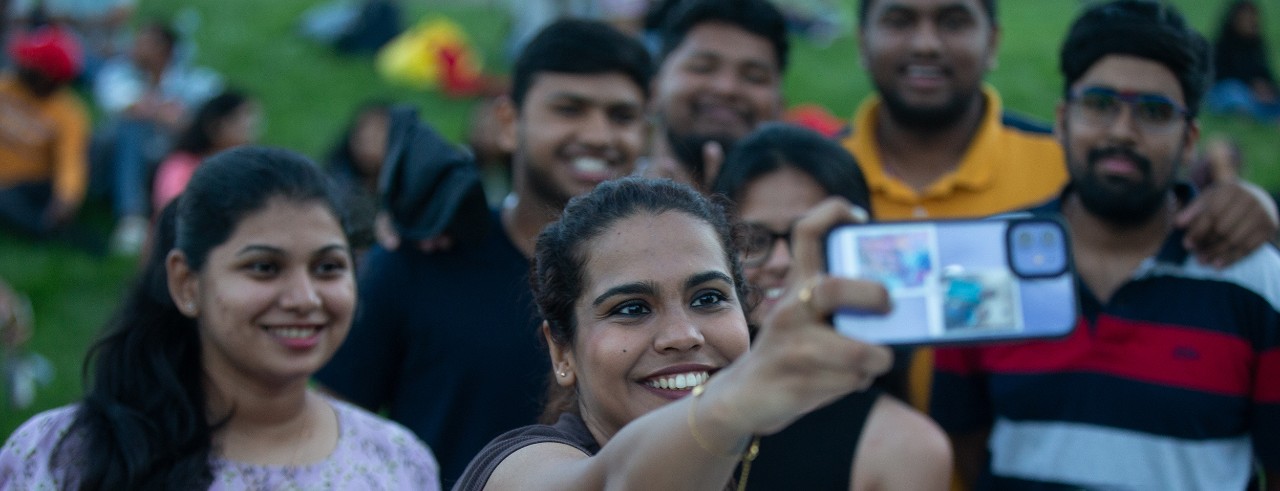
Featured image of UC students taken by Andrew Higley/UC Marketing + Brand.
Related Stories
Sugar overload killing hearts
November 10, 2025
Two in five people will be told they have diabetes during their lifetime. And people who have diabetes are twice as likely to develop heart disease. One of the deadliest dangers? Diabetic cardiomyopathy. But groundbreaking University of Cincinnati research hopes to stop and even reverse the damage before it’s too late.
Is going nuclear the solution to Ohio’s energy costs?
November 10, 2025

The Ohio Capital Journal recently reported that as energy prices continue to climb, economists are weighing the benefits of going nuclear to curb costs. The publication dove into a Scioto Analysis survey of 18 economists to weigh the pros and cons of nuclear energy. One economist featured was Iryna Topolyan, PhD, professor of economics at the Carl H. Lindner College of Business.
App turns smartwatch into detector of structural heart disease
November 10, 2025

An app that uses an AI model to read a single-lead ECG from a smartwatch can detect structural heart disease, researchers reported at the 2025 Scientific Sessions of the American Heart Association. Although the technology requires further validation, researchers said it could help improve the identification of patients with heart failure, valvular conditions and left ventricular hypertrophy before they become symptomatic, which could improve the prognosis for people with these conditions.