
Wrongful conviction: ‘If it can happen to me it can definitely happen to you’
Wrongful conviction: ‘If it can happen to me it can definitely happen to you’
Ohio Innocence Project exonerees Richard Horton and Nancy Smith speak with WYSO about their journeys

Richard Horton and Nancy Smith didn’t know each other but they joined a select club that no one wants to be part of — Ohio residents who were wrongfully convicted and imprisoned for crimes they didn’t do. Both are exonerees who were helped by the Ohio Innocence Project at UC Law.
They recently shared their stories for two segments on wrongful conviction on WYSO public radio station.
The Ohio Innocence Project at UC Law was founded in 2003 and is continuing its initial purpose: working to free every person in Ohio who has been convicted of a crime they didn’t commit. OIP’s work also includes helping develop and advocate for lasting criminal justice reform through legislation, educating the public to be sensitive to systemic problems in justice and to rally for change. OIP has helped 42 people secure their freedom. The group of clients collectively spent more than 800 years behind bars for crimes they didn’t do.
Horton, now 47, was convicted in 2006 and sentenced to 23 years in prison for allegedly breaking into a home in Columbus and shooting a victim in the leg during an armed robbery. He was released in 2022 after serving more than 16 years. His case was dismissed by authorities in 2023.
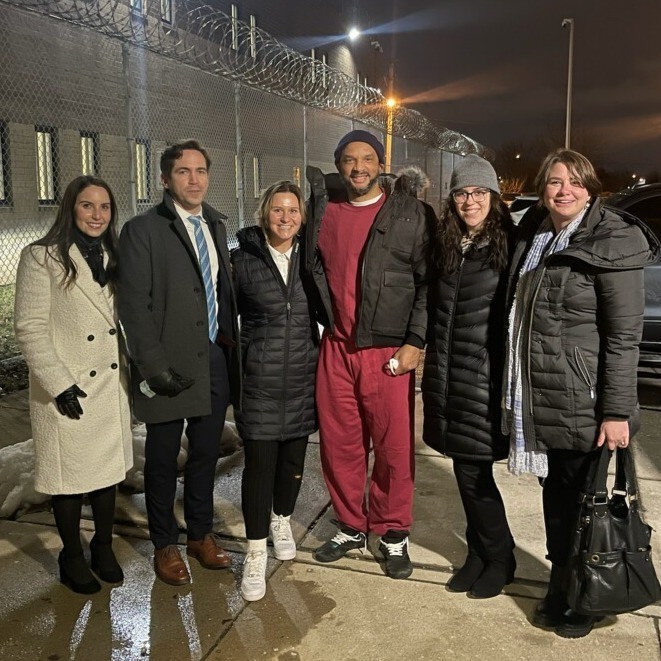
Horton (center) is shown minutes after his release with members of the OIP team that worked to help free him. From left, former OIP Fellow and now attorney Kiley Beale, OIP staff attorney Brian Howe, current OIP Fellow Baylee Kalmbach, Richard Horton, current OIP Fellow Isabelle Weber and former OIP Fellow Cate Douglas. Photo submitted.
His legal team, supported by several law students at UC Law, researched various DNA analysis techniques that were not available at the time of Richard’s trial. The students’ work discovered a new technique that allowed evidence from the crime to be tested by the Ohio Bureau of Criminal Investigations, the preeminent crime lab in Ohio.
That testing revealed that DNA from a partial fingerprint found on a fired shell casing at the crime scene did not come from Richard. It is believed to have been the first time that this technique has led to a reversal of a conviction.
“To get the Ohio Innocence Project to take your case is...it's a big deal,” Horton told WYSO for a segment. “It's an awesome deal because they get approached with thousands of cases probably on a monthly basis. I was wrongly incarcerated for a robbery/home invasion. So, to get them to take interest in my case was a huge blessing.”
Smith, 67, of Lorain, Ohio, is a former Head Start bus driver who in 1994 was wrongfully convicted of sexually abusing children in her care. That wasn’t true and Smith has battled daily to clear her name ever since. She spent nearly 15 years behind bars before her release with the help of the Ohio Innocence Project. In February 2022, the charges against her were finally dismissed by a judge.
“I had a mother make an allegation against me, saying that I took her daughter to a birthday party where I molested this child with my boyfriend...I was like, 'Are you kidding me,” Smith told WYSO for a segment.
She says the alleged victims were checked at a hospital and no signs of abuse were found.
“A police detective interviewed me,” Smith says. “I took a polygraph test, and I passed. It was no problem because nothing ever occurred anyway. But this mother was not going to stop. She went to the mayor, to the TV station, to the newspapers, and turned this into a big hysteria.”
Listen to Nancy Smith’s segment on WYSO online.
Listen to Richard Horton’s segment on WYSO online.
Featured top image of OIP exoneree Nancy Smith. Photo by Andrew Higley/UC Marketing + Brand.
Impact Lives Here
The University of Cincinnati is leading public urban universities into a new era of innovation and impact. Our faculty, staff and students are saving lives, changing outcomes and bending the future in our city's direction. Next Lives Here.
Related Stories
UC launches Bearcats Affordability Grant
January 7, 2026
The University of Cincinnati is making college more attainable for students across Ohio with the creation of the Bearcats Affordability Grant. The new grant will provide a pathway to tuition-free college for students of families who make less than $75,000 per year. Beginning in fall 2026, the Bearcats Affordability Grant will cover the remaining cost of tuition for Ohio residents who are Pell eligible.
Sugar overload killing hearts
November 10, 2025
Two in five people will be told they have diabetes during their lifetime. And people who have diabetes are twice as likely to develop heart disease. One of the deadliest dangers? Diabetic cardiomyopathy. But groundbreaking University of Cincinnati research hopes to stop and even reverse the damage before it’s too late.
Is going nuclear the solution to Ohio’s energy costs?
November 10, 2025

The Ohio Capital Journal recently reported that as energy prices continue to climb, economists are weighing the benefits of going nuclear to curb costs. The publication dove into a Scioto Analysis survey of 18 economists to weigh the pros and cons of nuclear energy. One economist featured was Iryna Topolyan, PhD, professor of economics at the Carl H. Lindner College of Business.