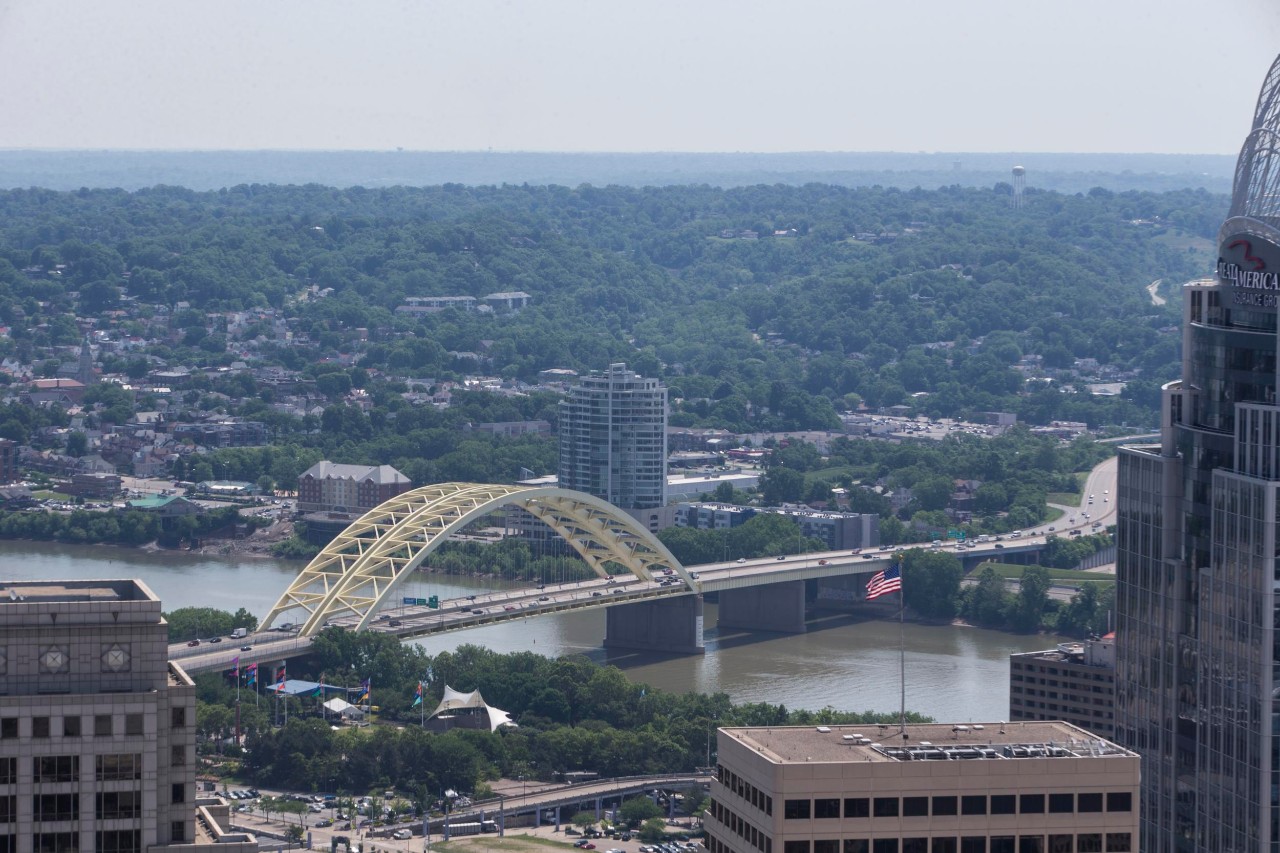
Engineering expert discusses next steps after fire closes bridge
UC College of Engineering and Applied Science professor discusses bridge repairs

WLWT-5 turned to an engineering professor at the University of Cincinnati to explain what inspectors would be looking for to assess fire damage on the Daniel Carter Beard Bridge.
The bridge was closed to traffic in both directions early Friday morning after a fire erupted under the span on the Cincinnati side at Sawyer Point's 1,000 Hands Playground.
Nobody was injured in the blaze, but the southbound span was substantially damaged, officials said. The northbound span reopened to traffic on Friday night.

UC Associate Professor Gian Andrea Rassati talks to WLWT-5 about reopening the Daniel Carter Beard Bridge. Photo/WLWT-5
UC College of Engineering and Applied Science Associate Professor Gian Andrea Rassati spoke to WLWT5's Ashley Kirklen and Sheree Paolello about what engineers look for to determine if the span's steel or concrete sustained structural damage.
Rassati teaches in UC's Department of Civil and Architectural Engineering and Construction Management. He said inspectors will examine the structural integrity of the steel members.
“They're looking at which members will need replacing. And based on the pictures I've seen, there are several that will need replacement,” Rassati said.
“And they're also looking at the concrete deck, the roadway and all the ancillary structures like the signs,” he said. “So there's a lot to do.”
A fire caused by a truck crash damaged and closed the Brent Spence Bridge in 2020. That span was closed to traffic for six weeks.
Rassati said the fire captured on video Friday morning looked much bigger than the fire that damaged and closed the Brent Spence Bridge.
“That's the million-dollar question: how hot did that fire burn?” he said.
“Depending on the temperature and time of exposure, some steel members might be OK. And others that look OK might need to be replaced because of the temperature they reached in the fire,” he said.
Rassati said bridge repairs can be done more quickly than most people realize.
“It's suprisingly fast. The fabricators, erectors and design engineers know what to do. A lot of them were trained by our program,” he said.
“It's shorter than you think, but it's still going to be a little painful. It's not going to be days. It will probably be weeks or months.”
Featured image at top: UC College of Engineering and Applied Science Associate Professor Gian Andrea Rassati talks to WLWT5's Ashley Kirklen and Sheree Paolello about fire damage to the Daniel Carter Beard Bridge. Photo/WLWT5

UC's College of Engineering and Applied Science hosts a contest to design a bridge that will support the most weight using tiny wooden beams. Photo/Katie Hageman
Related Stories
Sugar overload killing hearts
November 10, 2025
Two in five people will be told they have diabetes during their lifetime. And people who have diabetes are twice as likely to develop heart disease. One of the deadliest dangers? Diabetic cardiomyopathy. But groundbreaking University of Cincinnati research hopes to stop and even reverse the damage before it’s too late.
Is going nuclear the solution to Ohio’s energy costs?
November 10, 2025

The Ohio Capital Journal recently reported that as energy prices continue to climb, economists are weighing the benefits of going nuclear to curb costs. The publication dove into a Scioto Analysis survey of 18 economists to weigh the pros and cons of nuclear energy. One economist featured was Iryna Topolyan, PhD, professor of economics at the Carl H. Lindner College of Business.
App turns smartwatch into detector of structural heart disease
November 10, 2025

An app that uses an AI model to read a single-lead ECG from a smartwatch can detect structural heart disease, researchers reported at the 2025 Scientific Sessions of the American Heart Association. Although the technology requires further validation, researchers said it could help improve the identification of patients with heart failure, valvular conditions and left ventricular hypertrophy before they become symptomatic, which could improve the prognosis for people with these conditions.