UC project uses AI to improve worker safety
Ohio project will deploy technology to make workplaces safer

Spectrum News highlighted a new research project at the University of Cincinnati designed to leverage the latest digital tools to improve worker safety in Ohio.
UC's College of Engineering and Applied Science received a $1.4 million grant from the Ohio Bureau of Workers' Compensation to develop demonstration projects to improve the safety of workers around autonomous robots that are becoming more ubiquitous at warehouses and other workplaces.
Professors Sam Anand and Manish Kumar in UC's Industry 4.0/5.0 Institute are using tools such as “digital twins” that provide computer models and simulations of real workplaces to study safety and efficiency.
Anand and his students in UC's Smart Manufacturing Lab deploy generative artificial intelligence to predict human motion in manufacturing. This could be as simple as watching how workers lift objects or navigate their workspace.
“If you do something in the wrong way, it may not cause injuries at the moment, but after six months to a year it could cause serious pain to your body,” UC doctoral student Dorsa Rezayat told Spectrum News.
“This will have an effect on the bottom line of industries to make them more productive and cost effective and have healthy workers,” Anand told Spectrum News.
The state agency also awarded a grant to UC to help develop smart hard hats.
Mechanical engineering Professor Jing Shi said they are investigating new energy-absorbing materials that can be used as hard hat liners to reduce injury caused by blows to the head. And embedded sensors in the hard hats can help workers and their employers tell whether they should seek medical attention for a concussion or other head or neck injury after a head impact.
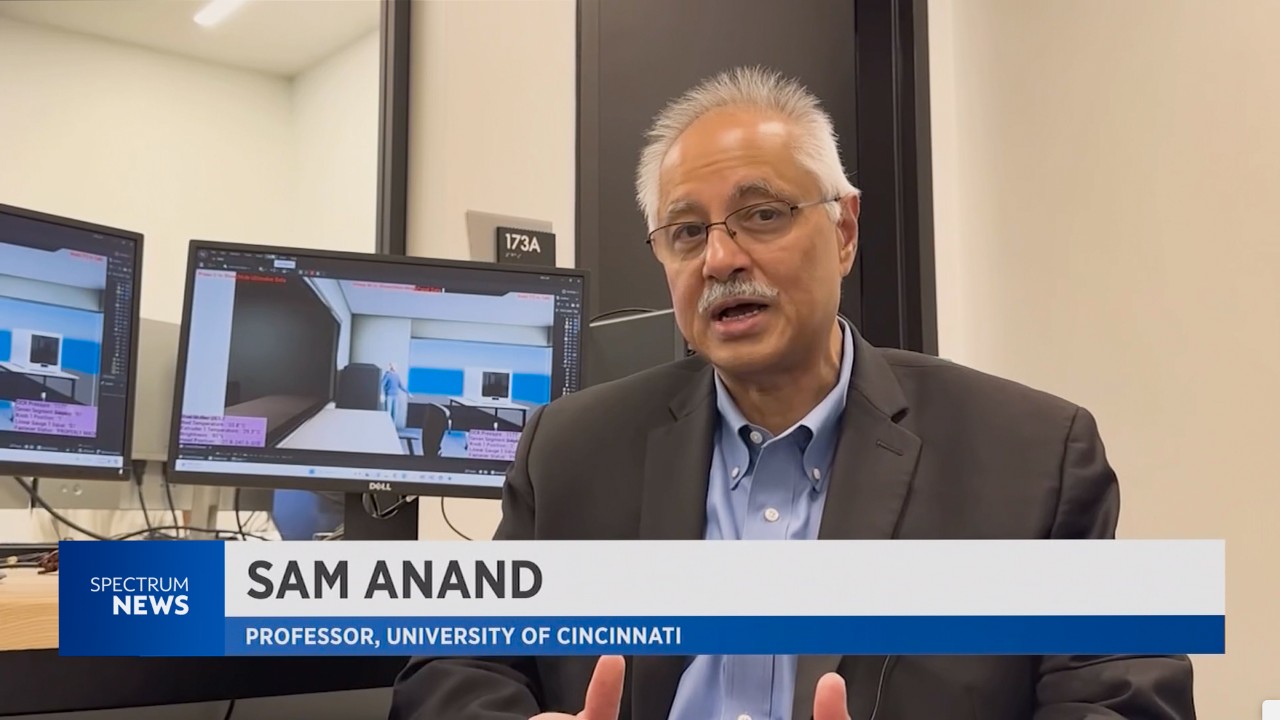
Featured image at top: UC College of Engineering and Applied Science Professor Sam Anand talks to Spectrum News about his project to improve worker safety in Ohio. Photo/Spectrum News
Related Stories
Sugar overload killing hearts
November 10, 2025
Two in five people will be told they have diabetes during their lifetime. And people who have diabetes are twice as likely to develop heart disease. One of the deadliest dangers? Diabetic cardiomyopathy. But groundbreaking University of Cincinnati research hopes to stop and even reverse the damage before it’s too late.
Is going nuclear the solution to Ohio’s energy costs?
November 10, 2025

The Ohio Capital Journal recently reported that as energy prices continue to climb, economists are weighing the benefits of going nuclear to curb costs. The publication dove into a Scioto Analysis survey of 18 economists to weigh the pros and cons of nuclear energy. One economist featured was Iryna Topolyan, PhD, professor of economics at the Carl H. Lindner College of Business.
App turns smartwatch into detector of structural heart disease
November 10, 2025

An app that uses an AI model to read a single-lead ECG from a smartwatch can detect structural heart disease, researchers reported at the 2025 Scientific Sessions of the American Heart Association. Although the technology requires further validation, researchers said it could help improve the identification of patients with heart failure, valvular conditions and left ventricular hypertrophy before they become symptomatic, which could improve the prognosis for people with these conditions.