National initiative is investing in new biking corridors
UC professor explains why the project provides more environmental equity

WVXU's Cincinnati Edition spoke to a University of Cincinnati history professor about how improving biking and pedestrian access is an environmental justice issue in the city.
The show hosted a segment on a plan by the nonprofit Tri-State Trails to develop a new biking and walking corridor called the CROWN project between neighborhoods across the Queen City.
“Right now in these neighborhoods, to get downtown, the thoroughfares you have to navigate are really big roadways with minimal sidewalks and no bike infrastructure. And that feels really treacherous,” said Wade Johnston, executive director of Tri-State Trails.
“This whole project is about reconnecting neighborhoods and making it pleasant to walk and bike,” Johnston said.
UC College of Arts and Sciences Professor David Stradling said projects that encourage more pedestrian and bike access are really about righting a social wrong in dealing with the disruptions of highways that have divided communities.
“They are very noisy. They are uncomfortable to be around. And, of course, air pollution is a real issue,” Stradling said. “There is an environmental justice issue in repairing neighborhoods that have been adversely affected by transportation policy over the past 100 years.”
Stradling is head of UC's Department of History and also teaches in UC's School of Environment and Sustainability. He is the author of several books, including 2010's “The Nature of New York: An Environmental History of the Empire State.”
Also joining the conversation was Bridget Marquis, director of Reimagining the Civic Commons.
Stradling told Cincinnati Edition host Lucy May that walkable neighborhoods improve the quality of life for residents.
“I was lucky enough to live through the pandemic in Clifton in a very walkable neighborhood with a lot of green spaces like Burnet Woods,” Stradling said. “We spent a lot of time outside and with neighbors because we could.”
Listen to WVXU's Cincinnati Edition.
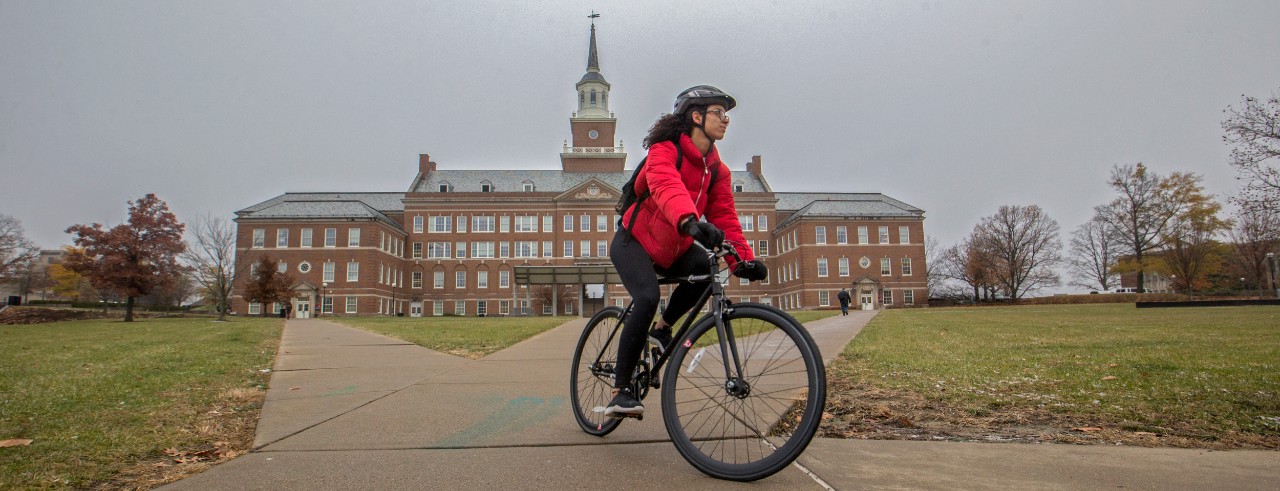
Featured image at top: A bicyclist rides in front of Arts and Sciences Hall. UC Professor David Stradling spoke to WVXU's Cincinnati Edition about the benefits of neighborhoods that encourage walking and biking. Photo/Joseph Fuqua II/UC

UC Professor David Stradling speaks at a UC Libraries event in this file photo to unveil his 2018 book “In Service to the City: A History of the University of Cincinnati.” Stradling was a guest on WVXU's Cincinnati Edition. Photo/Andrew Higley/UC Marketing + Brand
Related Stories
Sugar overload killing hearts
November 10, 2025
Two in five people will be told they have diabetes during their lifetime. And people who have diabetes are twice as likely to develop heart disease. One of the deadliest dangers? Diabetic cardiomyopathy. But groundbreaking University of Cincinnati research hopes to stop and even reverse the damage before it’s too late.
Is going nuclear the solution to Ohio’s energy costs?
November 10, 2025

The Ohio Capital Journal recently reported that as energy prices continue to climb, economists are weighing the benefits of going nuclear to curb costs. The publication dove into a Scioto Analysis survey of 18 economists to weigh the pros and cons of nuclear energy. One economist featured was Iryna Topolyan, PhD, professor of economics at the Carl H. Lindner College of Business.
App turns smartwatch into detector of structural heart disease
November 10, 2025

An app that uses an AI model to read a single-lead ECG from a smartwatch can detect structural heart disease, researchers reported at the 2025 Scientific Sessions of the American Heart Association. Although the technology requires further validation, researchers said it could help improve the identification of patients with heart failure, valvular conditions and left ventricular hypertrophy before they become symptomatic, which could improve the prognosis for people with these conditions.