UC lands federal grant to use digital tools to improve transit
UC will work on seven demonstration projects for Ohio agencies

WVXU highlighted a $5.1 million federal grant awarded to the University of Cincinnati to create new digital platforms designed to improve safety, save money and increase efficiency of transit construction projects.
UC College of Engineering and Applied Science Professor Hazem Elzarka will work on seven demonstration projects with Cincinnati Metro, Akron Metro and the Butler County Regional Transit Authority. The projects will leverage emerging technologies such as data integration, cloud computing, artificial intelligence and modeling and simulation to streamline and coordinate work processes.
Elzarka and Associate Professor Richard Li in UC’s Department of Civil and Architectural Engineering and Construction Management will collaborate with UC School of Information Technology Professor Hazem Said and Assistant Professor-Educator Vineela Kunapareddi.
“There are direct benefits for the transit agencies, but there are indirect benefits for the construction industry,” Elzarka said. “Today, only the largest firms really can afford to implement digital technologies in their projects. So we’re hoping that our research findings will help demonstrate potential benefits of this for smaller firms.”
Likewise, Elzarka said, UC construction management and information technology students will get practical experience working with the latest digital tools.
Our goal is to help transit agencies deliver projects on time, on task and on budget.
Veronica Vanterpool, FTA Deputy Administrator
The Federal Transit Administration grant is funded through the Bipartisan Infrastructure Law that President Joe Biden signed in 2021.
“Our goal is to help transit agencies deliver projects on time, on task and on budget,” FTA Deputy Administrator Veronica Vanterpool said in a statement announcing the grant award.
“Today's selection will help us do that by improving efficiency and providing tools that reduce construction delays and costs and enable workers to perform tasks faster, more safely, smarter and more accurately.”
Elzarka said they will apply new digital tools to seven new construction projects with the hope to demonstrate how the technology leads to smarter and quicker construction management decisions.
A vast amount of data on budgets, design and construction that go into new transit projects will be stored in a single cloud-based location to provide ready access even years from now.
“When you have a well-run project where decisions are made quickly, workers aren’t in the field as long where they face the most danger,” Elzarka said.
The results of the demonstrations will be used to produce a guide for other transit agencies and construction firms with best practices in planning and deploying advanced digital construction management solutions.
“This investment from the Bipartisan Infrastructure Law will save taxpayers money and speed up transit projects,” U.S. Sen. Sherrod Brown, D-Ohio, said.
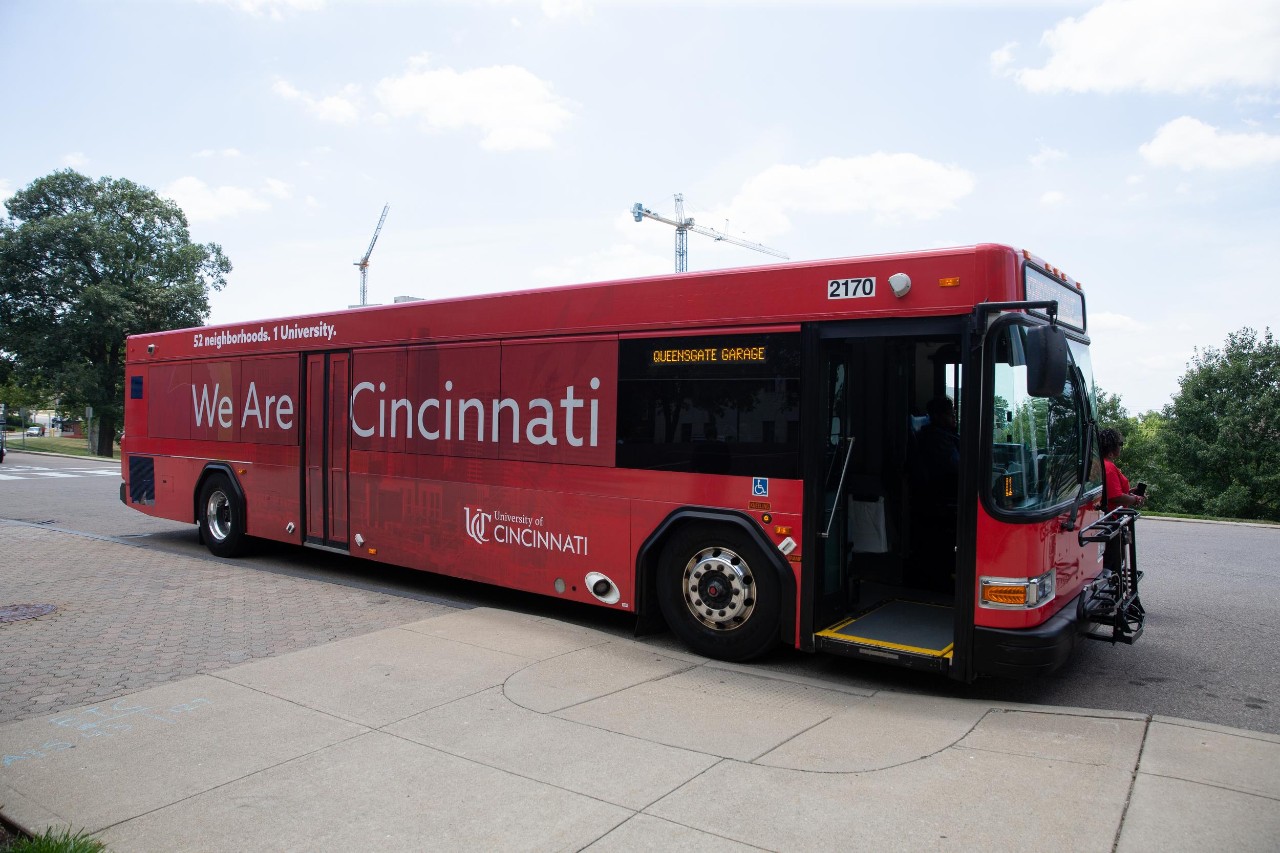
Featured image at top: A Cincinnati Metro bus is branded in UC red in this image from 2023. Photo/Andrew Higley/UC Marketing + Brand
Related Stories
Sugar overload killing hearts
November 10, 2025
Two in five people will be told they have diabetes during their lifetime. And people who have diabetes are twice as likely to develop heart disease. One of the deadliest dangers? Diabetic cardiomyopathy. But groundbreaking University of Cincinnati research hopes to stop and even reverse the damage before it’s too late.
Is going nuclear the solution to Ohio’s energy costs?
November 10, 2025

The Ohio Capital Journal recently reported that as energy prices continue to climb, economists are weighing the benefits of going nuclear to curb costs. The publication dove into a Scioto Analysis survey of 18 economists to weigh the pros and cons of nuclear energy. One economist featured was Iryna Topolyan, PhD, professor of economics at the Carl H. Lindner College of Business.
App turns smartwatch into detector of structural heart disease
November 10, 2025

An app that uses an AI model to read a single-lead ECG from a smartwatch can detect structural heart disease, researchers reported at the 2025 Scientific Sessions of the American Heart Association. Although the technology requires further validation, researchers said it could help improve the identification of patients with heart failure, valvular conditions and left ventricular hypertrophy before they become symptomatic, which could improve the prognosis for people with these conditions.