Defining different types of dementia
UC expert featured in Lake Charles, Louisiana news report

The University of Cincinnati's Russell Sawyer was featured in a Lake Charles, Louisiana television station KPLC story defining the differences between frontotemporal and alcohol-induced dementia following actor Bruce Willis and talk show host Wendy Williams publicly revealing dementia diagnoses over the past few years.
“It usually presents with changes in people’s personality and changes in language that affect people’s ability to both perform their jobs and eventually take care of themselves,” Sawyer, MD, assistant professor in the Department of Neurology & Rehabilitation Medicine in UC's College of Medicine and a UC Health physician, said of frontotemporal dementia.
Genetics may play a role for up to 40% of patients with frontotemporal dementia, he added. “Either gene therapy in which we change out the gene for a new functional gene or replacing the proteins that we’re missing" are potential treatments.
Alcohol-induced dementia is the direct effect of drinking too much for too long and is associated with memory loss, difficulty with problem-solving and impaired judgment.
“Two drinks per week over a one-year period of time was associated with both smaller brains, and more thinking and memory problems,” Sawyer explained.
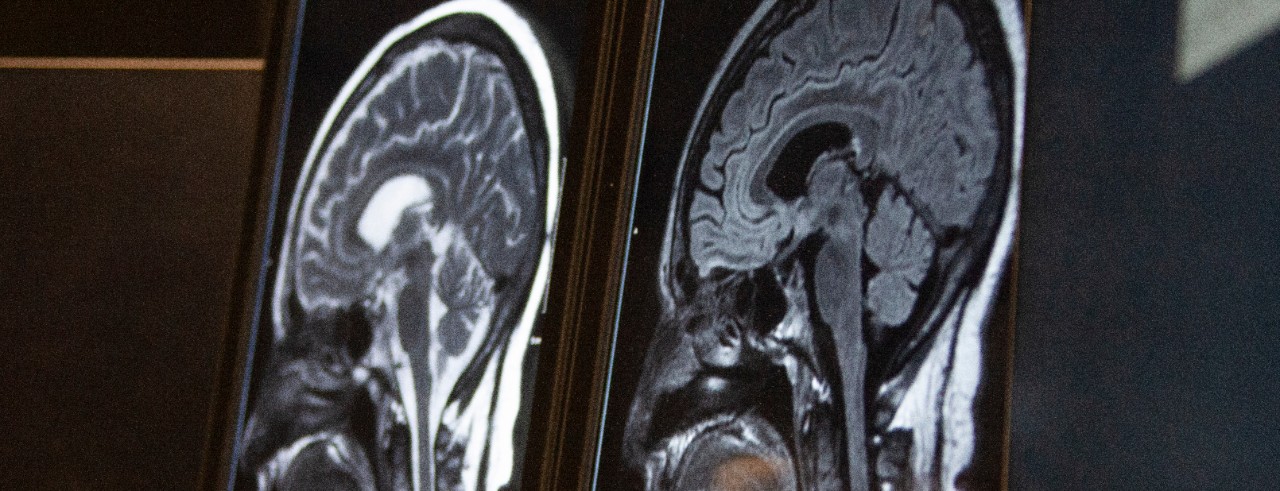
Featured photo at top of MRI brain scan. Photo/Ravenna Rutledge/UC Marketing + Brand.
Related Stories
Sugar overload killing hearts
November 10, 2025
Two in five people will be told they have diabetes during their lifetime. And people who have diabetes are twice as likely to develop heart disease. One of the deadliest dangers? Diabetic cardiomyopathy. But groundbreaking University of Cincinnati research hopes to stop and even reverse the damage before it’s too late.
Is going nuclear the solution to Ohio’s energy costs?
November 10, 2025

The Ohio Capital Journal recently reported that as energy prices continue to climb, economists are weighing the benefits of going nuclear to curb costs. The publication dove into a Scioto Analysis survey of 18 economists to weigh the pros and cons of nuclear energy. One economist featured was Iryna Topolyan, PhD, professor of economics at the Carl H. Lindner College of Business.
App turns smartwatch into detector of structural heart disease
November 10, 2025

An app that uses an AI model to read a single-lead ECG from a smartwatch can detect structural heart disease, researchers reported at the 2025 Scientific Sessions of the American Heart Association. Although the technology requires further validation, researchers said it could help improve the identification of patients with heart failure, valvular conditions and left ventricular hypertrophy before they become symptomatic, which could improve the prognosis for people with these conditions.