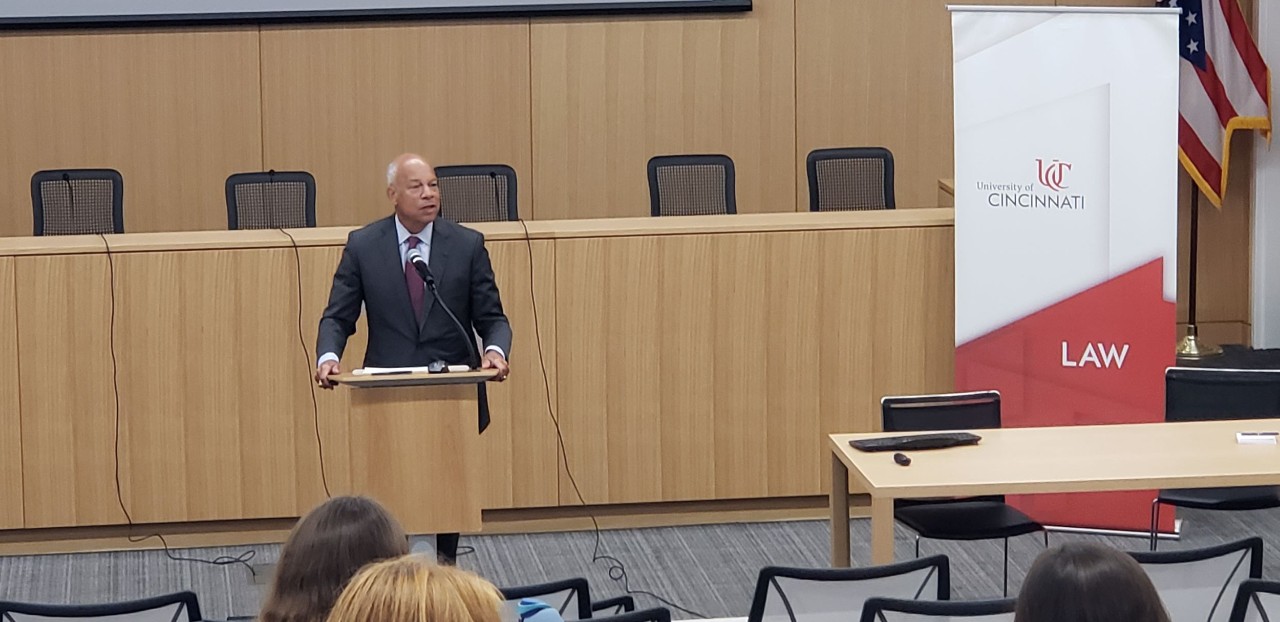
UC Law hosted forum discussing election security, American democracy and civility
WLWT and WVXU interview keynote speaker former Homeland Security Secretary Jeh Johnson

A national lawyers group partnered with the University of Cincinnati College of Law to host a Sept. 18 event to highlight the importance of election security and the need to protect American democracy.
The American Bar Association Task Force for American Democracy brought a host of speakers to UC Law as part of a country-wide listening tour. Former Homeland Security Security Jeh Johnson was the keynote speaker for the event. Johnson served under the Obama Administration from 2013-2017.
“Overheated rhetoric makes previously unacceptable behavior acceptable,” Johnson told UC law students, faculty and staff who gathered for the address.
“Political rhetoric in our country is frankly out of control,” he adds. “This election will be very close. The winner of the election in our country for president and vice president are not those who win the popular vote. Winners can lose and losers can win because of the electoral college.”
Voters in five or six swing states will likely determine the presidency. More than 160 million votes may be cast, but perhaps only 100,000 in these critical states will determine who will be president, says Johnson.
WLWT Channel 5 covered the day’s events while WVXU also aired a segment with Johnson.

Former Homeland Security Secretary Jeh Johnson speaks with WLWT Channel 5 at UC Law. Photo provided.
The ABA Task Force has been convening listening tours in states across the nation, after the outcome of the 2020 election was questioned by some Americans.
Johnson warned that polls are showing younger Americans may be losing faith in the nation’s electoral system. He co-chairs the task force along with retired federal judge Michael Luttig, a noted conservative.
“Young Americans in particular are questioning, ‘why democracy, and why not try some other form of government?”
Johnson says Americans are taking the tenants of democracy enjoyed for granted.
“Democracy is the freedom of speech and freedom of dissent,” says Johnson. “In an autocracy these freedoms are suppressed and chilled.”
Johnson said the task force is developing a set of long term recommendations to strengthen democracy by encouraging good political behavior among elected leaders and discouraging highly partisan bad behavior by candidates.
He and other members of the task force have also been traveling the country encouraging law students, professors and others connected to the legal profession to get involved in promoting democracy.
Learn more about the ABA Task Force for American Democracy online.
Featured top image of Jeh Johnson addressing UC Law students, faculty and staff. Photo provided.
Related Stories
Sugar overload killing hearts
November 10, 2025
Two in five people will be told they have diabetes during their lifetime. And people who have diabetes are twice as likely to develop heart disease. One of the deadliest dangers? Diabetic cardiomyopathy. But groundbreaking University of Cincinnati research hopes to stop and even reverse the damage before it’s too late.
Is going nuclear the solution to Ohio’s energy costs?
November 10, 2025

The Ohio Capital Journal recently reported that as energy prices continue to climb, economists are weighing the benefits of going nuclear to curb costs. The publication dove into a Scioto Analysis survey of 18 economists to weigh the pros and cons of nuclear energy. One economist featured was Iryna Topolyan, PhD, professor of economics at the Carl H. Lindner College of Business.
App turns smartwatch into detector of structural heart disease
November 10, 2025

An app that uses an AI model to read a single-lead ECG from a smartwatch can detect structural heart disease, researchers reported at the 2025 Scientific Sessions of the American Heart Association. Although the technology requires further validation, researchers said it could help improve the identification of patients with heart failure, valvular conditions and left ventricular hypertrophy before they become symptomatic, which could improve the prognosis for people with these conditions.