Prostate cancer trial tests drug that targets cancer's ability to repair damage
Cancer Center hosts Phase 3 EvoPAR trial

The University of Cincinnati Cancer Center is a trial site for a new Phase 3 trial testing a novel drug to treat a subset of patients with prostate cancer.
Robert Franklin, MD, said the EvoPAR trial focuses on patients with metastatic hormone-sensitive prostate cancer.
“This trial is available to men who have either a new diagnosis of stage 4 prostate cancer or who had prior therapy like surgery or radiation but the cancer has come back,” said Franklin, assistant professor in the Department of Internal Medicine in UC’s College of Medicine and a UC Health physician.
The current standard of care for men with this cancer is a combination of two hormonal drugs often with the addition of chemotherapy. Trial participants will be randomized to receive either the trial drug or placebo in addition to the standard hormonal drugs.

Robert Franklin, MD, left, and Katie Askren, FNP-C, right, look over a chart in the clinic. Photo/Andrew Higley/UC Marketing + Brand.
The trial drug is in a class of drugs called PARP inhibitors that have gained a well-established role in the management of prostate cancer over the last 3 years.
PARP is a protein in cells that helps the cancer cells repair damaged DNA, and by blocking PARP the cancer cells become more prone to dying. This can be particularly effective in a subset of men who have inherited disorders with genetic repair like BRCA mutations.
“One particularly exciting advantage of this PARP inhibitor is that, unlike the earlier-generation PARP inhibitors, it causes less side effects in the blood,” Franklin said.
The National Cancer Institute estimates that approximately 3.4 million men in the United States lived with prostate cancer in 2021, and approximately 12.8% of American men will be diagnosed with prostate cancer at some point during their lifetime.
“Prostate cancer is unfortunately a cancer that affects an enormous number of men and their families,” Franklin said. “As we gain more powerful insights into the biology of prostate cancer, we are excited to use clinical trials like this one to help men live longer and healthier lives.”
For more information on trial eligibility and enrollment, please call 513-585-8222.
Screening is key
The American Cancer Society recommends men begin a discussion with their health care provider about prostate cancer screenings at the following ages:
- Age 50: Men at average risk of prostate cancer who are expected to live at least 10 more years
- Age 45: Men at high risk of developing prostate cancer, including African American men and those who have a first-degree relative (father or brother) diagnosed with prostate cancer at an early age (younger than age 65)
- Age 40: Men at even higher risk, including those with more than one first-degree relative who had prostate cancer at an early age
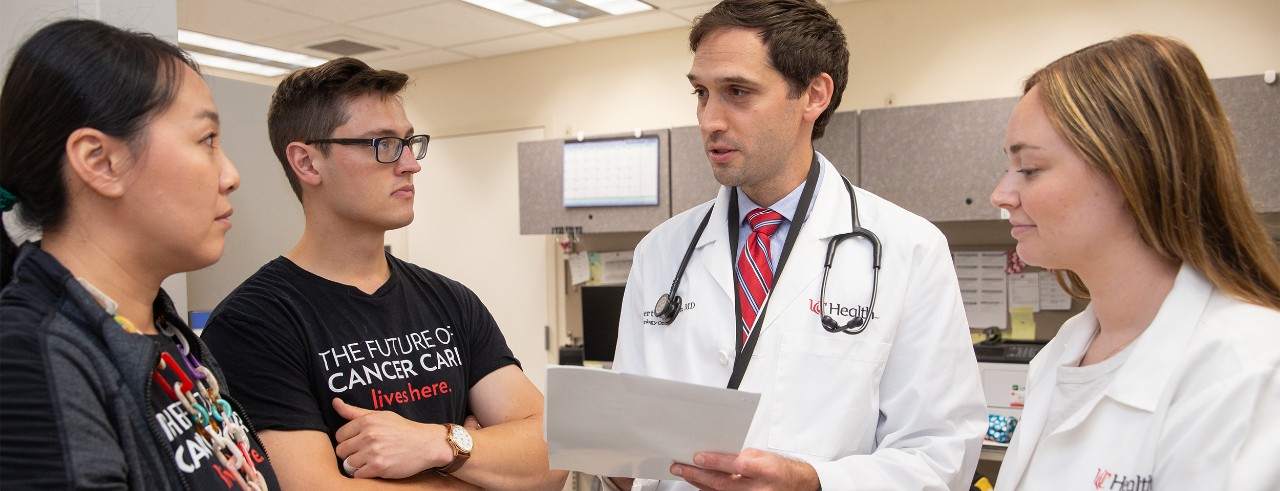
Featured photo at top of Dr. Franklin, second from right, speaking with colleagues in the clinic. Photo/Andrew Higley/UC Marketing + Brand.
Related Stories
Sugar overload killing hearts
November 10, 2025
Two in five people will be told they have diabetes during their lifetime. And people who have diabetes are twice as likely to develop heart disease. One of the deadliest dangers? Diabetic cardiomyopathy. But groundbreaking University of Cincinnati research hopes to stop and even reverse the damage before it’s too late.
Is going nuclear the solution to Ohio’s energy costs?
November 10, 2025

The Ohio Capital Journal recently reported that as energy prices continue to climb, economists are weighing the benefits of going nuclear to curb costs. The publication dove into a Scioto Analysis survey of 18 economists to weigh the pros and cons of nuclear energy. One economist featured was Iryna Topolyan, PhD, professor of economics at the Carl H. Lindner College of Business.
App turns smartwatch into detector of structural heart disease
November 10, 2025

An app that uses an AI model to read a single-lead ECG from a smartwatch can detect structural heart disease, researchers reported at the 2025 Scientific Sessions of the American Heart Association. Although the technology requires further validation, researchers said it could help improve the identification of patients with heart failure, valvular conditions and left ventricular hypertrophy before they become symptomatic, which could improve the prognosis for people with these conditions.