Poll: Lower-income Black parents talk to kids about race challenges more than others
UC expert speaks to Parents.com on Gallup findings

The University of Cincinnati's Steven Kniffley spoke with Parents.com about a recent Gallup poll that found lower-income Black families with young children are more likely to discuss the challenges of race with their kids than other families.
According to the poll, 59% of participants say they talk with their children about the challenges of race and the things they may face either often (30%) or sometimes (29%). Fewer participants (48%) say they speak with their kids about the advantages they may have because of their race. Twenty-five percent of Black parents who participated in the poll say they often converse about advantages, and 23% say sometimes.
Kniffley, PsyD, said low income and unique environmental stressors that intersect with race — including housing discrimination, health, education disparities and policing policies — are more likely to mean children may encounter more overt forms of racism.
"To address these more overt forms of racial microaggressions, Black children will need to employ racial microaggressions skills at a greater frequency and earlier ages compared to other racial and income groups," Kniffley, senior associate dean for Pathway Innovation and Inclusive Excellence and professor in the Department of Psychiatry and Behavioral Neuroscience in the UC College of Medicine, told Parents.com.
Kniffley said Black children experience an average of six racial microaggressions per day, with most having their first racist interpersonal encounter between ages 4-5. With Black children more vulnerable to anxiety, depression and racial trauma as a result, he said Black parents have a unique task of equipping their children with the skills needed to navigate racial microaggressions.
"In general, these skills fall under the umbrella of racial socialization and comprise three main areas: racial identity development, advocacy and self-reflection/racial trauma processing," Kniffley said.
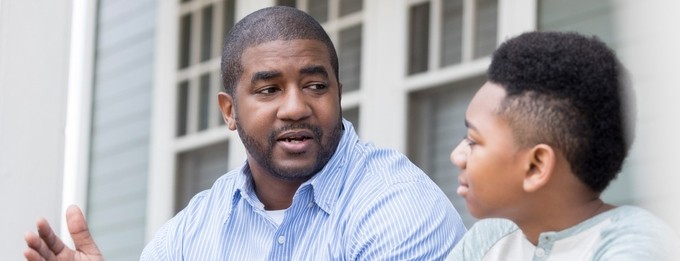
Featured photo at top of father and son having a conversation. Photo/SDI Productions/iStock.
Related Stories
Sugar overload killing hearts
November 10, 2025
Two in five people will be told they have diabetes during their lifetime. And people who have diabetes are twice as likely to develop heart disease. One of the deadliest dangers? Diabetic cardiomyopathy. But groundbreaking University of Cincinnati research hopes to stop and even reverse the damage before it’s too late.
Is going nuclear the solution to Ohio’s energy costs?
November 10, 2025

The Ohio Capital Journal recently reported that as energy prices continue to climb, economists are weighing the benefits of going nuclear to curb costs. The publication dove into a Scioto Analysis survey of 18 economists to weigh the pros and cons of nuclear energy. One economist featured was Iryna Topolyan, PhD, professor of economics at the Carl H. Lindner College of Business.
App turns smartwatch into detector of structural heart disease
November 10, 2025

An app that uses an AI model to read a single-lead ECG from a smartwatch can detect structural heart disease, researchers reported at the 2025 Scientific Sessions of the American Heart Association. Although the technology requires further validation, researchers said it could help improve the identification of patients with heart failure, valvular conditions and left ventricular hypertrophy before they become symptomatic, which could improve the prognosis for people with these conditions.