Are community colleges still a pathway to a four-year degree?
Jack Miner, vice provost for enrollment management, joins radio panel reviewing options in higher ed

Nationally, community colleges are often considered an affordable, cost-saving option for students wanting a bachelor’s degree. Start at a smaller two-year school and then transfer to a larger four-year institution.
But data released by the federal Department of Education shows that only 13% of community college students earn a bachelor’s degree from a traditional, four-year institution within eight years.
WVXU’s Cincinnati Edition examined possible barriers that prevent these students from eventually obtaining a bachelor’s degree. Jack Miner, vice provost for enrollment for UC, was one of four panelists addressing that topic on a recent segment.
Cost is a big factor for community college students wishing to continue their education for a four-year degree. On average those two-year schools cost anywhere from a half to a third of tuition and fees at a public four-year institution. And in some parts of the country, students at community colleges find their credits won’t easily transfer to four-year institutions.
But in Ohio, the state created the Ohio Guaranteed Transfer about a dozen years ago to ease the path from community colleges to four-year public institutions, explains UC’s Jack Miner to WVXU listeners.
“It is really that concept that during the first two years in community college, those credits you earn are guaranteed to transfer to a four-year school and guaranteed to apply to your degree,” Miner said.
“That is something that in so many states students are getting hung up on. They earn credits at the community college and they try to transfer to a four-year school and then the credits don’t transfer and they have to take courses over. They essentially start back at step one in their education and they have two years worth of debt and expenses. So Ohio has done that right.”
Miner says UC also tries to partner locally with Cincinnati State and Southern State Community College to create pathways into programs so students can ensure a four-year degree.
The Ohio Guaranteed Transfer doesn’t apply to transferring from a community college to a private college or university in the state.
Also, at UC students can begin a two-year program at one of the university’s regional campuses at Blue Ash College or Clermont College and then continue on for a four-year degree at the Uptown campus. Both campuses are economical, offer smaller classes and have pathways for students onto the Uptown campus.
“We have two regional campuses that are about the same price point as a community college,” says Miner. “One of the shifts that we have seen this year specifically with students saving about half on tuition is students at the Blue Ash campus are still choosing to live in residence halls on the Uptown campus so they are absolutely on a pathway toward transfer.”
Listen to the full segment on WVXU online.
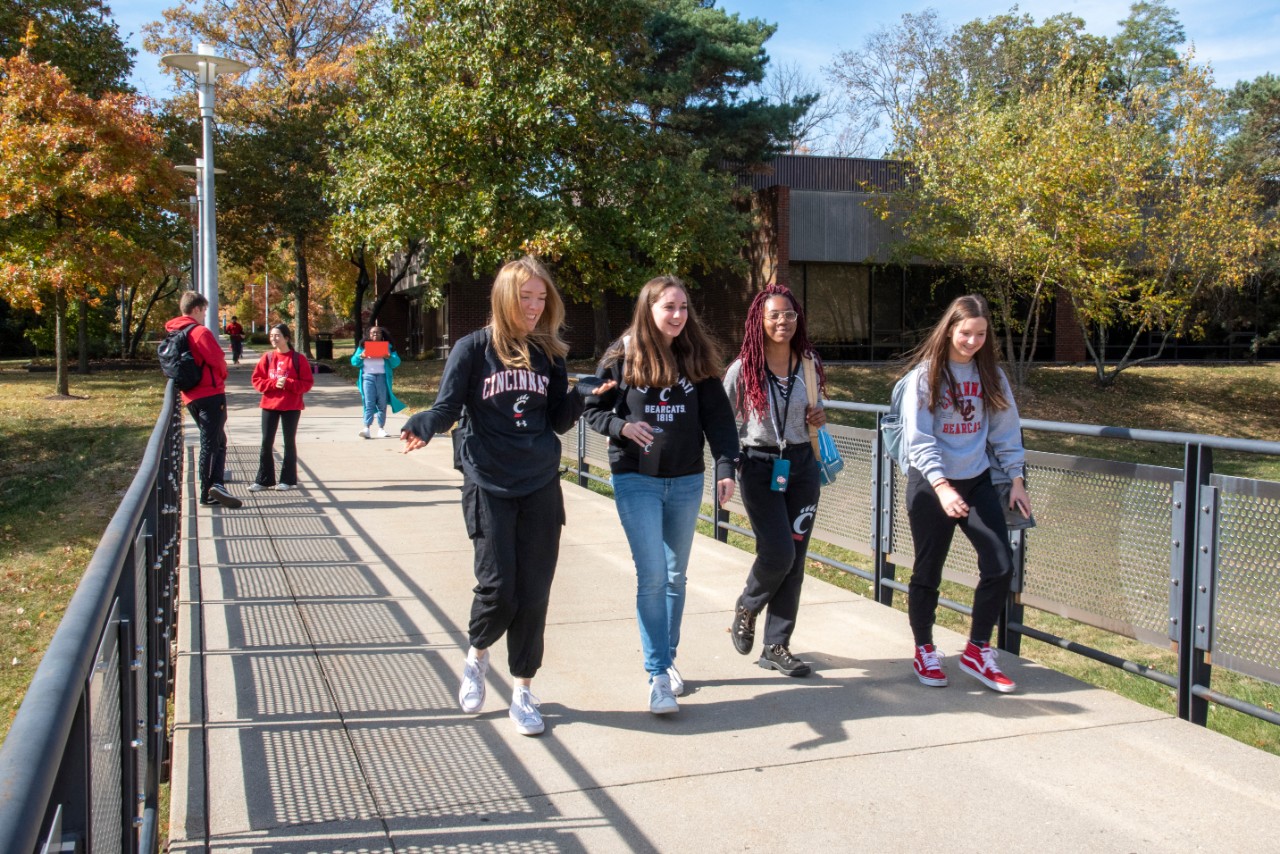
Featured top image of students walking the UC Blue Ash campus. The regional campuses of Blue Ash College and Clermont College are important pathways to a four-year degree in Greater Cincinnati. Photo provided.
Related Stories
Sugar overload killing hearts
November 10, 2025
Two in five people will be told they have diabetes during their lifetime. And people who have diabetes are twice as likely to develop heart disease. One of the deadliest dangers? Diabetic cardiomyopathy. But groundbreaking University of Cincinnati research hopes to stop and even reverse the damage before it’s too late.
Is going nuclear the solution to Ohio’s energy costs?
November 10, 2025

The Ohio Capital Journal recently reported that as energy prices continue to climb, economists are weighing the benefits of going nuclear to curb costs. The publication dove into a Scioto Analysis survey of 18 economists to weigh the pros and cons of nuclear energy. One economist featured was Iryna Topolyan, PhD, professor of economics at the Carl H. Lindner College of Business.
App turns smartwatch into detector of structural heart disease
November 10, 2025

An app that uses an AI model to read a single-lead ECG from a smartwatch can detect structural heart disease, researchers reported at the 2025 Scientific Sessions of the American Heart Association. Although the technology requires further validation, researchers said it could help improve the identification of patients with heart failure, valvular conditions and left ventricular hypertrophy before they become symptomatic, which could improve the prognosis for people with these conditions.