TTY (teletype) for deaf communications precursor to texting
The Deaf community was texting and video calling long before there were cell phones

Accidentally, Alexander Graham Bell invented the telephone in 1876. He was trying to develop audiology equipment to help deaf people — as both his mother and his wife were deaf.
While his invention revolutionized communications, it wasn’t until the 1960s that a deaf inventor would develop a device to facilitate communication for non-hearing persons.
The device became known first as the teletypewriter, later teletype or TTY. The machine allowed the user to connect a telephone handset into a specialized coupler that sent the message to a third party. Known as a relay system, whereby trained professionals relay the message to the recipient and vice versa.
TTY has code for words such as GA for “go ahead” just as current text messaging uses code like IDK for “I don’t know” or LOL for “laugh out loud.”

Julliette Laracuente-Huebner with her grandparents. Photo/provided
“It was text messaging just like we have now,” and as video technology evolved these relay systems included video calls, says UC American Sign Language (ASL) instructor Deanna Herbers who is deaf.
Ohio received its relay system after 1987 and was strongly advocated for by the Deaf community in and around Columbus, Ohio. Among the committee members to bring the service to the state was Jerry Huebner, grandfather to second-year UC student Juliette Laracuente-Huebner.
“It makes me feel proud to know that my family is connected to something so big and instrumental to the Deaf community,” says Laracuente-Huebner.
Today, Ohio Relay is still a free service that provides full telephone accessibility to people who are deaf, hard-of-hearing, deaf-blind and speech-disabled, but newer technologies like Sorenson, Purple and Convo are more commonly used by a spectrum of deaf and hearing people, says UC’s Herbers.
Many technologies, she says, have evolved thanks to the Deaf community.
“We had video phone calls before FaceTime started, and we used pagers before texting became popular with the hearing community.”
In a related story, "A Sixth Sense," read how Laracuente-Huebner.was reunited with a distant relative through an ASL class at UC.
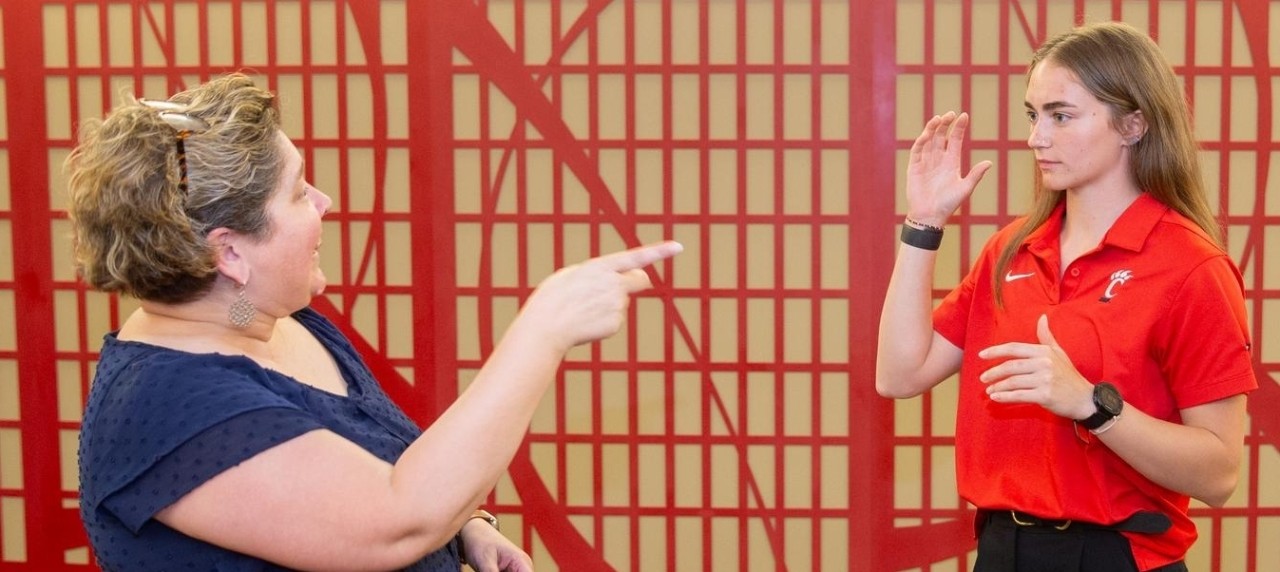
Featured image at top: ASL instructor Deanna Herbers signing with UC student Julliette Laracuente-Huebner. Photo/Andrew Higley/ UC Marketing + Brand
Impact Lives Here
The University of Cincinnati is leading public urban universities into a new era of innovation and impact. Our faculty, staff and students are saving lives, changing outcomes and bending the future in our city's direction. Next Lives Here.
Related Stories
Sugar overload killing hearts
November 10, 2025
Two in five people will be told they have diabetes during their lifetime. And people who have diabetes are twice as likely to develop heart disease. One of the deadliest dangers? Diabetic cardiomyopathy. But groundbreaking University of Cincinnati research hopes to stop and even reverse the damage before it’s too late.
Is going nuclear the solution to Ohio’s energy costs?
November 10, 2025

The Ohio Capital Journal recently reported that as energy prices continue to climb, economists are weighing the benefits of going nuclear to curb costs. The publication dove into a Scioto Analysis survey of 18 economists to weigh the pros and cons of nuclear energy. One economist featured was Iryna Topolyan, PhD, professor of economics at the Carl H. Lindner College of Business.
App turns smartwatch into detector of structural heart disease
November 10, 2025

An app that uses an AI model to read a single-lead ECG from a smartwatch can detect structural heart disease, researchers reported at the 2025 Scientific Sessions of the American Heart Association. Although the technology requires further validation, researchers said it could help improve the identification of patients with heart failure, valvular conditions and left ventricular hypertrophy before they become symptomatic, which could improve the prognosis for people with these conditions.