Lattice therapy can help target tumors
Rio Grande Valley, Texas news station highlights UC research

Rio Grande Valley, Texas news station KRGV-TV highlighted University of Cincinnati Cancer Center researcher Andrew Frankart's new trial testing lattice therapy to provide more targeted radiation for patients with large tumors.
Lattice therapy is a technique where certain parts of tumors are preferentially targeted with higher doses of radiation compared to other areas.
"Right now, with radiation, we're more restricted to moderate doses that can help relieve symptoms and provide a temporary effect, but may not be sufficient dosing to provide a lasting impact or to control the tumor itself," Frankart, MD, a Cancer Center physician researcher and assistant professor of radiation oncology in UC’s College of Medicine, told KRGV. "The difference with lattice therapy is it's still using that arc to generate a plan, but we're purposefully making spheres or circles of higher dose within the target."
A five-year, $729,000 American Cancer Society/American Society for Radiation Oncology Clinician Scientist Development Grant is supporting the translation of Frankart’s initial findings into clinical practice through the clinical trial, which is expected to enroll 37 adult patients and analyze the underlying biology of tumor and immune responses to lattice therapy radiation.
“We’re focusing on patients who have large or bulky tumors. The approach is more based upon where it’s located and how large it is, and those are things that have previously prevented radiation from being as effective,” Frankart said. “Using this new approach to overcome some of those barriers hopefully means it can benefit more patients because we’re broadly including multiple disease sites.”
Read or watch the KRGV-TV story.
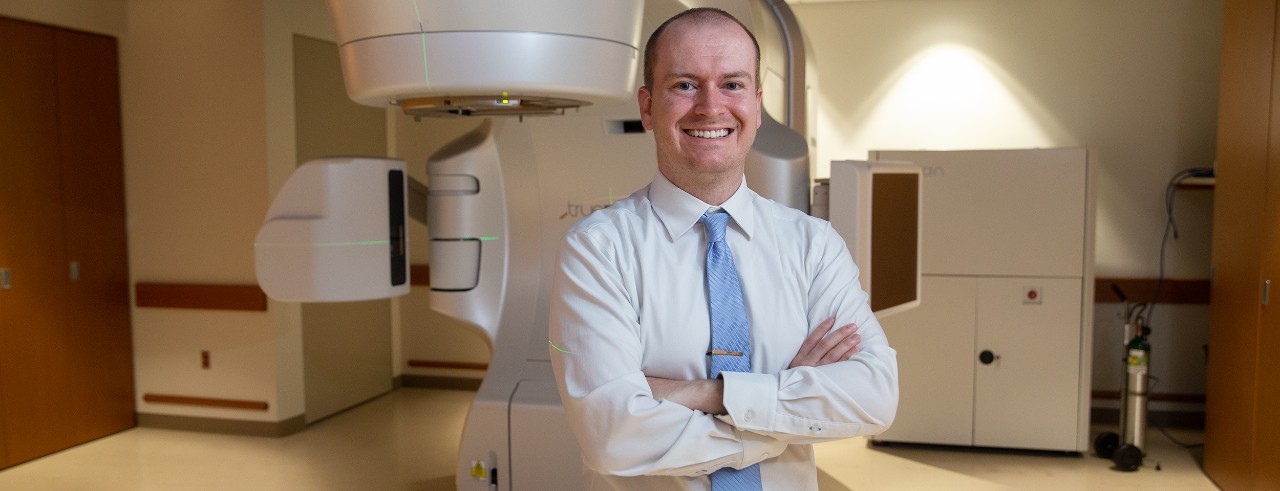
Featured photo at top of Frankart in a radiation treatment room. Photo/Andrew Higley/UC Marketing + Brand.
Related Stories
Sugar overload killing hearts
November 10, 2025
Two in five people will be told they have diabetes during their lifetime. And people who have diabetes are twice as likely to develop heart disease. One of the deadliest dangers? Diabetic cardiomyopathy. But groundbreaking University of Cincinnati research hopes to stop and even reverse the damage before it’s too late.
Is going nuclear the solution to Ohio’s energy costs?
November 10, 2025

The Ohio Capital Journal recently reported that as energy prices continue to climb, economists are weighing the benefits of going nuclear to curb costs. The publication dove into a Scioto Analysis survey of 18 economists to weigh the pros and cons of nuclear energy. One economist featured was Iryna Topolyan, PhD, professor of economics at the Carl H. Lindner College of Business.
App turns smartwatch into detector of structural heart disease
November 10, 2025

An app that uses an AI model to read a single-lead ECG from a smartwatch can detect structural heart disease, researchers reported at the 2025 Scientific Sessions of the American Heart Association. Although the technology requires further validation, researchers said it could help improve the identification of patients with heart failure, valvular conditions and left ventricular hypertrophy before they become symptomatic, which could improve the prognosis for people with these conditions.