New technology could help treat hearing loss more effectively
NIH-funded UC researcher studying magnetic nanoparticle delivery

Just as a business needs an effective and reliable service to deliver its goods to customers, medications need an effective delivery system to get them to the specific area of the body where they can have an impact.
The University of Cincinnati’s Daniel Sun, MD, has received a career development award of just more than $1 million from the National Institutes of Health’s National Institute on Deafness and Other Communication Disorders to research the potential of using magnetic nanoparticles as a delivery system for drugs to reach the inner ear and treat hearing loss.
Aside from often ineffective steroids, there are currently no drugs approved by the Food and Drug Administration to treat hearing loss, and getting the medications into the inner ear, where hearing loss occurs, is a major hurdle.
“There are a lot of interesting medications that are in the pipeline that have a lot of potential to transform the way we treat hearing loss and allow us to delay or even reverse hearing loss,” said Sun, the Myles L. Pensak, MD, Endowed Professor in Neurotology and Skull Base Surgery, director of the Division of Neurotology, neurotology fellowship program director and associate professor of otolaryngology in the University of Cincinnati College of Medicine, and a UC Health physician. “But we don’t have a good way to get these promising medications into the ear very effectively.”

Sun said a breakthrough in drug delivery combined with the new medications being developed could open a new world for noninvasive treatment of hearing loss. Photo/UC Health.
Magnetic nanoparticles have been used as a drug delivery system in other parts of the body, but Sun said his research is helping develop a better understanding of exactly how to engineer the nanoparticles specifically for the ear’s anatomy.
“The goal is to create something that’s minimally invasive and then use a magnetic field to steer these nanoparticles into the ear where hearing loss is happening,” Sun said.
Different kinds of hearing loss, like age-related hearing loss, noise trauma and sudden hearing loss, are caused by different mechanisms and therefore treated by different medications. If magnetic nanoparticles are effective, they could act as the delivery truck that gets loaded up with the specific medication each patient needs based on their kind of hearing loss.
“Based on the way they’re engineered, these particles can carry many different forms of medications,” Sun said. “It’s essential that we can use a common platform for different medications that can target different types of hearing loss.”
In addition to the magnetic field research, Sun and Donglu Shi, PhD, from UC’s Department of Mechanical and Materials Engineering, are collaborating to study the effectiveness of lasers to activate the nanoparticles and help them penetrate the inner ear.

Sun, center, collaborates with colleagues at the UC Gardner Neuroscience Institute. Photo/UC Health.
“We want to approach it very systematically and rigorously to truly understand how to design these nanoparticles in a way that is biocompatible, that is safe for hearing and balance function in the ear,” Sun said. “At the same time, we want to provide very robust drug delivery capabilities. We’re really starting from the ground up to understand how these particles really penetrate the membrane that separates our middle ear from the inner ear and how these particles actually go to the areas of the inner ear that we need them to go to.”
Long term, Sun said a breakthrough in drug delivery combined with the new medications being developed could open a new world for noninvasive treatment of hearing loss.
“We really want to look to a future where people, regardless of age or their health, can safely undergo these treatments with these promising medications in a way that is minimally invasive and also effective in treating their hearing loss,” he said.
Impact Lives Here
The University of Cincinnati is leading public urban universities into a new era of innovation and impact. Our faculty, staff and students are saving lives, changing outcomes and bending the future in our city's direction. Next Lives Here.
Read or listen to a WVXU story about the research.
Sun was initially awarded this grant while at Johns Hopkins University and transferred the grant when he joined the faculty at UC.
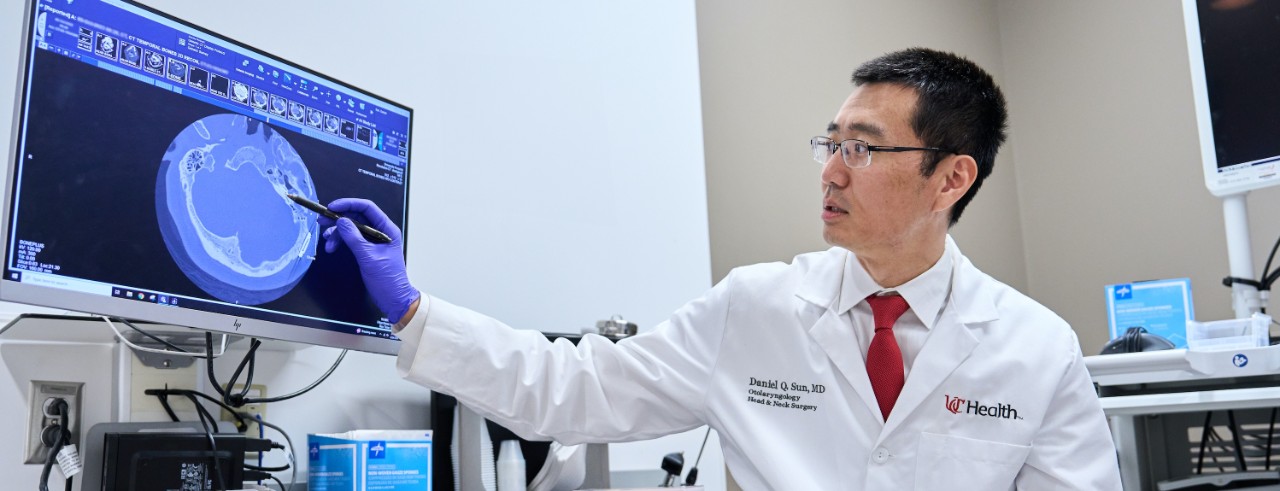
Featured photo at top of Sun pointing to a scan on a monitor. Photo/UC Health.
Related Stories
Sugar overload killing hearts
November 10, 2025
Two in five people will be told they have diabetes during their lifetime. And people who have diabetes are twice as likely to develop heart disease. One of the deadliest dangers? Diabetic cardiomyopathy. But groundbreaking University of Cincinnati research hopes to stop and even reverse the damage before it’s too late.
Is going nuclear the solution to Ohio’s energy costs?
November 10, 2025

The Ohio Capital Journal recently reported that as energy prices continue to climb, economists are weighing the benefits of going nuclear to curb costs. The publication dove into a Scioto Analysis survey of 18 economists to weigh the pros and cons of nuclear energy. One economist featured was Iryna Topolyan, PhD, professor of economics at the Carl H. Lindner College of Business.
App turns smartwatch into detector of structural heart disease
November 10, 2025

An app that uses an AI model to read a single-lead ECG from a smartwatch can detect structural heart disease, researchers reported at the 2025 Scientific Sessions of the American Heart Association. Although the technology requires further validation, researchers said it could help improve the identification of patients with heart failure, valvular conditions and left ventricular hypertrophy before they become symptomatic, which could improve the prognosis for people with these conditions.