UC marks 4 years saving lives with mobile stroke unit
UC's Christopher Richards discusses advantages to specialized ambulance

The University of Cincinnati's Christopher Richards, MD, spoke with Local 12 about the four-year anniversary of the mobile stroke unit that can bring the emergency department directly to patients.
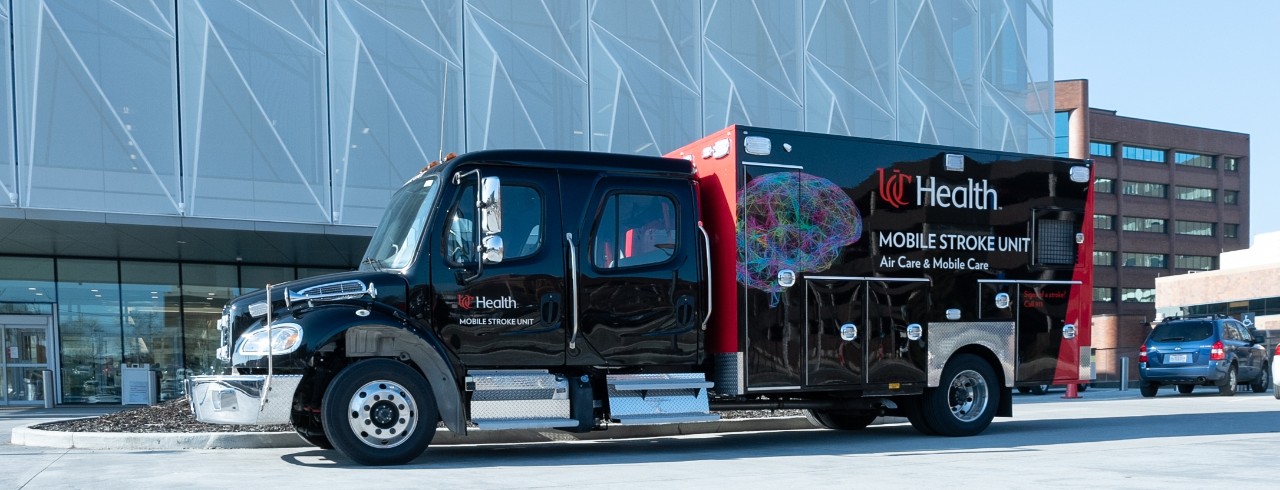
One of only a few in the nation, the mobile stroke unit is a specially outfitted ambulance equipped with a CAT scanner, clot-busting medications, trained stroke professionals and connection to doctors on the UC stroke team.
"In that four years, we've been dispatched out almost 3,000 times, transported almost 600 patients and more than 100 patients have had some sort of treatment for their acute stroke," said Christopher Richards, assistant professor in the University of Cincinnati's Department of Emergency Medicine in the College of Medicine, medical director of the UC Health Mobile Stroke Unit and a UC Health emergency physician. "We essentially bring the emergency department to that patient's home with our CAT scan, our clot-busting medications and our doctors, our stroke specialists from the UC stroke team."
The mobile stroke unit is also a critical part of certain research projects, like the FASTEST trial testing a drug to treat strokes that needs to be administered within two hours of stroke onset.
Watch or read the Local 12 story.
Featured photo at top of UC Health's mobile stroke unit courtesy of UC Health.
Remember how to identify a stroke
Because of the quick onset of stroke, it is important to know the FAST mnemonic device that details the most common signs of stroke and how to respond:
- F: Facial drooping
- A: Arm or leg drop, or weakness in the arm or leg
- S: Speech issues, such as slurred speech or an inability to get your words out
- T: Time is of the essence; call 911 immediately
Related Stories
UC launches Bearcats Affordability Grant
January 7, 2026
The University of Cincinnati is making college more attainable for students across Ohio with the creation of the Bearcats Affordability Grant. The new grant will provide a pathway to tuition-free college for students of families who make less than $75,000 per year. Beginning in fall 2026, the Bearcats Affordability Grant will cover the remaining cost of tuition for Ohio residents who are Pell eligible.
BearcatGPT AI platform now available to all UC faculty and staff
December 9, 2025
University of Cincinnati Digital Technology Solutions is excited to announce that BearcatGPT, the university’s private, secure AI platform, is now available to all UC faculty and staff.
Sugar overload killing hearts
November 10, 2025
Two in five people will be told they have diabetes during their lifetime. And people who have diabetes are twice as likely to develop heart disease. One of the deadliest dangers? Diabetic cardiomyopathy. But groundbreaking University of Cincinnati research hopes to stop and even reverse the damage before it’s too late.