Finding meaning in medicine
How UC Clermont propelled a student from construction work to medical school

When Milford, Ohio, native Luke Ustick graduated from high school, he didn’t see higher education in his future.
“I was homeschooled, but I didn’t apply myself,” Ustick said. “I never thought I would come to college.”
Instead, he planned to pursue a trade and tried different types of work — in siding, windows, landscaping and concrete — for three years, searching for his path.
“With everything, I always wanted more,” Ustick said.
An avid runner and hiker, Ustick decided to become a physical therapist and began attending the University of Cincinnati Clermont College’s physical therapist assistant program as a launch point. When Ustick’s anatomy and physiology professor, Karen Mathis, invited health professionals to speak to his class about their jobs, he noticed a common thread among them.
“Every one of them chose to do something they enjoyed doing, even though it was hard,” said Ustick. “That stuck with me.”

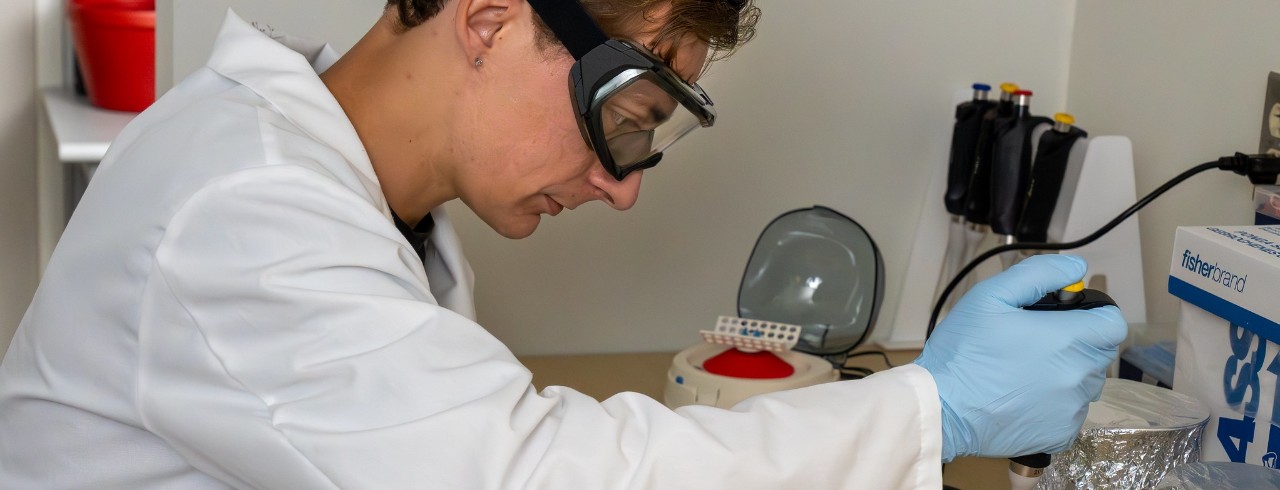
UC Clermont pre-medicine graduate Luke Ustick in the college's cancer research lab. Photo/Danny Kidd
At the end of his first year at UC Clermont, Ustick loved his biology class so much that his professor, Vicki Gomez-Stallons, recommended Ustick for a research lab position at the college. He spent a year studying cancer stem cells, presented his findings with fellow student Yatra Patel to Cincinnati Children’s Medical Center — and chose to pursue medical school. “I was hooked.”
Now, the aspiring doctor who once thought he would never set foot in a college classroom will begin courses as a medical science student in UC’s College of Medicine this fall. Ustick hopes to eventually work as a physician in geriatrics or surgery.
But first, he landed a role as one of two paid pre-fellows in Cincinnati Children’s Summer Undergraduate Research Fellowship, thanks to the Cronin Career Scholars program.
With everything, I always wanted more ... I'm looking for a career that has impact.
Luke Ustick UC Clermont pre-medicine graduate; current College of Medicine student
The Cronin Career Scholars program collaborates with on-campus and community organizations to create local internships. Students work part time, learn professional skills and apply what they learn in the classroom to the workplace — in real time. It is the first paid internship program of its kind available to UC Clermont students.
Ustick studied microproteins in the hospital’s cardiology lab — and was ready for the challenge.
“I enjoy physiology and science and want to use this knowledge to diagnose and help people — to change lives — in meaningful ways. Getting hands-on experience now makes it all more real,” said Ustick. “I’m looking for a career that has an impact.”
Learn more about the Cronin Career Scholars co-op program.
Featured image at top: UC Clermont pre-medicine graduate Luke Ustick conducts research in the college's cancer lab. Photo/Danny Kidd
About UC Clermont
UC Clermont College is in Clermont County on 91 beautifully wooded acres in Batavia Township. The college is an accredited, open-access institution offering more than 60 programs and degrees. UC Clermont is part of the nationally recognized University of Cincinnati. For more information, call 513-556-5400 or visit www.ucclermont.edu.
Related Stories
Sugar overload killing hearts
November 10, 2025
Two in five people will be told they have diabetes during their lifetime. And people who have diabetes are twice as likely to develop heart disease. One of the deadliest dangers? Diabetic cardiomyopathy. But groundbreaking University of Cincinnati research hopes to stop and even reverse the damage before it’s too late.
App turns smartwatch into detector of structural heart disease
November 10, 2025

An app that uses an AI model to read a single-lead ECG from a smartwatch can detect structural heart disease, researchers reported at the 2025 Scientific Sessions of the American Heart Association. Although the technology requires further validation, researchers said it could help improve the identification of patients with heart failure, valvular conditions and left ventricular hypertrophy before they become symptomatic, which could improve the prognosis for people with these conditions.
Combination immunotherapy helps overcome melanoma treatment resistance
November 10, 2025

MSN highlighted research led by the University of Cincinnati Cancer Center's Trisha Wise-Draper showing a combination of immunotherapy medications can activate a robust immune response and help overcome treatment resistance in patients with refractory melanoma.