Kristy Swift named assistant professor of music studies at CCM
An accomplished musicologist and organist, Swift also holds two doctoral degrees from CCM

UC College-Conservatory of Music Interim Dean Jonathan Kregor has announced the appointment of Kristy Swift, PhD and DMA, to the position of Assistant Professor of Music Studies at CCM. In this role, Swift will lead the Bachelor of Arts in Music program offered through CCM's Division of General Studies. The appointment is effective Aug. 15, 2024.

CCM faculty member Kristy Swift. Photo/provided
This is a new role for Swift, who has been serving as Associate Professor of Musicology – Educator at CCM since 2020. In 2024, Swift received a UC Faculty Excellence Award in Research, Teaching and Service sponsored by the Office of the Provost and the Office of Research. Her research and teaching have been further supported by UC’s Office of Research, CCM Faculty Development Funding and CCMpower.
Swift’s research interests include activism, social justice and musicology; digital humanities; film music; historiography; identity and music; music history pedagogy; music of Cincinnati; public musicology; opera; and sound, music and trauma. Her forthcoming monographs are Thinking About Music History: Textbooks and the Canon (Clemson University Press) and Music History Resources (Routledge), and she is co-editing the collection Trauma-informed Pedagogy and the Post-secondary Music Class (Routledge) with Kimber Andrews, Associate Director of the UC Center for the Enhancement of Teaching and Learning. Swift’s article and reviews are published in the Journal of Music History Pedagogy, Journal of the American Musicological Society and Music Research Forum, and she is developing the digital research and teaching tool Music History Materials. Swift has presented her research nationally and internationally at meetings of the American Musicological Society; Lilly Conference on College Teaching, Music and the Moving Image; Society for American Music; Teaching Music History; Christian Congregational Music: Local and Global Perspectives; and Sound and Music Through the Lens of Trauma conferences.
At CCM, Swift has created new courses including Activism, Social Justice and Musicology; American Opera/American History; Black Opera; Handel Renaissance; Opera and Disability; Protest(ed) Music; Seventeenth and Eighteenth-Century Divas and Divos; Sing Cincinnati; Sound, Music and Trauma; Copland, Verdi and Wagner; and she has taught core curriculum classes in the undergraduate music history sequence, opera history and style, and graduate research and writing.
Swift serves on leadership boards of professional music organizations: she is currently co-chair of the American Musicological Society Pedagogy Study Group and a member of the College Music Society Subcommittee for Scholarship, Research and Pedagogy. She has chaired the planning committee of the Teaching Music History Conference and served on the Society for American Music Education Committee. Swift has been a reviewer for the Journal of Music History Pedagogy and Music Research Forum.
As organ and piano soloist and accompanist, Swift has performed throughout the United States and currently serves as Director of Music at Newtown United Methodist Church where she was a member of the organ committee for the installation of M. P. Rathke Opus 8 pipe organ.
Swift earned a PhD in musicology from UC, a DMA in organ studying with Roberta Gary at CCM, an MM in organ studying with Willis Bodine at the University of Florida and a BME from the University of Florida.
“As a leader in music history pedagogy, Kristy Swift puts her research to use every day as an instructor, advisor and thought leader. Such a unique blend of theory and practice makes her the ideal faculty member to lead our Bachelor of Arts in Music program, which foregrounds music as a cultural and artistic practice,” says Kregor. “I am grateful to our search committee chair, Roger Klug, and committee members Megan Ille, Stephen Meyer, Holly Pratt and Denton Yockey for facilitating this successful search.”
“I am very excited to begin this new role,” said Swift, “and I’m especially eager to work closely with students, faculty, staff, and administrators in CCM's Composition, Musicology and Theory and General Studies divisions and also with partners across the college, university and community.”
Next Lives Here
At the University of Cincinnati, we realize the impact our teaching, research, artistry and service can have on our community and the world. So, we don’t wait for change to happen. We break boundaries, boldly imagine and create what’s Next. To us, today’s possibilities spark tomorrow’s reality. That’s why we are leading urban public universities into a new era of innovation and impact, and that's how we are defining Next for the performing and media arts.
We're about engaging people and ideas - and transforming the world.
We are UC. Welcome to what's Next.
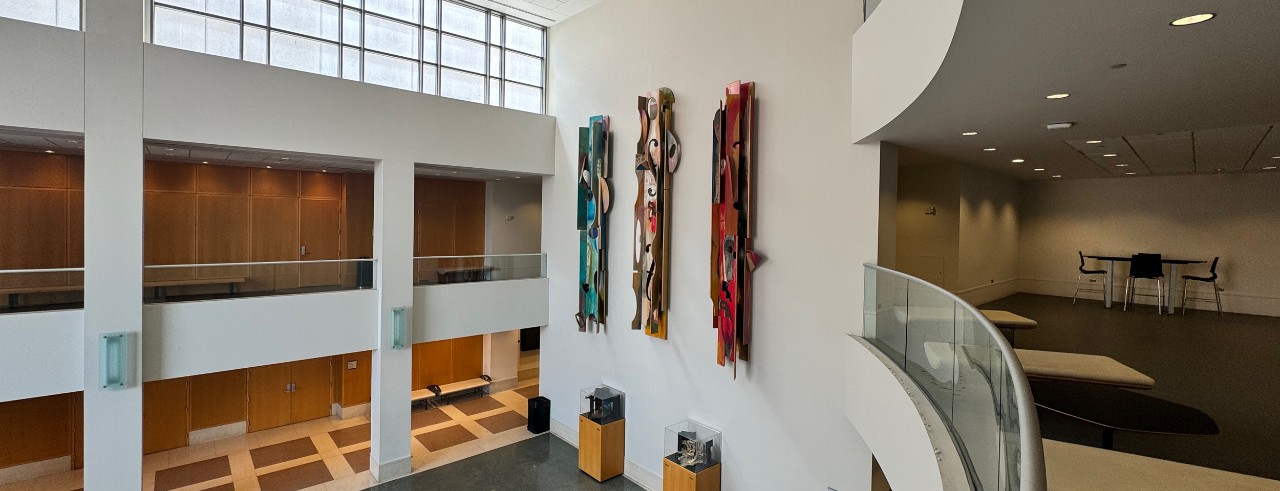
Featured image at top: A July 2024 photograph of the Corbett Center Atrium. Photo/Curt Whitacre
Related Stories
Sugar overload killing hearts
November 10, 2025
Two in five people will be told they have diabetes during their lifetime. And people who have diabetes are twice as likely to develop heart disease. One of the deadliest dangers? Diabetic cardiomyopathy. But groundbreaking University of Cincinnati research hopes to stop and even reverse the damage before it’s too late.
Is going nuclear the solution to Ohio’s energy costs?
November 10, 2025

The Ohio Capital Journal recently reported that as energy prices continue to climb, economists are weighing the benefits of going nuclear to curb costs. The publication dove into a Scioto Analysis survey of 18 economists to weigh the pros and cons of nuclear energy. One economist featured was Iryna Topolyan, PhD, professor of economics at the Carl H. Lindner College of Business.
App turns smartwatch into detector of structural heart disease
November 10, 2025

An app that uses an AI model to read a single-lead ECG from a smartwatch can detect structural heart disease, researchers reported at the 2025 Scientific Sessions of the American Heart Association. Although the technology requires further validation, researchers said it could help improve the identification of patients with heart failure, valvular conditions and left ventricular hypertrophy before they become symptomatic, which could improve the prognosis for people with these conditions.