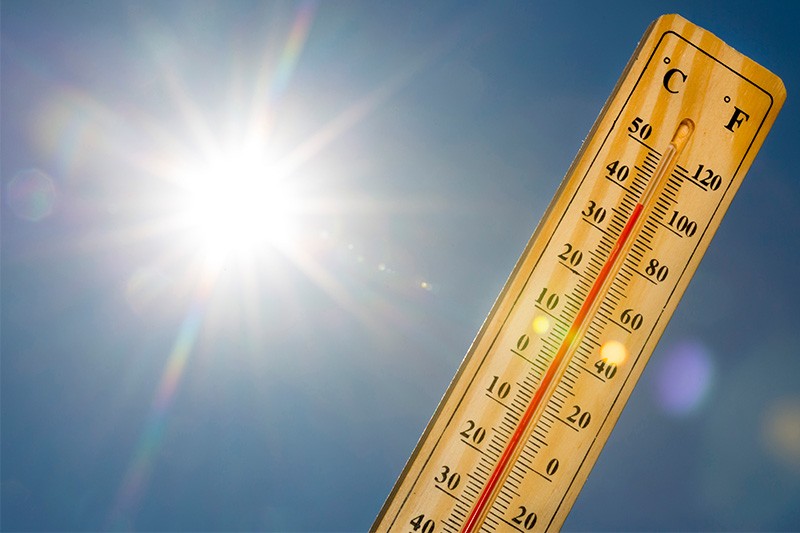
Heat waves in the U.S. kill more people in their homes than anywhere else
UC nursing professor speaks with The Cincinnati Enquirer about heat-related deaths

Summer is officially here.
The Summer Solstice began on Thursday, June 20, 2024, but for many of us the hotter than normal temperatures would suggest The Old Farmer’s Almanac is a bit late with its announcement.
Millions of Americans are battling a punishing heat dome that has settled over the northeastern United States creating the potential for record-breaking high temperatures this week that stretch from the Queen City in Cincinnati to Portland, Maine.
That puts some populations - households without air conditioning - at grave risk.
The Cincinnati Enquirer conducted an analysis of National Weather Service data and found that almost half the 3,142 people who died from heat-related ailments in the past 20 years died at home. Many people who die in heat waves lack air conditioning or have health problems that can be fatal in excessive heat, the Enquirer found.

Associate Professor Tasha Turner-Bicknell
Tasha Turner-Bicknell, an associate professor in the UC College of Nursing, spoke with the Enquirer about its findings. She is also director of advanced public health nursing programs at UC.
“When the weather gets this extreme, there's a definite risk,” Turner-Bicknell, told the Enquirer.
She says lack of air conditioning in the home is a factor for so many people dying of these heat-related deaths.
“Most of us take for granted that we live and work in air-conditioned environments,” she explains. "But we have a lot of members of our community that do not have air conditioning.”
Social isolation can be especially dangerous for those with disabilities or mobility-restrictions, according to Turner-Bicknell, who rely on others to leave their homes.
“Maybe they use a walker or a cane or a wheelchair, and maybe their caregivers are not available," she says. "They might be unable to get out of their house without assistance.”
Read the full Cincinnati Enquirer story online.
Learn more about Associate Professor Tasha Turner-Bicknell online.
Related Stories
Sugar overload killing hearts
November 10, 2025
Two in five people will be told they have diabetes during their lifetime. And people who have diabetes are twice as likely to develop heart disease. One of the deadliest dangers? Diabetic cardiomyopathy. But groundbreaking University of Cincinnati research hopes to stop and even reverse the damage before it’s too late.
Is going nuclear the solution to Ohio’s energy costs?
November 10, 2025

The Ohio Capital Journal recently reported that as energy prices continue to climb, economists are weighing the benefits of going nuclear to curb costs. The publication dove into a Scioto Analysis survey of 18 economists to weigh the pros and cons of nuclear energy. One economist featured was Iryna Topolyan, PhD, professor of economics at the Carl H. Lindner College of Business.
App turns smartwatch into detector of structural heart disease
November 10, 2025

An app that uses an AI model to read a single-lead ECG from a smartwatch can detect structural heart disease, researchers reported at the 2025 Scientific Sessions of the American Heart Association. Although the technology requires further validation, researchers said it could help improve the identification of patients with heart failure, valvular conditions and left ventricular hypertrophy before they become symptomatic, which could improve the prognosis for people with these conditions.