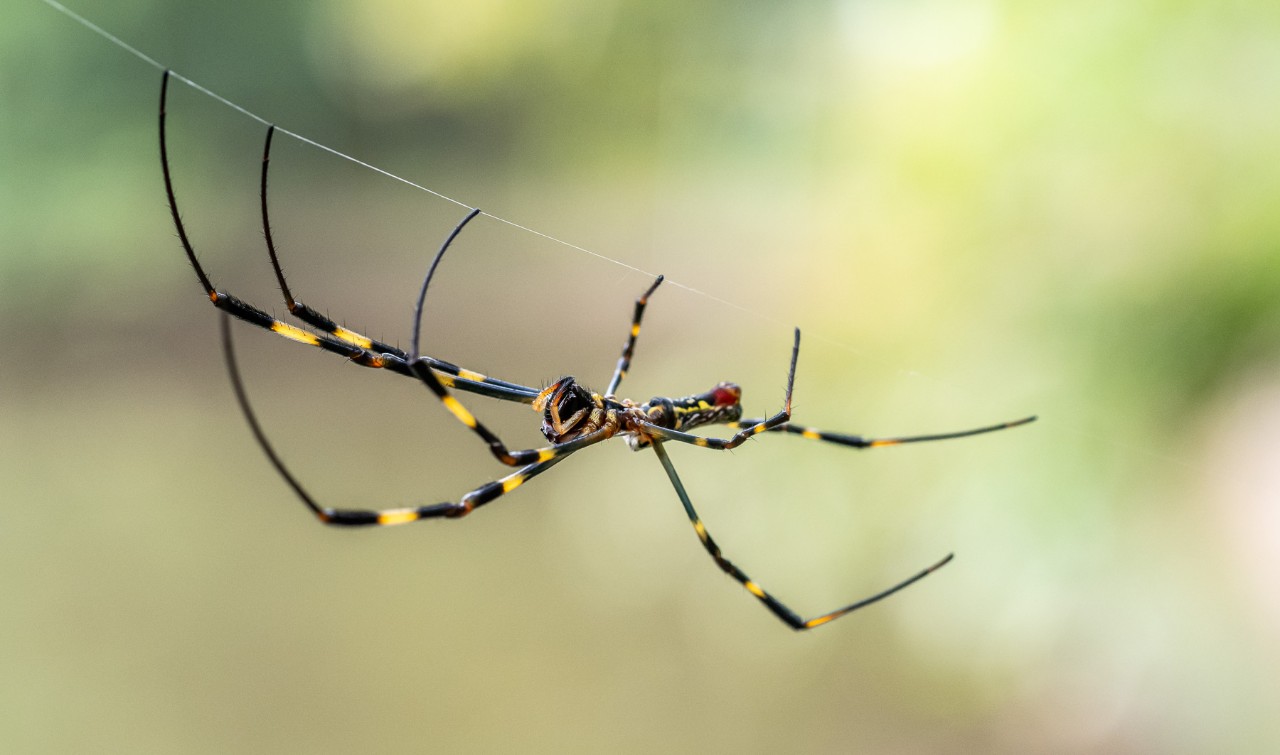
Joro spiders are heading up the coast
UC biologist says these garden spiders want to stay in the garden

Everyday Health turned to a University of Cincinnati biologist to learn more about an invasive spider from Asia that is showing up in more American back yards.
The Joro spider is a large, yellow orb-weaving spider from Japan that is slowly creeping across the American Southeast toward the Mid-Atlantic.

UC Professor Emeritus George Uetz. Photo/Lisa Ventre/UC
Female spiders grow to more than 3 inches in length. They build equally enormous webs spanning more than 10 feet to catch flying insects, which makes it hard for them to go unnoticed in gardens and back yards. But they are harmless and don't bite people, said George Uetz, a professor emeritus in UC's College of Arts and Sciences.
“They are very sedentary in their webs,” he told Everyday Health.
Uetz spent his career studying the fascinating behavior of spiders and other animals in his biology lab. He was named a fellow this year of the American Association for the Advancement of Sciences.
If disturbed, the spider freezes in place for as long as an hour.
“Approach them from a distance, observe them, and you will see they are no threat, as they stay in their web,” Uetz said.
Read the Everyday Health story.
Featured image at top: Joro spiders are showing up in more states. Photo/David Hansche
Related Stories
Sugar overload killing hearts
November 10, 2025
Two in five people will be told they have diabetes during their lifetime. And people who have diabetes are twice as likely to develop heart disease. One of the deadliest dangers? Diabetic cardiomyopathy. But groundbreaking University of Cincinnati research hopes to stop and even reverse the damage before it’s too late.
Is going nuclear the solution to Ohio’s energy costs?
November 10, 2025

The Ohio Capital Journal recently reported that as energy prices continue to climb, economists are weighing the benefits of going nuclear to curb costs. The publication dove into a Scioto Analysis survey of 18 economists to weigh the pros and cons of nuclear energy. One economist featured was Iryna Topolyan, PhD, professor of economics at the Carl H. Lindner College of Business.
App turns smartwatch into detector of structural heart disease
November 10, 2025

An app that uses an AI model to read a single-lead ECG from a smartwatch can detect structural heart disease, researchers reported at the 2025 Scientific Sessions of the American Heart Association. Although the technology requires further validation, researchers said it could help improve the identification of patients with heart failure, valvular conditions and left ventricular hypertrophy before they become symptomatic, which could improve the prognosis for people with these conditions.