Award-winning ethnomusicologist Ailsa Lipscombe joins CCM’s faculty
Her research explores the intersections between music, sound studies and critical disability studies

UC College-Conservatory of Music Interim Dean Jonathan Kregor has announced the addition of Ailsa Lipscombe, PhD, to the college’s faculty of distinguished performing and media arts experts, researchers and educators. An award-winning researcher, Lipscombe begins her new role as Assistant Professor of Ethnomusicology at CCM on Aug. 15, 2024.

New CCM faculty member Ailsa Lipscombe. Photo/provided
Lipscombe holds a PhD in Music from the University of Chicago. Her primary research explores intersectional experiences of medicalization, with a focus on reimagining listening praxes through embodiment, relationality and trauma. Her work has been supported by the Fulbright Association, Te Tūapapa Mātauranga o Aotearoa me Amerika, the Society for Ethnomusicology and the Society for Music Theory.
Lipscombe regularly presents research at the nexus of ethnomusicology, sound studies and critical disability studies at conferences across North America and Australasia. She was awarded the 2021 Charles Seeger Prize by the Society for Ethnomusicology for her paper "When Silence Is Heard: Embodied Listening in Medical Facilities' Competing Sonic Epistemes." Her first monograph—titled Listening Beyond Crisis: Disability and the Medicalization of Everyday Life—is under contract with the University of Michigan Press, to be published within their Music and Social Justice series.
In her current postdoctoral position at Te Herenga Waka, Lipscombe is building on her expertise in digital ethnography and the decolonization of research methodologies to explore ethical transformations of Indigenous archiving in Aotearoa New Zealand. In this work, she centers community engagement and an ethics of care, guided by her own intersectional positionality as a queer, disabled researcher whose family whakapapas (traces their genealogy to) the Māori iwi of Te Whakatōhea.
When she is not working, Lipscombe enjoys competitive axe-throwing, curating the perfect road trip playlist and visiting national parks with her wife.
“Combining rigorous theoretical methods and practical applications, Ailsa Lipscombe’s research and teaching will give CCM students exciting opportunities to grow as scholars and performers,” said Kregor. “I am grateful to our search committee chair, Christopher Segall, and committee members Michele Kay, Stefan Fiol and Kristy Swift for their collaborative effort on this successful search.”
Next Lives Here
At the University of Cincinnati, we realize the impact our teaching, research, artistry and service can have on our community and the world. So, we don’t wait for change to happen. We break boundaries, boldly imagine and create what’s Next. To us, today’s possibilities spark tomorrow’s reality. That’s why we are leading urban public universities into a new era of innovation and impact, and that's how we are defining Next for the performing and media arts.
We're about engaging people and ideas - and transforming the world.
We are UC. Welcome to what's Next.
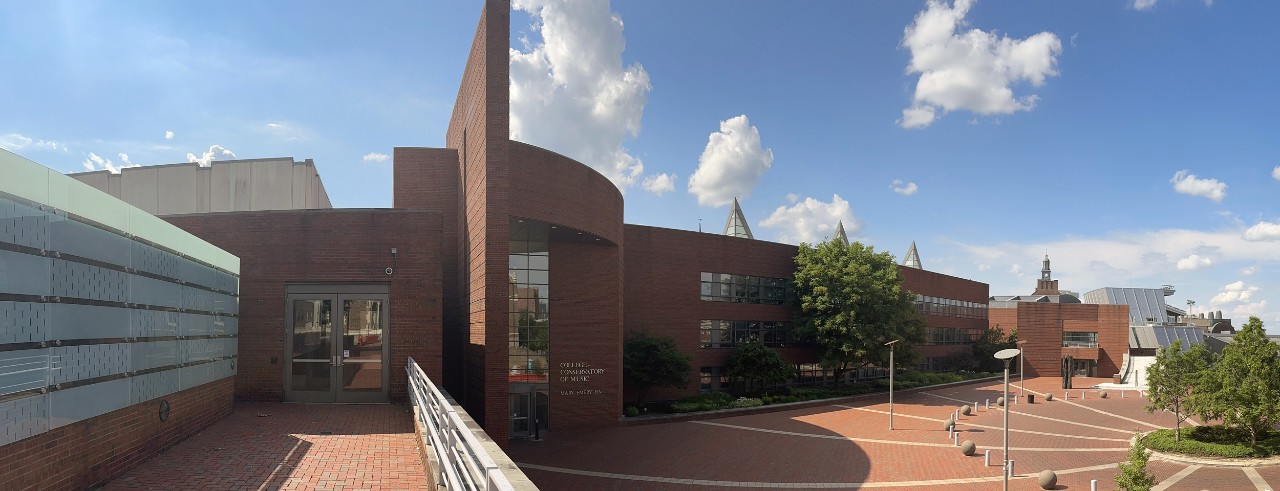
Featured image at top: A May 2024 panoramic photograph of CCM's Corbett Center for the Performing Arts and Mary Emery Hall. Photo/Curt Whitacre
Related Stories
Sugar overload killing hearts
November 10, 2025
Two in five people will be told they have diabetes during their lifetime. And people who have diabetes are twice as likely to develop heart disease. One of the deadliest dangers? Diabetic cardiomyopathy. But groundbreaking University of Cincinnati research hopes to stop and even reverse the damage before it’s too late.
Is going nuclear the solution to Ohio’s energy costs?
November 10, 2025

The Ohio Capital Journal recently reported that as energy prices continue to climb, economists are weighing the benefits of going nuclear to curb costs. The publication dove into a Scioto Analysis survey of 18 economists to weigh the pros and cons of nuclear energy. One economist featured was Iryna Topolyan, PhD, professor of economics at the Carl H. Lindner College of Business.
App turns smartwatch into detector of structural heart disease
November 10, 2025

An app that uses an AI model to read a single-lead ECG from a smartwatch can detect structural heart disease, researchers reported at the 2025 Scientific Sessions of the American Heart Association. Although the technology requires further validation, researchers said it could help improve the identification of patients with heart failure, valvular conditions and left ventricular hypertrophy before they become symptomatic, which could improve the prognosis for people with these conditions.