Inside the wild ways many creatures make milk
UC biologist Joshua Benoit tells Smithsonian that some cockroaches make an equivalent

Smithsonian magazine turned to a University of Cincinnati biologist to explain the weird and surprising ways that animals make milk for their young.
UC College of Arts and Sciences Professor Joshua Benoit told Smithsonian that it's not just goats, cows and other mammals that produce fat-rich milk for their babies.

UC Professor Joshua Benoit spoke to Smithsonian about animals other than mammals that produce milk. Photo/Joseph Fuqua/UC
Scientists once thought that milk production was a characteristic exclusive to mammals. The name is derived from the Latin word for “breast.”
But Benoit said scientists are finding that this isn't necessarily the case.
Everything from jumping spiders to penguins to some amphibians produce a milky, protein-rich secretion to feed their young. And while it doesn't share the same evolutionary origin, it has a similar function, Benoit said.
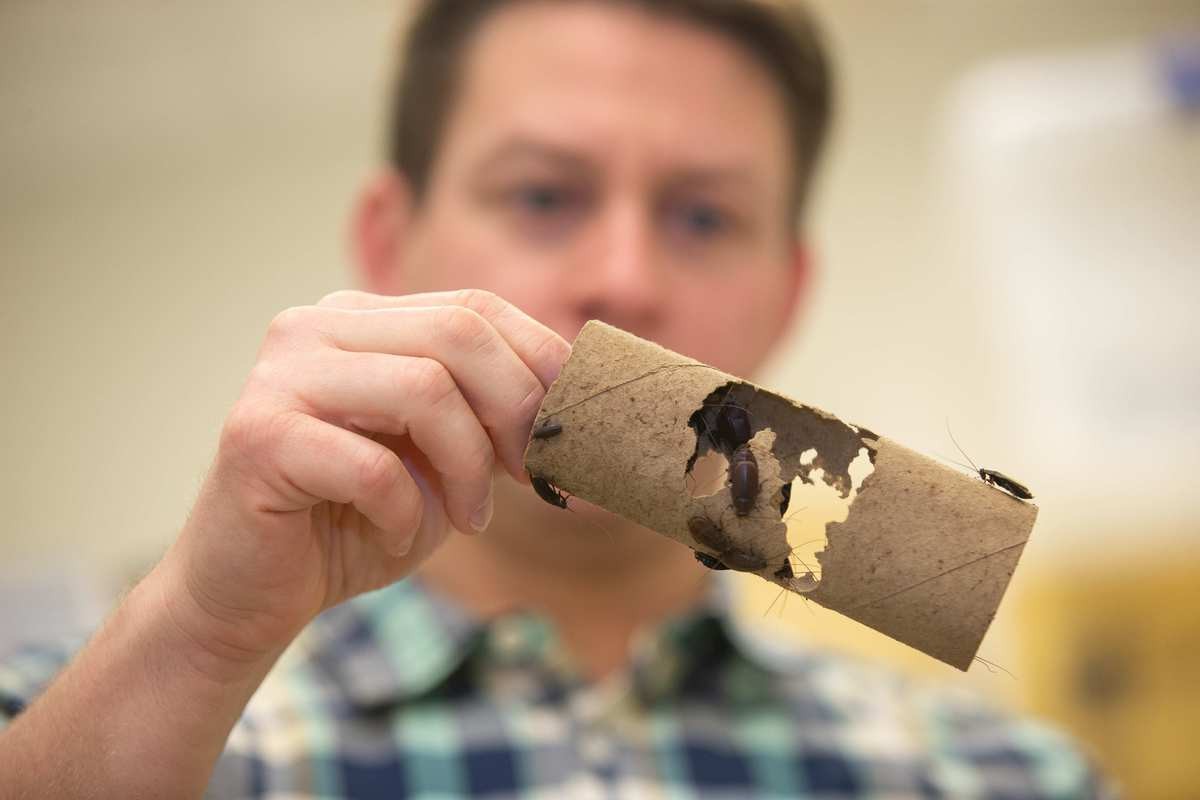
In his biology lab, he has studied insects such as beetle-mimic cockroaches that feed milk to their newborn babies.
“We usually call it a milk-like substance,” he told Smithsonian. “For all intents, it does the same thing, and even some of the proteins present are similar.”
Benoit said tsetse flies along with some ants and spiders, too, secrete a nourishing milk-like substance for their babies. And each species arrived at this survival strategy for raising babies independently, which demonstrates its benefits across the animal kingdom, he said.
Featured image at top: UC Professor Joshua Benoit holds up beetle-mimic cockroaches in his biology lab. Photo/Andrew Higley/UC Marketing + Brand
Related Stories
Sugar overload killing hearts
November 10, 2025
Two in five people will be told they have diabetes during their lifetime. And people who have diabetes are twice as likely to develop heart disease. One of the deadliest dangers? Diabetic cardiomyopathy. But groundbreaking University of Cincinnati research hopes to stop and even reverse the damage before it’s too late.
Is going nuclear the solution to Ohio’s energy costs?
November 10, 2025

The Ohio Capital Journal recently reported that as energy prices continue to climb, economists are weighing the benefits of going nuclear to curb costs. The publication dove into a Scioto Analysis survey of 18 economists to weigh the pros and cons of nuclear energy. One economist featured was Iryna Topolyan, PhD, professor of economics at the Carl H. Lindner College of Business.
App turns smartwatch into detector of structural heart disease
November 10, 2025

An app that uses an AI model to read a single-lead ECG from a smartwatch can detect structural heart disease, researchers reported at the 2025 Scientific Sessions of the American Heart Association. Although the technology requires further validation, researchers said it could help improve the identification of patients with heart failure, valvular conditions and left ventricular hypertrophy before they become symptomatic, which could improve the prognosis for people with these conditions.