Local 12: UC investigates potential PFAS contamination in groundwater
UC launches a new water quality investigation along Great Miami River

Local 12 highlighted a new University of Cincinnati project to study water quality in southwest Ohio.
At the Theis-Nash Environmental Monitoring and Modeling Site along the Great Miami River, UC has studied the flow of water from the surface into the aquifer, a source of drinking water for much of southwest Ohio. These monitoring wells initially provided researchers with real-time data about the hydrodynamics of surface river water as it moved through the aquifer, particularly during periodic floods.

Assistant Professor Annette Rowe is studying the microbiology of groundwater along the Great Miami River. Photo/Andrew Higley/UC Marketing + Brand
Now the monitoring site named for UC Professor Emeritus David Nash and the late hydrogeologist C.V. Theis will turn its focus to excess nutrients like nitrogen and phosphorous and contaminants such as PFAS.
Groundwater is a source of drinking water for more than 2 million people in Ohio. Scientists are trying to understand what happens to chemicals such as PFAS, known as a forever chemicals, that leaches into the groundwater.
PFAS has been found in water along the entirety of the Ohio River.
UC microbiologist Annette Rowe, an assistant professor of biology, said many chemicals we release into the environment end up in our drinking water.
"The more we produce, the more we put into those ecosystems, the more they accumulate and have the potential to have detrimental impacts on every trophic level," she told Local 12.
We're just trying to understand what's going on and how big a problem it is. And every researcher's hope is that then will lead us to how do we fix these problems?" Rowe said.
UC is looking at ways microbes interact with the chemicals, which could make them less harmful to human health, Rowe said.
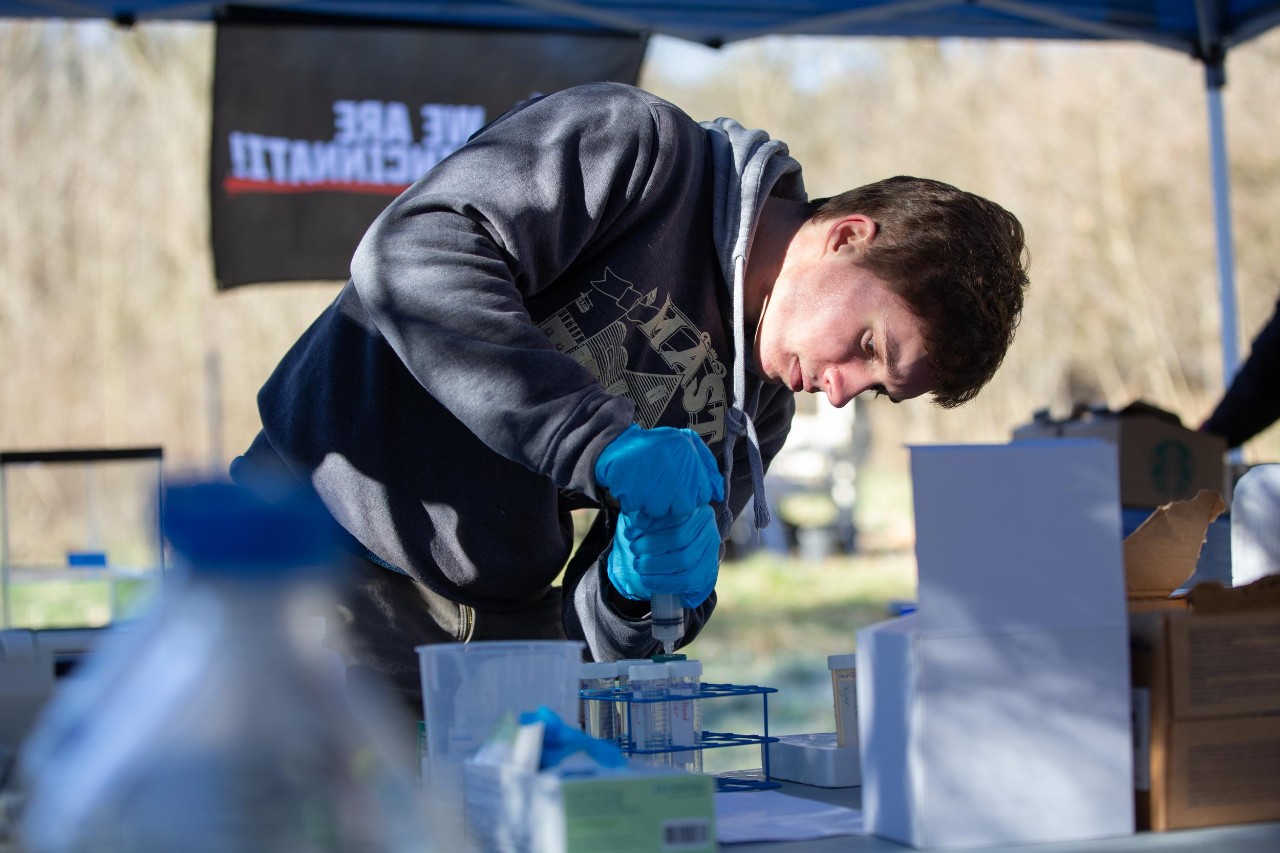
Featured image at top: UC students work with water samples at the groundwater observatory, which includes a network of monitoring wells. Photo/Andrew Higley/UC Marketing + Brand

Work crews dig a new monitoring well along the Great Miami River. Photo/Andrew Higley/UC Marketing + Brand
Related Stories
Sugar overload killing hearts
November 10, 2025
Two in five people will be told they have diabetes during their lifetime. And people who have diabetes are twice as likely to develop heart disease. One of the deadliest dangers? Diabetic cardiomyopathy. But groundbreaking University of Cincinnati research hopes to stop and even reverse the damage before it’s too late.
Is going nuclear the solution to Ohio’s energy costs?
November 10, 2025

The Ohio Capital Journal recently reported that as energy prices continue to climb, economists are weighing the benefits of going nuclear to curb costs. The publication dove into a Scioto Analysis survey of 18 economists to weigh the pros and cons of nuclear energy. One economist featured was Iryna Topolyan, PhD, professor of economics at the Carl H. Lindner College of Business.
App turns smartwatch into detector of structural heart disease
November 10, 2025

An app that uses an AI model to read a single-lead ECG from a smartwatch can detect structural heart disease, researchers reported at the 2025 Scientific Sessions of the American Heart Association. Although the technology requires further validation, researchers said it could help improve the identification of patients with heart failure, valvular conditions and left ventricular hypertrophy before they become symptomatic, which could improve the prognosis for people with these conditions.