Dr. Karen Craven honored with Service-Learning award
Students support elderly, individuals living with disabilities

The University of Cincinnati's College of Cooperative Education and Professional Studies has honored Dr. Karen Craven, assistant professor of occupational therapy in the College of Allied Health Sciences, with the 2024 Jack Twyman Award for Service-Learning.
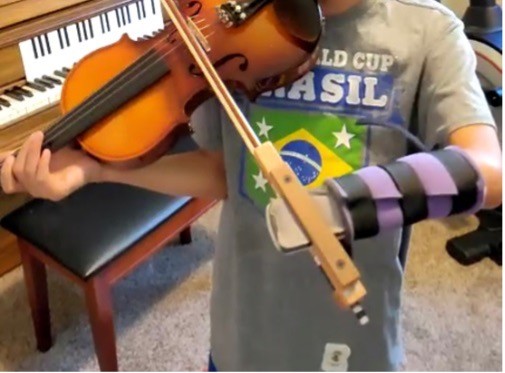
Child using violin bow holder developed by UC students with May We Help. Photo provided.
Service-Learning is an approach to education that pushes students outside the classroom to produce work of real value to a community organization as part of a course or program requirement.
In Dr. Craven’s course, Community-Based Occupational Therapy (OT 7081), students work with local non-profits, including May We Help, which provides custom solutions for individuals with special needs. Students work with staff and engineers to create and design adaptations to everyday tasks to help individuals with disabilities engage in meaningful occupations. For example, students worked to develop a violin bow holder that attaches to the forearm of a child who is missing his hand and much of his forearm due to congenital limb differences. This bow-holder allows him to play the violin in a more typical manner.
Dr. Craven demonstrates time and time again her commitment to collaboration across disciplines, across organizations, and between students, clients, and community partners. In addition to working with May We Help, Dr. Craven created an event she named Successful Aging in the Geriatric Experience (SAGE) that her students run at a different senior living community each year to support the geriatric population in the community as part of the service-learning experience.
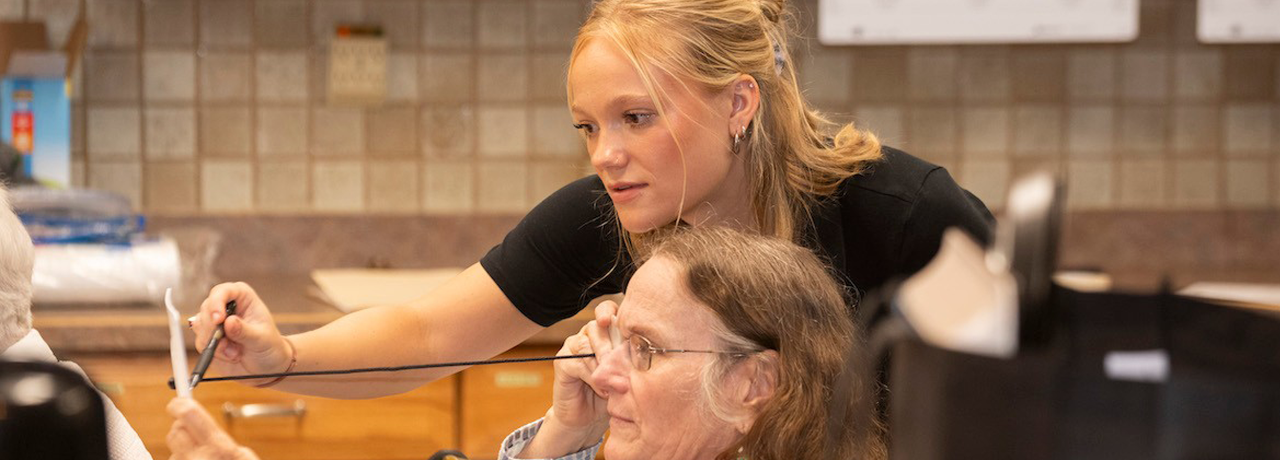
SAGE supports aging in place by providing an opportunity for seniors within the community to participate in various assessments and learning opportunities. Seniors are partnered with occupational therapy graduate students to navigate through a series of assessments and educational stations to identify opportunities to reduce risks and improve function in their valued activities. Senior participants receive detailed feedback, results and recommendations within a report put together by students.
Dr. Craven oversees all projects with May We Help and reviews each set of recommendations and results for participants in the SAGE event prior to sharing them with those individuals. “I am honored and grateful to have been selected for this award, but I really want to recognize Stephanie Lambers, adjunct assistant professor and occupational therapist, who has taught this course with me the past several years. Stephanie brings her expertise, connections with the community, commitment to teaching the future generation of occupational therapists, and a whole lot of energy to this course. Our students have fully embraced these community projects and consistently report them as favorite activities in the program," says Dr. Craven. "The students view these as wonderful opportunities to put into action many of the skills they have been developing in the program and getting to serve people in the community. It is very impactful for them, as well as the people we reach.”
The University of Cincinnati's Service-Learning program is one of the largest in the country, with several thousand students engaging in some form of service-learning in a typical year. The Jack Twyman Award is given annually to a collaborative educational team or individual engaged in a Service-Learning project that exemplifies the Bearcat Bond and the values alumnus Jack Twyman demonstrated in his life.
Featured image at top of Occupational therapy student Anne Reed assisting senior during Successful Aging in the Geriatric Experience (SAGE) 2023. Photo provided.
Related Stories
UC launches Bearcats Affordability Grant
January 7, 2026
The University of Cincinnati is making college more attainable for students across Ohio with the creation of the Bearcats Affordability Grant. The new grant will provide a pathway to tuition-free college for students of families who make less than $75,000 per year. Beginning in fall 2026, the Bearcats Affordability Grant will cover the remaining cost of tuition for Ohio residents who are Pell eligible.
BearcatGPT AI platform now available to all UC faculty and staff
December 9, 2025
University of Cincinnati Digital Technology Solutions is excited to announce that BearcatGPT, the university’s private, secure AI platform, is now available to all UC faculty and staff.
Sugar overload killing hearts
November 10, 2025
Two in five people will be told they have diabetes during their lifetime. And people who have diabetes are twice as likely to develop heart disease. One of the deadliest dangers? Diabetic cardiomyopathy. But groundbreaking University of Cincinnati research hopes to stop and even reverse the damage before it’s too late.