Spectrum News: Marian Spencer’s legacy remembered amid Coney Island closure
UC community inspired by efforts of Cincinnati civil rights leaders

As part of a Women’s History series Spectrum News produced a segment on UC alumna Marian Spencer ('42) and her instrumental role in desegregating Cincinnati’s Coney Island as well as Cincinnati Public Schools. The reported closing of Coney Island worried some Spencer supporters who feared her legacy would be lost to history.
“Each time that I met Mrs. Spencer, I remember thinking, ‘How could this kind, quiet voice be so powerful?’” explains Cindy Jones, director of the Marian Spencer Scholarship program at the University of Cincinnati.
Jones spoke to Spectrum News about Spencer, whose legacy lives on at UC through a residence hall and scholarship named after her. The Marian Spencer Scholarship program is designed to provide access to higher education to high-achieving graduates of Cincinnati Public Schools. The scholarship provides full tuition, room and board at UC.
Spencer was the first African American woman elected to Cincinnati City Council in 1983 and the first female president of the Cincinnati chapter of the NAACP (1983-85). A former board of trustees member at UC, Spencer later donated 80 years of Cincinnati civil rights history to the university in forms as diverse as music and official memoranda to comprise the Marian and Donald Spencer Collection.

UC alumna Marian Spencer is shown with UC President Neville Pinto. Photo/Joseph Fuqua II.
“We don’t want her memory to ever be forgotten,” Jones told Spectrum News. “We’re keeping it alive in these students, in everything that we do and everything that I say, reminding them of all of the traits of Marian Spencer, grit, determination, perseverance, all of those things.”
As a Black student in the late 1930s and early 1940s, Spencer wasn't permitted to live in a dorm on UC’s campus. Today, there is a residence hall that bears her name, opened in 2018. The Marian Spencer Scholars will form a living-learning community housed together in the residence hall.
Spectrum News also spoke to two Spencer Scholars, Muslim Khzir, a second-year student, and Djeneba Camara, a first-year student, about their thoughts on Marian Spencer.
“She was someone that broke many barriers,” Khzir told Spectrum News. “She was a powerful person. I always look up to her because without her I wouldn’t be here where I am today.”
Camara saw Spencer as a role model as well.
“I know she was a fighter,” Camara also told Spectrum News. “I know she was brave. I know she was confident because of the things she’s done.”
View the Spectrum News segment online.
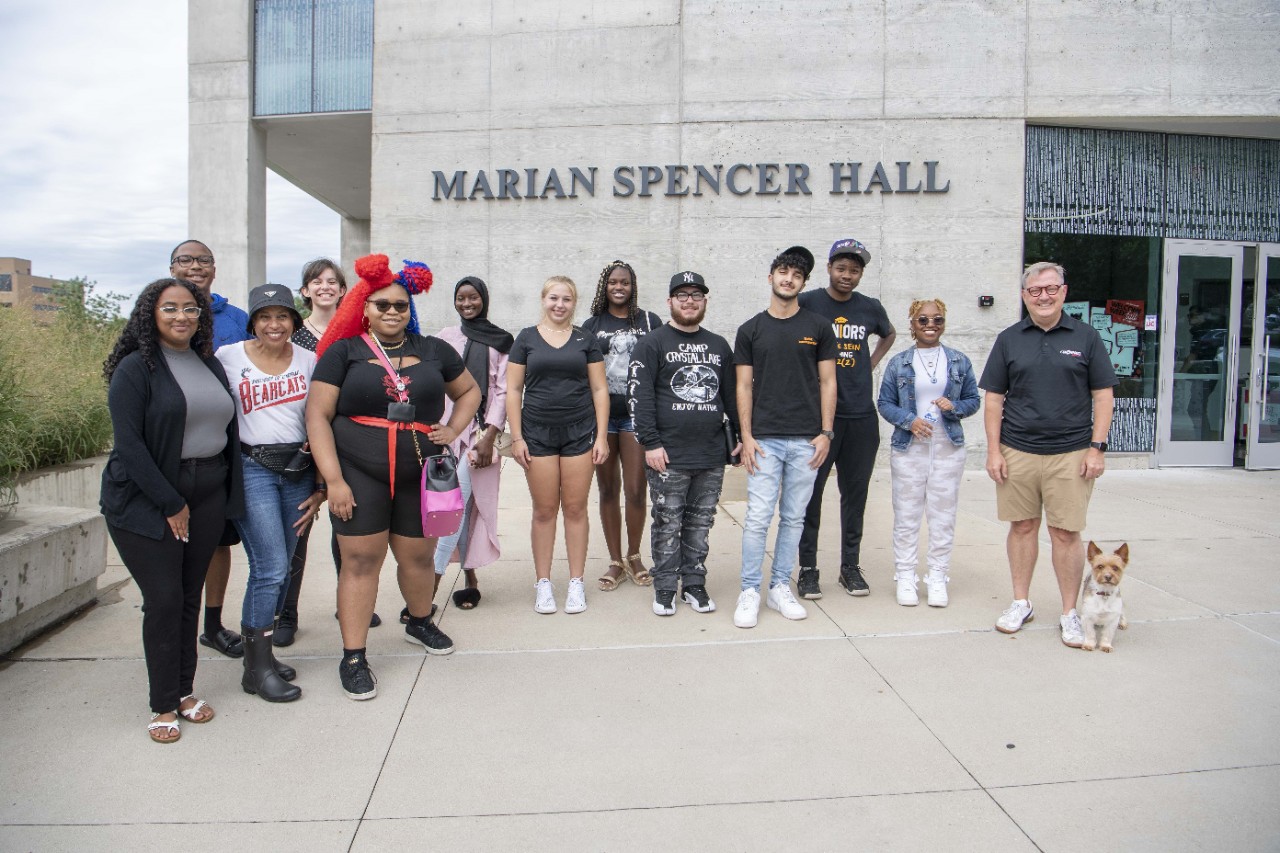
Featured top image of the first cohort of Marian Spencer Scholarship winners on the UC campus. Photo/Joseph Fuqua II.
Related Stories
Sugar overload killing hearts
November 10, 2025
Two in five people will be told they have diabetes during their lifetime. And people who have diabetes are twice as likely to develop heart disease. One of the deadliest dangers? Diabetic cardiomyopathy. But groundbreaking University of Cincinnati research hopes to stop and even reverse the damage before it’s too late.
Is going nuclear the solution to Ohio’s energy costs?
November 10, 2025

The Ohio Capital Journal recently reported that as energy prices continue to climb, economists are weighing the benefits of going nuclear to curb costs. The publication dove into a Scioto Analysis survey of 18 economists to weigh the pros and cons of nuclear energy. One economist featured was Iryna Topolyan, PhD, professor of economics at the Carl H. Lindner College of Business.
App turns smartwatch into detector of structural heart disease
November 10, 2025

An app that uses an AI model to read a single-lead ECG from a smartwatch can detect structural heart disease, researchers reported at the 2025 Scientific Sessions of the American Heart Association. Although the technology requires further validation, researchers said it could help improve the identification of patients with heart failure, valvular conditions and left ventricular hypertrophy before they become symptomatic, which could improve the prognosis for people with these conditions.