USA Today: April 2024 total solar eclipse renews debunked flat Earth conspiracy theories
Social media expert Jeffrey Blevins says eclipse misinformation is picking up speed

Even though the ancient Greeks figured out the Earth was round around 500 B.C. —and it’s been commonly accepted by scholars, navigators and cartographers — flat earth conspiracy theorists still exist, according to an article in USA Today.
In tandem, the April 2024 solar eclipse will certainly feed into the belief that if you travel too far in one direction you would fall off the edge of the earth.

Jeffrey Blevins, PhD, is a professor of journalism with dual appointments in UC's Department of Journalism and School of Public and International Affairs. Photo/Andrew Higley/UC Marketing + Brand.
“I’m already seeing it more and more as we get closer to the April 8 eclipse,” UC’s Jeffrey Blevins, a professor of journalism who studies social media and disinformation, stated in the article.
Blevins is among the experts cited who say the debunked "flat Earth" conspiracy theory doesn't slow down when an eclipse happens.
“They’re not just primed to believe the Earth is flat, they’re primed to believe you can’t trust science, academics, the media or government,” he said. “And it might also lead you to see other extremist views as plausible.”
Pointing to flat Earth theory as one of the oldest conspiracy theories, Blevins stated that it gained traction with early social media.
Blevins is a leading scholar in U.S. telecommunication law and policy, and critical political economy theory and is the co-author of “Social Media, Social Justice and the Political Economy of Online Networks.” He is a trusted media resource, and he has provided expertise on electronic media regulation and Federal Communications Commission policymaking to international, national, regional and local news media.
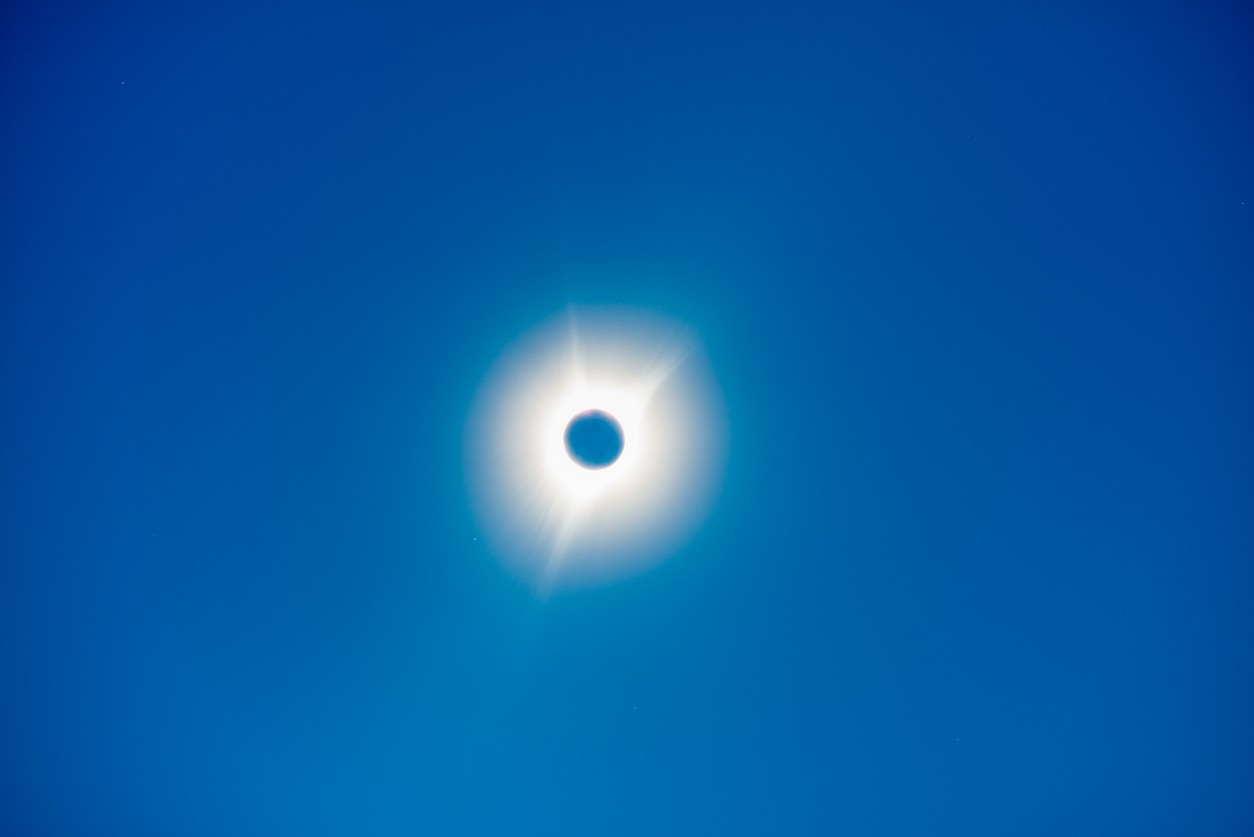
Featured image at top of solar eclipse: iStock Photo/Giannovi
Impact Lives Here
The University of Cincinnati is leading public urban universities into a new era of innovation and impact. Our faculty, staff and students are saving lives, changing outcomes and bending the future in our city's direction. Next Lives Here.
Related Stories
Sugar overload killing hearts
November 10, 2025
Two in five people will be told they have diabetes during their lifetime. And people who have diabetes are twice as likely to develop heart disease. One of the deadliest dangers? Diabetic cardiomyopathy. But groundbreaking University of Cincinnati research hopes to stop and even reverse the damage before it’s too late.
Is going nuclear the solution to Ohio’s energy costs?
November 10, 2025

The Ohio Capital Journal recently reported that as energy prices continue to climb, economists are weighing the benefits of going nuclear to curb costs. The publication dove into a Scioto Analysis survey of 18 economists to weigh the pros and cons of nuclear energy. One economist featured was Iryna Topolyan, PhD, professor of economics at the Carl H. Lindner College of Business.
App turns smartwatch into detector of structural heart disease
November 10, 2025

An app that uses an AI model to read a single-lead ECG from a smartwatch can detect structural heart disease, researchers reported at the 2025 Scientific Sessions of the American Heart Association. Although the technology requires further validation, researchers said it could help improve the identification of patients with heart failure, valvular conditions and left ventricular hypertrophy before they become symptomatic, which could improve the prognosis for people with these conditions.