Sensors & Diagnostics: At-home test protects oral health
Journal highlights UC research in quarterly newsletter

The journal Sensors & Diagnostics highlighted a University of Cincinnati research project in its quarterly newsletter.
UC College of Engineering and Applied Science Professor Andrew Steckl and his research partners developed a new device that can warn consumers about early risks of tooth decay from diseases such as gingivitis and periodontitis.
Steckl and UC Senior Research Associate Daewoo Han collaborated with Sancai Xie, a principal scientist at Procter & Gamble Co.
“There are good reasons to use saliva,” he said. “It’s relatively plentiful and easy to obtain through noninvasive methods. And saliva has a lot of important elements that can act as indicators of your health.”
Bacteria from gingivitis can travel through the bloodstream, leading to cardiovascular disease and other serious health problems, Steckl said.
At-home health testing has been available for generations for uses such as detecting pregnancy. But the COVID-19 pandemic introduced a wide audience of consumers to the concept of monitoring their health with new technology.
The at-home testing industry is expected to generate $45 billion annually by 2031, according to Allied Market Research.
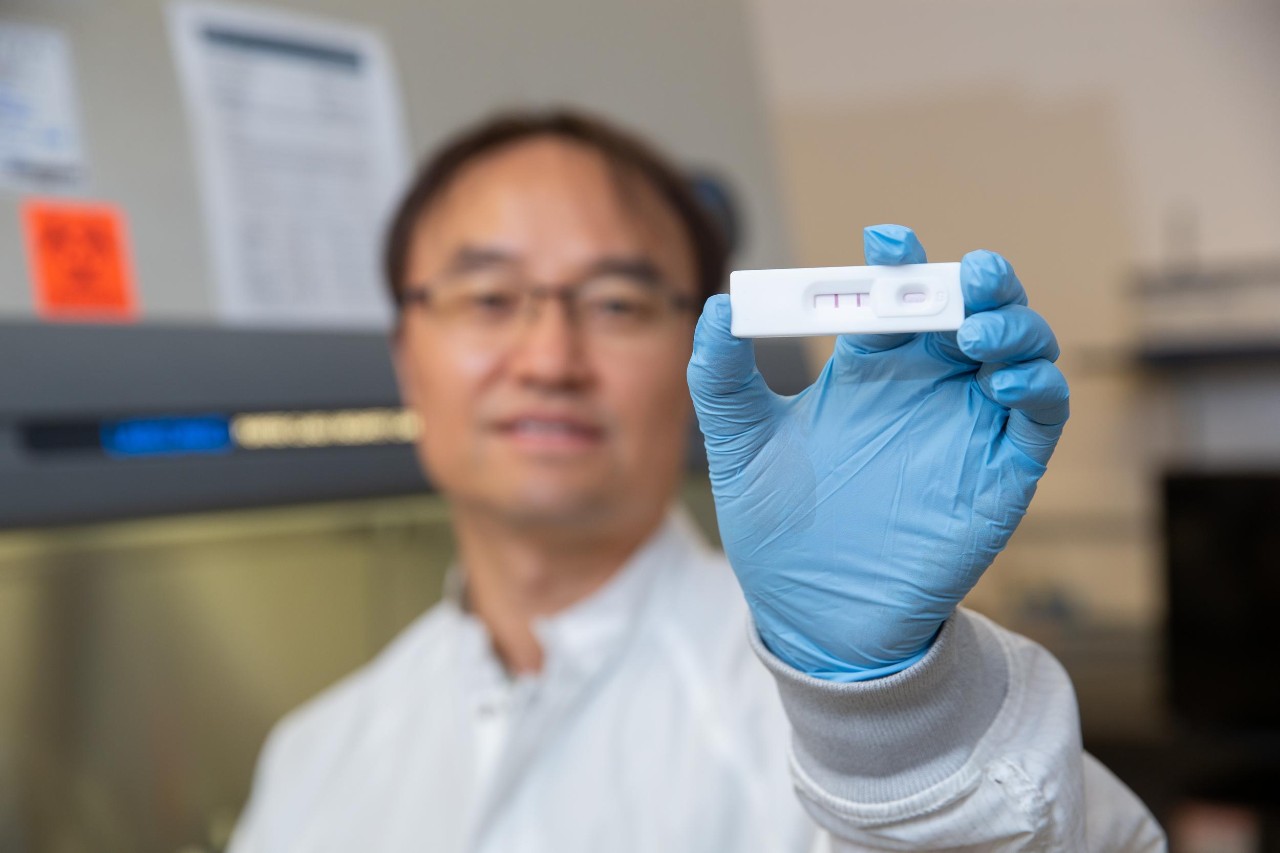
Featured image at top: UC Senior Research Associate Daewoo Han holds up UC's gingivitis test. Photo/Andrew Higley/UC Marketing + Brand
More UC engineering in the news

UC College of Engineering and Applied Science Professor Andrew Steckl is an Ohio Eminent Scholar. Photo/Andrew Higley/UC Marketing + Brand
- New Atlas: Home test kit could soon spot gingivitis
- Bite Magazine: New at-home test for gingivitis protects oral health
- Times of Oman: New test to detect early stages of tooth decay at home
- Science Daily: At-home test for gingivitis protects oral health
- Medical XPress: Engineers create at-home test that can diagnose gingivitis
Related Stories
Sugar overload killing hearts
November 10, 2025
Two in five people will be told they have diabetes during their lifetime. And people who have diabetes are twice as likely to develop heart disease. One of the deadliest dangers? Diabetic cardiomyopathy. But groundbreaking University of Cincinnati research hopes to stop and even reverse the damage before it’s too late.
Is going nuclear the solution to Ohio’s energy costs?
November 10, 2025

The Ohio Capital Journal recently reported that as energy prices continue to climb, economists are weighing the benefits of going nuclear to curb costs. The publication dove into a Scioto Analysis survey of 18 economists to weigh the pros and cons of nuclear energy. One economist featured was Iryna Topolyan, PhD, professor of economics at the Carl H. Lindner College of Business.
App turns smartwatch into detector of structural heart disease
November 10, 2025

An app that uses an AI model to read a single-lead ECG from a smartwatch can detect structural heart disease, researchers reported at the 2025 Scientific Sessions of the American Heart Association. Although the technology requires further validation, researchers said it could help improve the identification of patients with heart failure, valvular conditions and left ventricular hypertrophy before they become symptomatic, which could improve the prognosis for people with these conditions.